Taken Encounter Extraterrestrial performance.
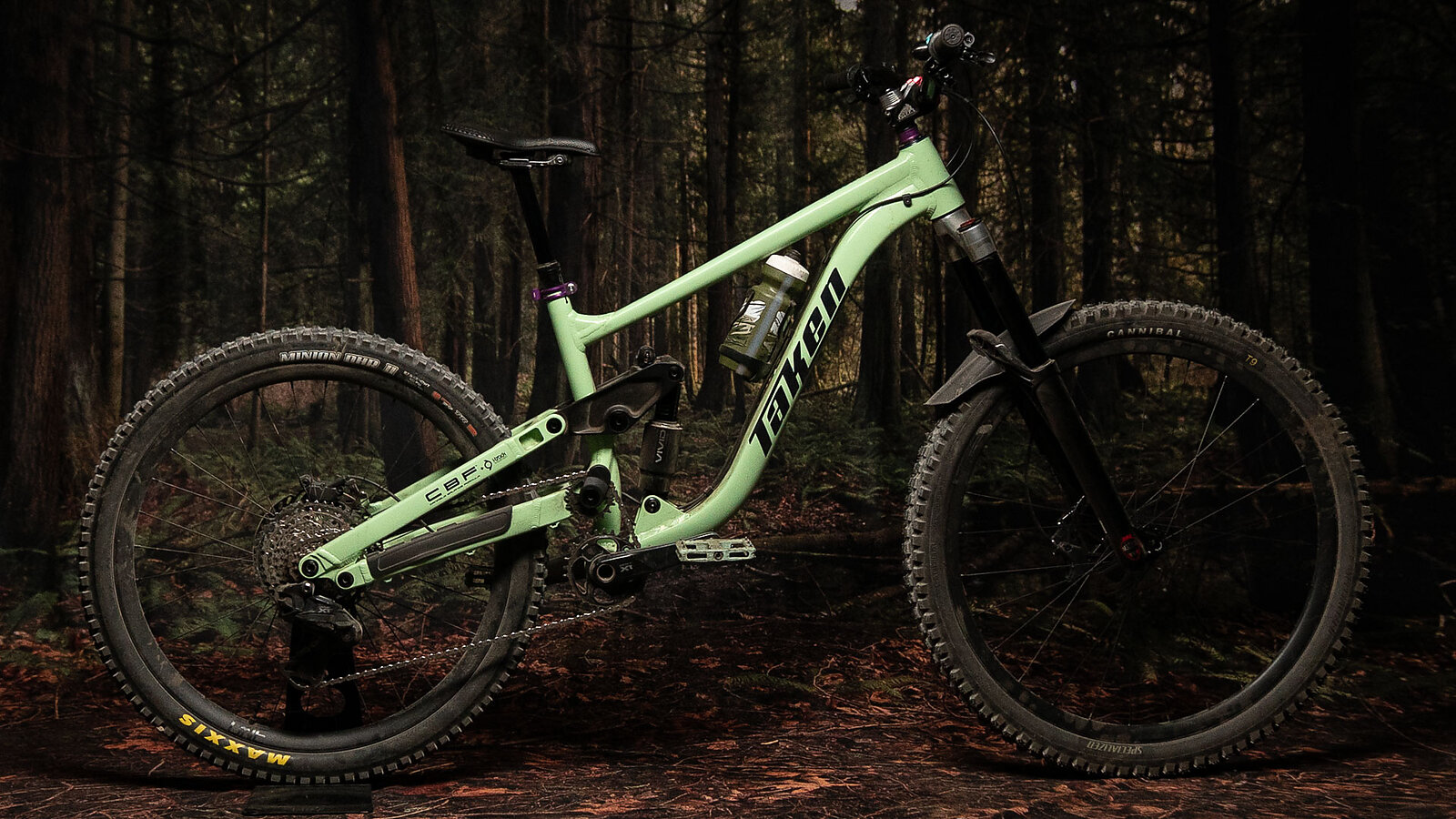
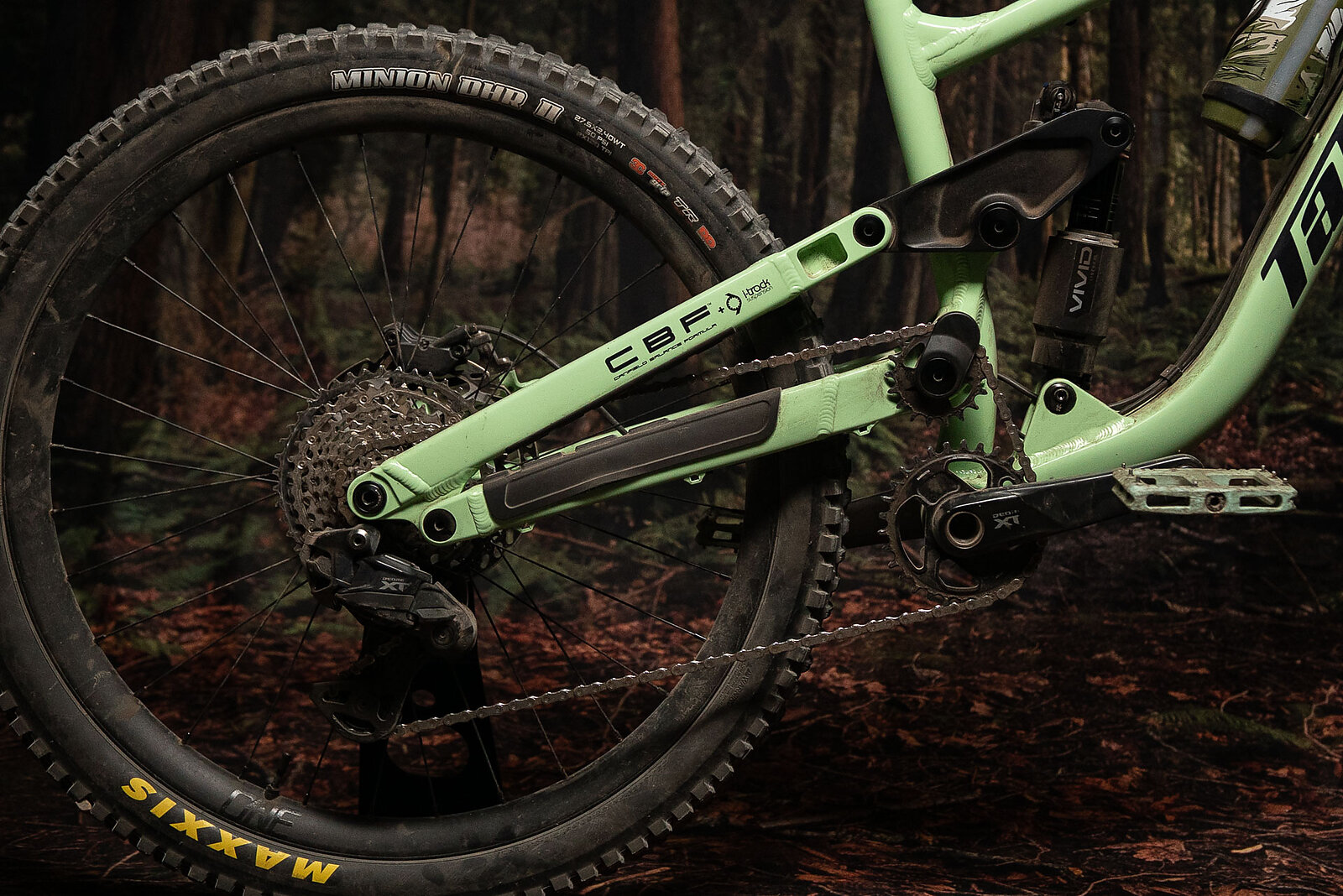
If you’re not familiar with Taken Cycles, that might be because the small, Idaho-based brand quietly launched with its first bike, the Encounter, quite recently at the start of July. If a brand’s first bike signifies its intentions, the Encounter is an aggressive start. It’s an all-alloy, high-pivot enduro rig that can be run with anywhere from 153 to 175 millimeters of rear travel depending on the shock stroke. It uses Canfield’s Balance Formula to dial in the pivot placement of the rear end, and an i-track seatstay mounted idler pulley to keep the chain lined up. It’s got external cables, a flip chip for 29 or 27.5” rear wheels, and it’s rated for dual crown forks.
Where does that name come from? Well, all the obvious bike brand names were “taken,” and from there the alien-themed model name and cow-getting abducted head tube badge were an easy step.
It might be tempting for a new brand to come out of the gate with a do-it-all bike that’s best suited to average riders doing average riding. But, so often, those bikes can come across as boring and redundant. Why should a smaller brand make a less refined Stumpjumper? Instead, the Encounter has a point of view. It’s a downhill-focused brawler that goes uphill better than it has any right to and, spoiler alert, it’s my favorite descending bike I’ve ridden this year.
Taken Encounter Details
- Travel: 153-175 mm (rear) 160-200 mm (front)
- Wheel Size: 29” or mixed
- Size Tested: Large
- Build Tested: Frame Only
- Head Tube Angle: 63.18°
- Weight: Frame only: 10.36 lbs, 4.7 kg Build as pictured: 37.8 lbs, 17.15 kg
- MSRP: $2,699 (frame, no shock)

Options and Permutations
For now, Taken is only selling Encounter frames—no complete builds. You can buy a frame only (no shock) for $2,699, or add a shock from RockShox, Fox, EXT, or Push when you order the frame.
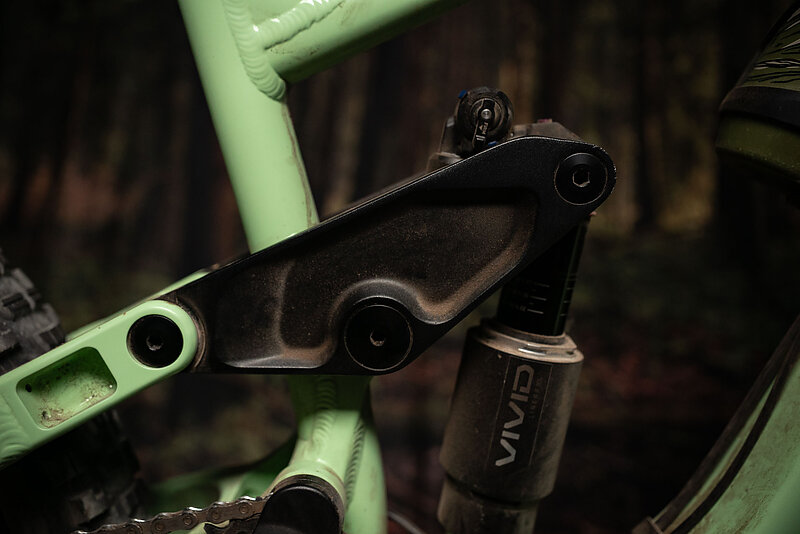
Taken says that thanks to the CBF suspension design, the Encounter is more versatile than its numbers suggest, so it can be run with anything from a 57.5-millimeter stroke shock to a 65-millimeter stroke, giving rear travel numbers from 153 to 175 millimeters. From there you can pair the frame with an appropriate length fork, from 160 all the way up to 200 millimeters if you so desire. It is worth pointing out that there aren’t any other geometry adjustments, so you’ll end up with a fairly long reach, low bottom bracket and steep seat tube angle if you drop the fork travel too much or, conversely, a short, high, slack situation if you raise it up. Taken’s geometry chart is all based around a 170-millimeter fork, so it’s on you to do the math if you decide to deviate too far from that.
Taken Encounter Frame Details
The Encounter’s alloy frame is manufactured at the Genio factory in Taiwan. Genio has a reputation for making some of the better alloy frames around, and a quick glance at the Encounter reveals details that might be familiar to owners of other Genio-made frames.
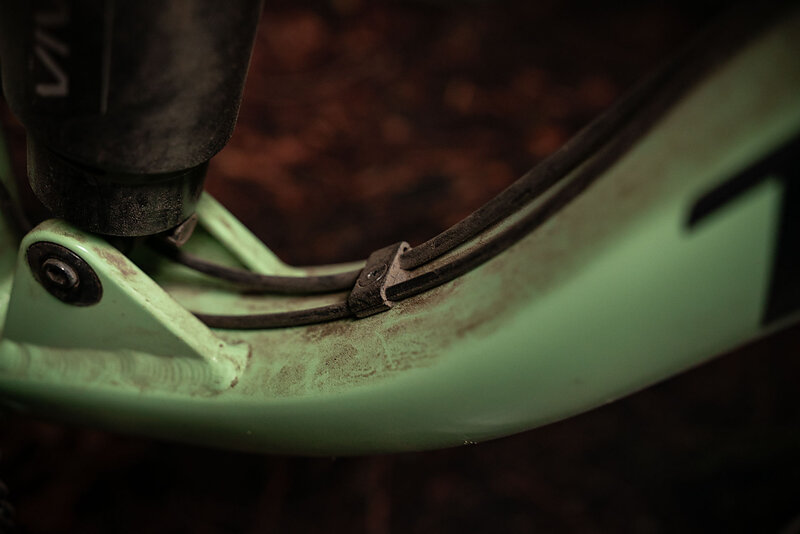
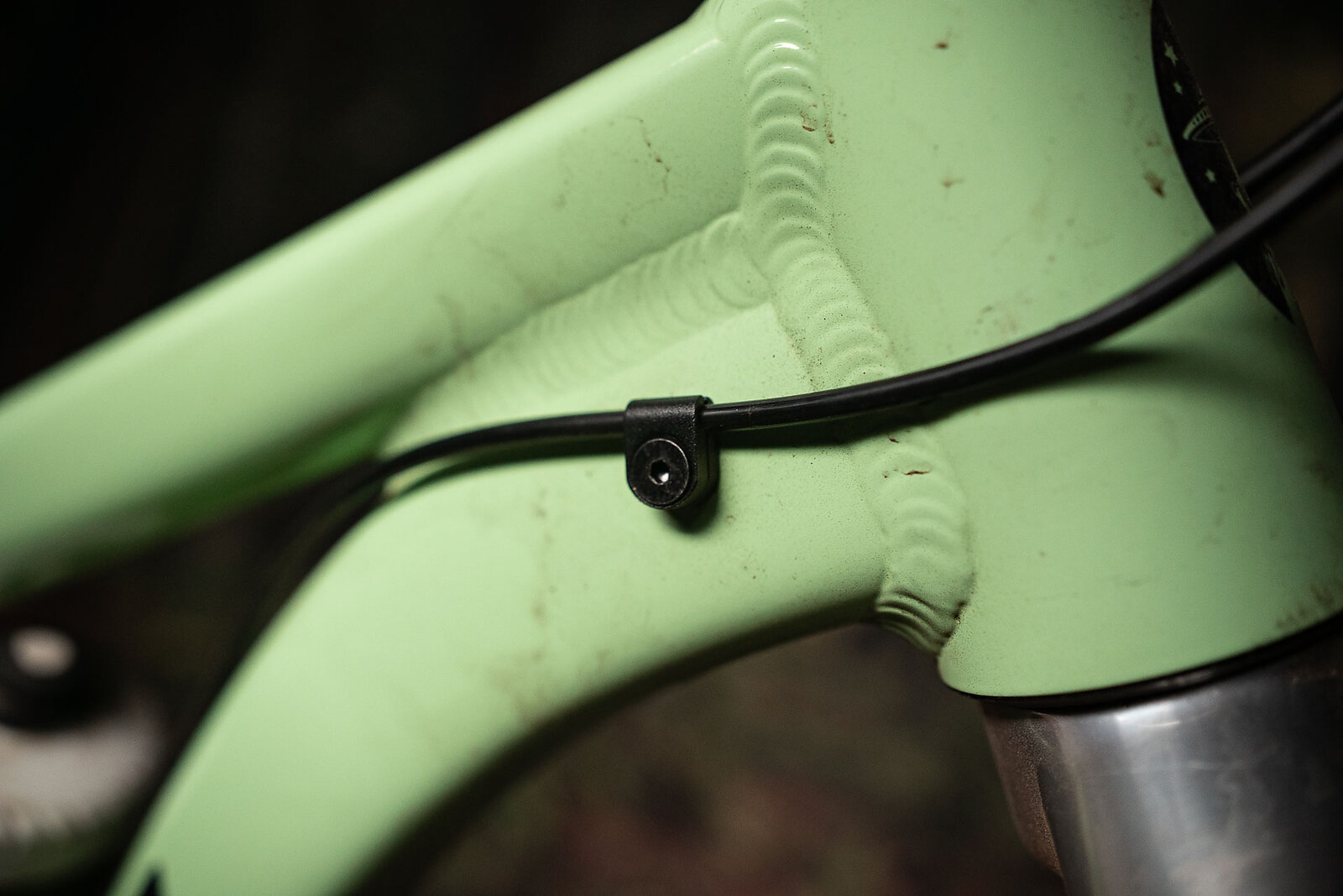
The Encounter has completely external cable routing clamped to the the top of the downtube, and then clipped or zip tied to the stays. I’m a big fan—it’s executed cleanly and makes swapping parts around quite easy. I haven’t had any issues with rattle. Taken says most shocks can be run with the reservoir facing forwards or back, other than the Fox Float X2 which only fits forwards. With the reservoir facing back, there’s more room in the front triangle for a bottle.
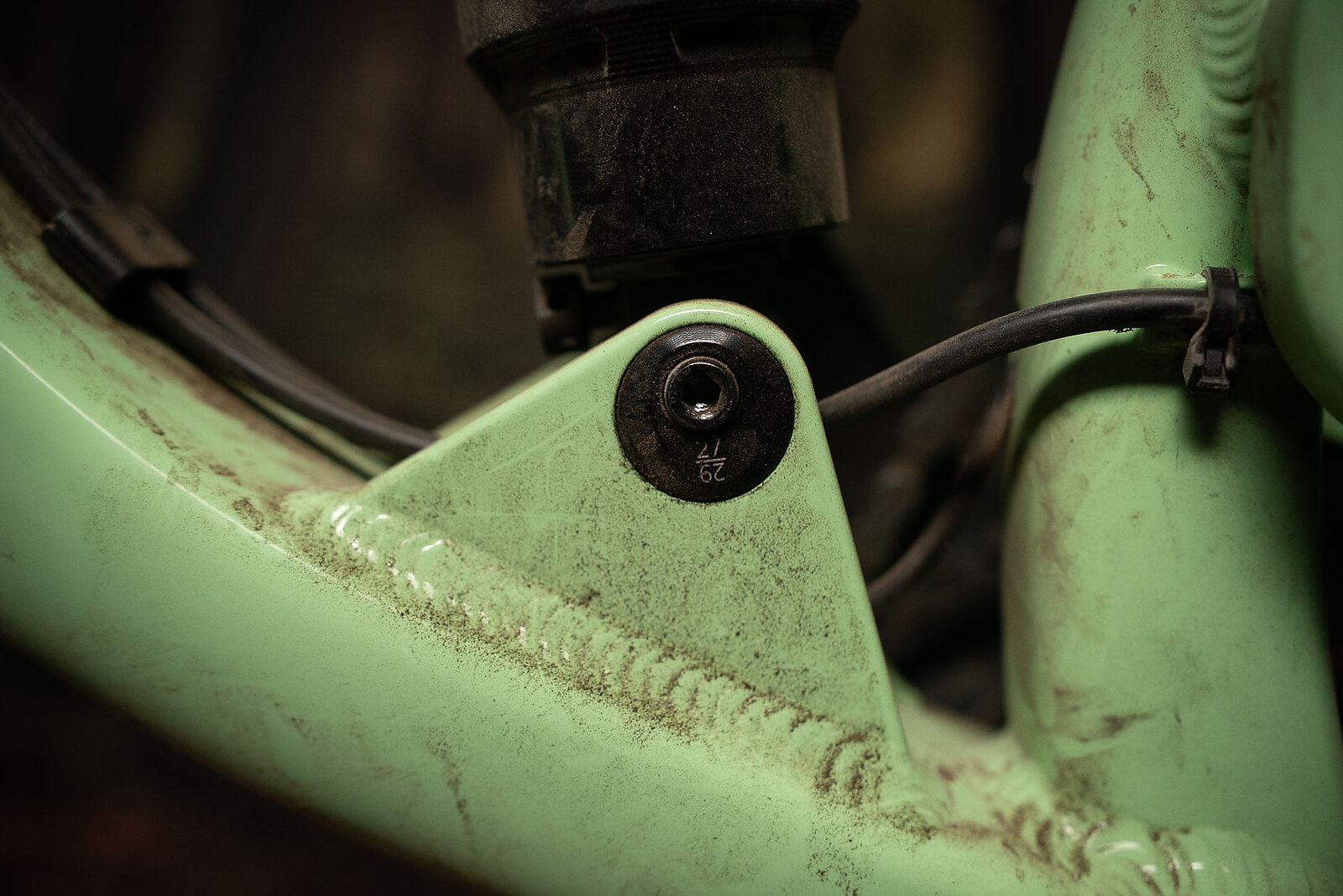
There’s only one flip chip on the frame at the lower shock mount to allow for mixed or full 29-inch wheels. Like the rest of the bike’s hardware, it’s burly and easy to swap. It is worth noting that Taken recommends hitting all pivot hardware with blue Loctite before riding. I had one of the trunnion shock bolts back out on a ride before I Loctited it, and since then it’s held strong.
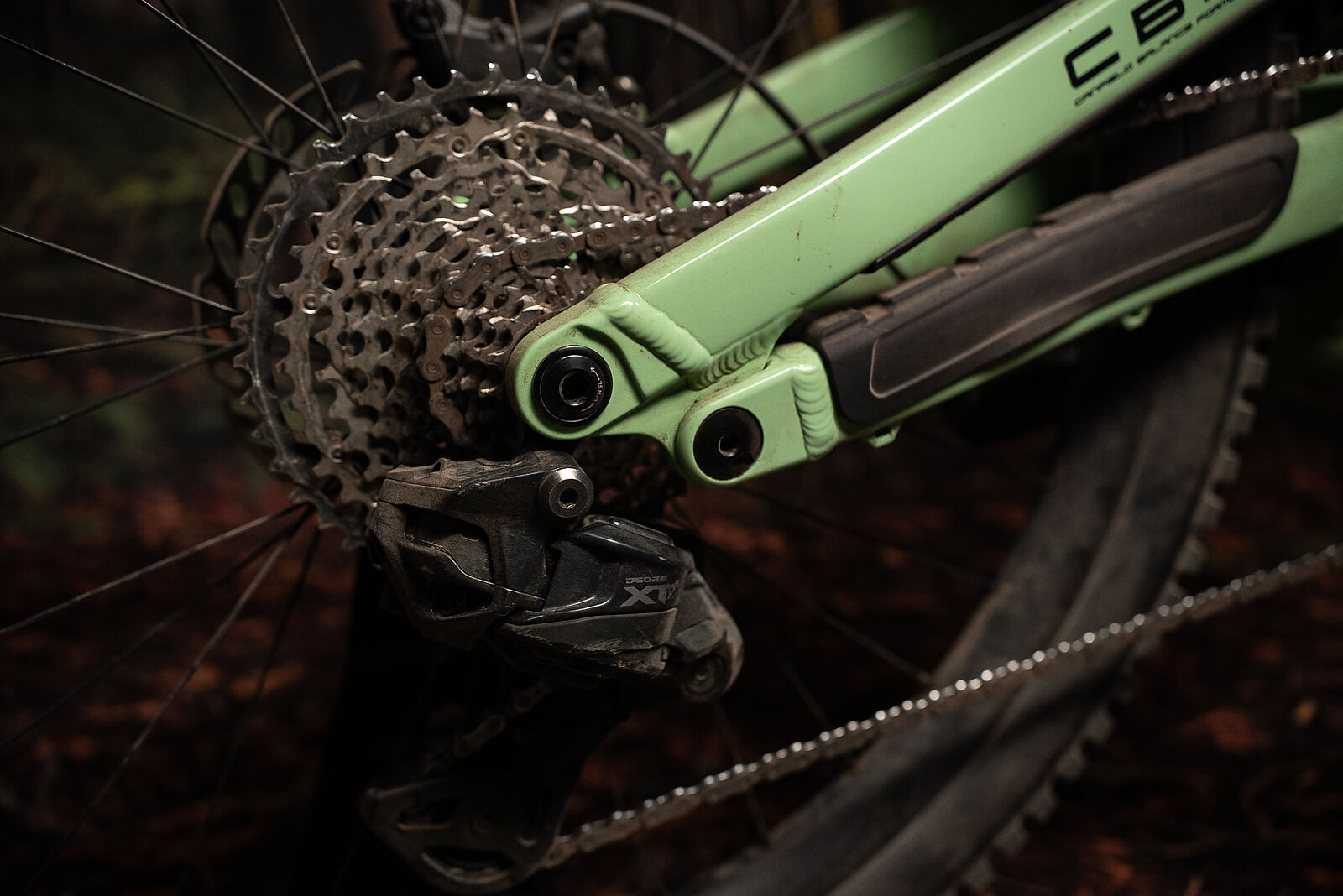
The derailleur hanger is SRAM’s UDH, and there’s a decent amount of rubber chainstay and bottom bracket protection. The headset is a standard ZS 44/56 affair, so you can get weird with anglesets if you so desire. The bottom bracket is threaded and the seat tube is 31.6 millimeters in diameter, both of which are great choices.
All-in, this is a simple, easy-to-work-on frame that has just about every feature I actually care about and none that I don’t. It’s a workhorse, which is exactly what I’m looking for in a bike in this travel range.
Taken Encounter Geometry
Why make a burly, high-pivot bike if you’re not going to give it aggressive geometry? In the default 175-millimeter travel, 27.5-inch rear-wheeled configuration I’ve been running, the large Encounter has a 541-millimeter stack, 476-millimeter reach, 63.18° head tube angle, a 77.74° effective seat tube angle, and 436.7-millimeter seat stays that grow to 447.7 millimeters at sag thanks to its rearward axle path. Those numbers are all right in line with other aggressive bikes like the Santa Cruz Nomad. The Encounter doesn’t have the option to run longer stays like the Yeti LT or the Devinici Spartan, but thanks to that high pivot the rear center feels longer than it looks on paper, in a positive way.
Taken Encounter Build
I got the Encounter as a frame only, with a Rockshox Vivid Air shock, and then built it up with my own parts. This isn’t a review of the build, but it’s worth sharing since it contributes to the (very reasonable) total weight of the bike. I’m running the Shimano medium cage XT Di2 drivetrain, Shimano’s new Deore brakes (and thicker rotors), and I’ve got OneUp’s Aluminum wheels shod with a DH casing Specialized Cannibal up front, and a DoubleDown Maxxis DHRII out back. I’ve run a couple of different forks up front, including the Manitou Mezzer at 170 millimeters and at 190, as well as the last two generations of RockShox Zeb.
This is not a lightweight build by any means (it features exactly zero carbon bits), so I was fairly surprised when the complete bike came in under 38 pounds. The Taken’s frame isn’t some dainty carbon thing, but it’s less of a boat anchor than it might appear to be, and it would be totally reasonable to get the Encounter under 36 pounds with the right build.
Riding the Taken Encounter
I’ve spent most of my time on the Taken so far with 180-millimeter travel forks, so that will be my point of reference for its performance until I put together a followup once I’ve tried more options.
I threw the Encounter into the deep end right off the bat. I built it up and immediately set off to show a bunch of friends a new trail I’d just finished. The climb for that trail is steep and unrelenting gravel, followed by steep and somewhat technical singletrack. Out the gate, I was super impressed with the Encounter’s pedaling efficiency. It felt very similar to every other CBF-designed rear suspension platform I’ve ridden. There’s next to zero bob when pedaling with the shock open, and it has a really nice round feel when it comes to clawing your way up more technical sections. It doesn’t create quite as much climbing traction as some other bikes, instead it stays tight and focused. The Taken’s climbing position is nice and upright, and I was happy to sit and spin my way up just about everything.
No, the Encounter doesn’t “climb like a goat” but it climbs as efficiently as any other bike in this class I’ve ridden and, in fact, feels more efficient with the shock open than the Santa Cruz Nomad. It’s more than adequate for a 170-plus-millimeter bike with burly parts, and I found that my desire to keep pedaling was much more of a limiting factor than the bike’s capability.
That first lap, on my trail with friends who are all much stronger riders than I, was a great proving ground for the Taken. The top half is steep and committed, with some decent-sized moves that require commitment and precision. The Taken feels right at home in those situations. It hits a balance of stability and agility that works well for my riding style. It doesn’t feel ponderous when I need to make small adjustments to line up for a precise entrance, but on the runout it stays so composed and settled that I’ve found myself making questionable choices, confident that the bike will back me up.
It feels quite similar to the Trek Slash in this regard, although it’s even less heavy and ponderous than the Slash, and is easier to move around and change direction on. My favorite thing about high pivot bikes like the Slash and the Taken is that on chunky compressions after rock rolls or drops, it feels like the rear end lengthens and creates traction and stability in the runout. It almost feels like I can leave my rear wheel behind, and instead focus on lining up the front with the exit. The Encounter delivers that sensation in spades, and left me stoked to push into scarier and more committing terrain.
But, when things are mellower, it doesn’t feel like a handful. It’s got a ton of mid-stroke support, so it’s easy to pump and push into corners and I’ve found myself slashing the rear end around at every opportunity. It’s not as much of a “go straight and charge” bike as the Yeti LT, instead it’s easier to goof around on.
The current generation Trek Slash was, for a long time, my white whale. It was my favorite descending bike I’d ever owned, and for two years I’ve been searching for something to replace it. The Taken Encounter is the first bike I’ve found that could seriously replace it. It’s quieter and more efficient uphill, while also weighing a few pounds less than the alloy Slash. Headed downhill, it comes as close to matching the Slash’s confidence-instilling magic as any bike I’ve ridden. That’s why it’s my favorite bike I’ve ridden so far this year.
I’m stoked to spend more time on the Encounter, play around with the shock tune, and try out some different fork and shock combinations, and will be back with a followup piece diving deeper into this rig.
For Now
Taken Cycles came out swinging with its first bike, the Encounter. It’s a solid, easy-to-work-on, easy-to-love rig that handles the gnarliest trails with ease. And it’s no slouch on the ups either. If you’re looking for a bike that urges you push your comfort zone, and will get you to the top efficiently, you could do a lot worse than the Encounter.
Learn more: Taken Cycles