Canyon Spectral:ON CF 9 Do-it-all refinement.
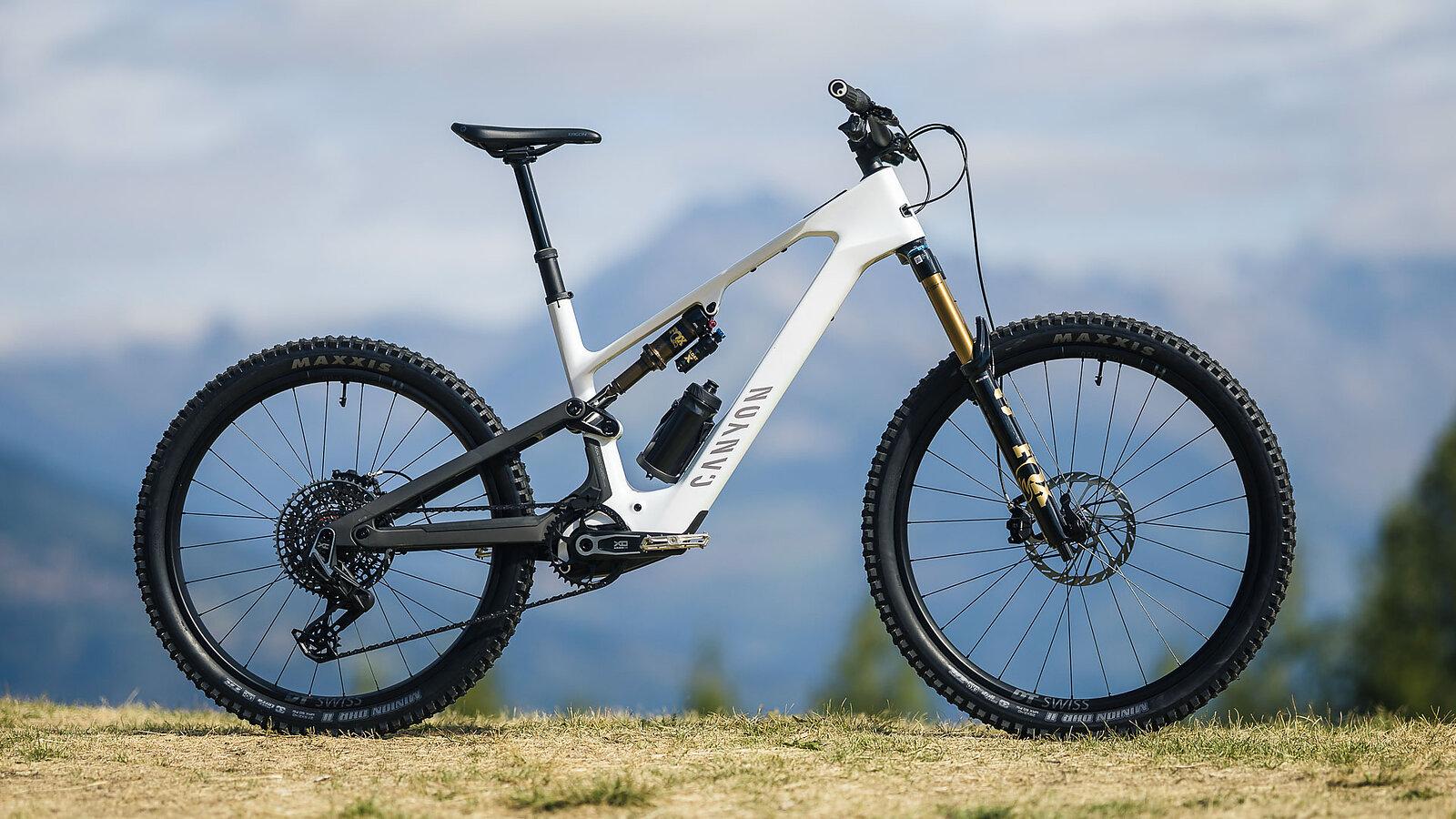
Canyon has a new e-bike, and it’s powered by the Avinox M2S system. That’s the clear, easy headline for this bike, but it also doesn’t tell the full story. There’s a huge swath of Avinox e-bikes hitting the market, so Canyon has gone to great lengths to help make sure the Spectral:ON stands out beyond just its propulsion system. To that end it’s positioned as the brand’s default e-bike, the middle ground that will appeal to the most riders. And the folks at the brand have put a whole bunch of effort into making sure it’s as refined and dialed as possible.
I think (and mostly just hope) we’re starting to see a sea change around how people shop for e-bikes. Ideally, we’ll move beyond the power unit battles and focus on the important part: how the bike rides over how many watts it puts out. The Spectral:ON might be an example of that shift. Canyon is spending very little energy communicating about the drive system, and is instead focused on how much work went into making sure the bike does bike things well. And, to that end, the Spectral:ON might just be the best-actualized, best-riding e-bike I’ve spent time with so far. So let’s get ON with it.
Canyon Spectral:ON CF 9 Details
- Travel: 150 mm (rear) 160 mm (front)
- Wheel Size: MX with 29” capabilities
- Size Tested: Medium
- Build Tested: CF 9
- Head Tube Angle: 64° (high setting)
- Motor: Avinox M2S (1300 W peak power, 150Nm Torque)
- Battery: 700 Wh
- Stated Weight: 47.84 lbs (21.7 kg)
- MSRP: $9,499
Editor’s Note: The Spectral:ON CF 9 will be available to order in early December, and will launch in North America early in 2027. Additional Spectral:ON models will be announced throughout the winter.
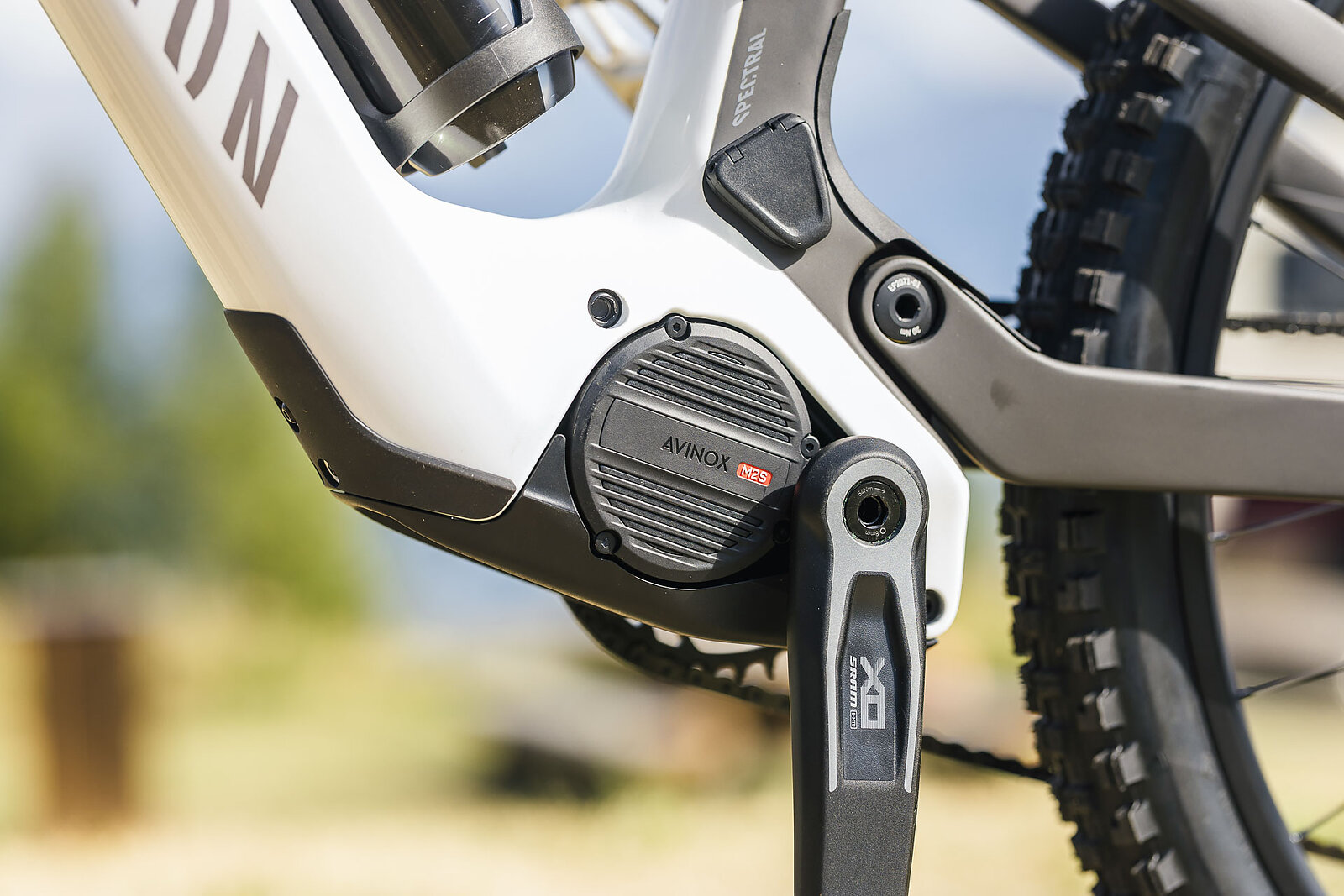
Canyon Spectral:ON CF 9 Motor and Battery
Yep. It’s an Avinox M2s e-bike. No surprises here. Canyon has done some custom tuning with the assist modes so that in Trail mode you get a max of 105 Nm of torque and 1,000 W of power, and in Turbo you get 130 Nm and 1,300 W. Of course you can tweak all of those modes in the excellent app, or in the easy-to-use touch screen on the bike.
The Spectral:ON uses a fixed 700 Wh battery that allows Canyon to create a slimmer silhouette and better-distribute the weight. Anecdotally, it sounds like some folks are getting very similar ranges out of 800 and 700 Wh Avinox batteries, perhaps due to the lower weight, and some weird efficiency changes in how the cells distribute power, so you’re not really sacrificing much with the 700 Wh battery, and it’s got a better form factor to design the bike around.
It bears repeating that, in my experience, power and torque numbers aside, the Avinox M2S is still the smoothest, and best-feeling e-bike system around. It just feels more intuitive and all-round “better” than any Bosch, Specialized, or TQ motor I’ve ridden so far. That pays off on the Spectral:ON with a ride feel that’s quite easy to love and live with. I didn’t ever find myself thinking about what mode I was in, or fighting the motor. This is the only motor system that I trust enough to descend technical, exposed trails in Turbo mode on, because I have yet to have any weird kicks of power. On the way up, it doesn’t have as much overrun as Bosch systems, so you have to be more calculated instead of just brapping up technical moves, but it’s also better-controlled so you’re less likely to lose traction.
Canyon Spectral:ON CF 9 Geometry
Canyon’s geometry updates over the previous mid-powered Spectral are somewhat predictable. The head tube angle gets 1.5° slacker to 64°, the seat tube gets 2° steeper to 78.5°, the reach on the size medium I rode jumps 10 millimeters to 470 millimeters, and it gets longer chainstays across the board, with 441.8 millimeters on the small and medium, and 446.8 on the large and extra large. Combined with a 442-millimeter stack height on the Medium, you’ve got a recipe for a thoroughly modern trail bike. There’s also a flip chip that allows you to swing those chainstays out 8.2 millimeters further, although that will also drop your bottom bracket and angles if you leave a 27.5-inch wheel on, since it’s meant to accommodate a 29-inch rear wheel.
It’s worth noting that Canyon’s “gravity” bikes (Spectral, Torque, and Sender) all adhere to a different size philosophy than the smaller bikes in the range. So on a Lux Trail I’m a large, with a 470-millimeter reach, but on a Spectral I’m a medium, with the exact same reach. Look at the geo chart before you buy!
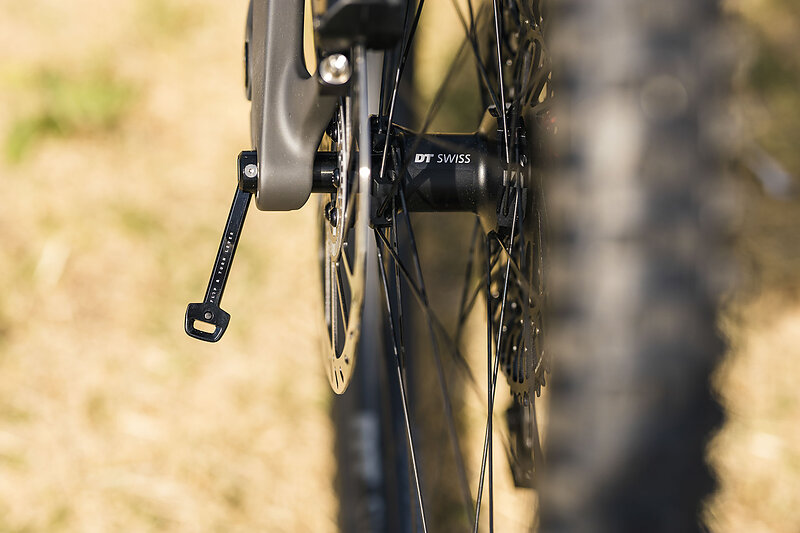
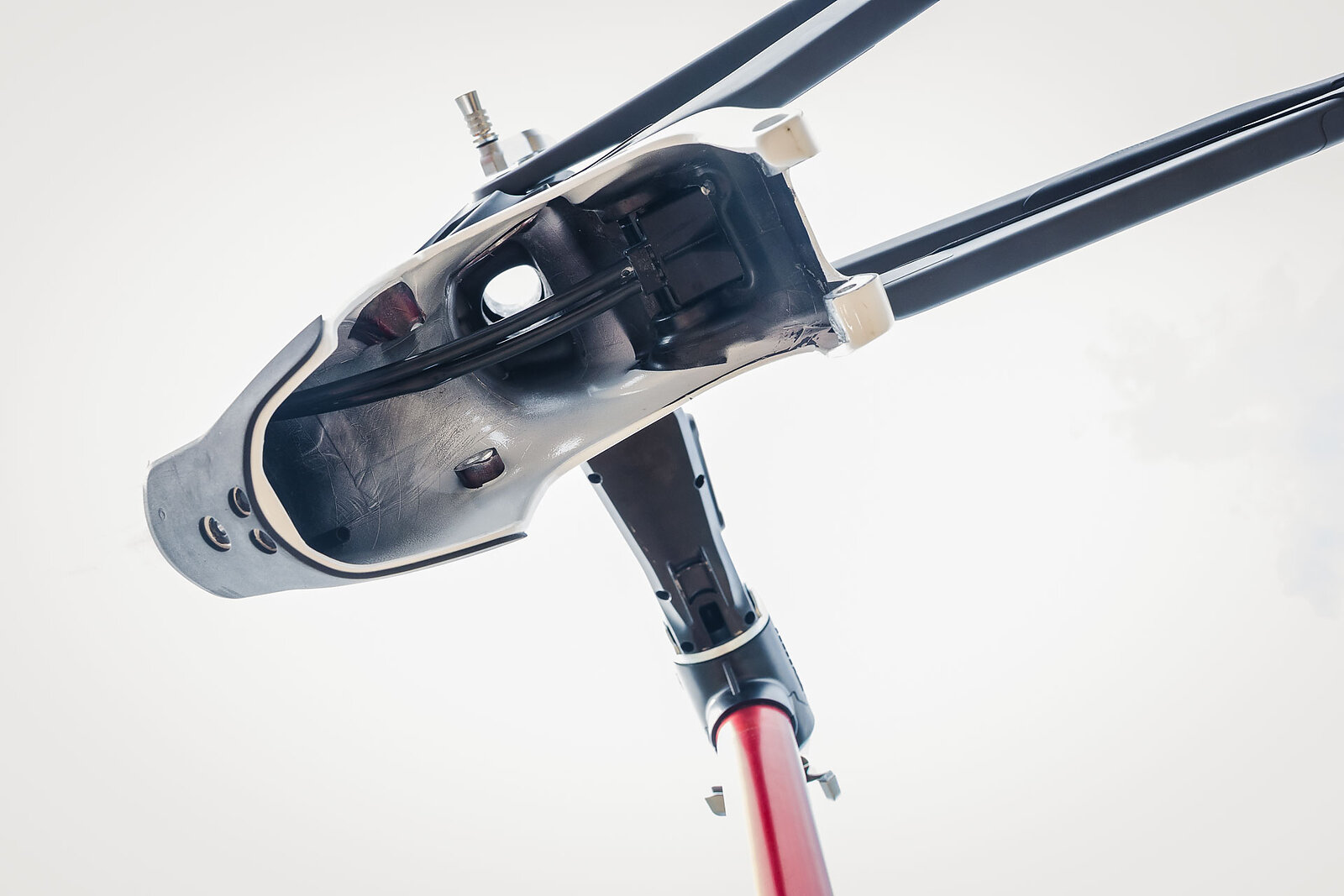
Canyon Spectral:ON CF 9 Frame Details
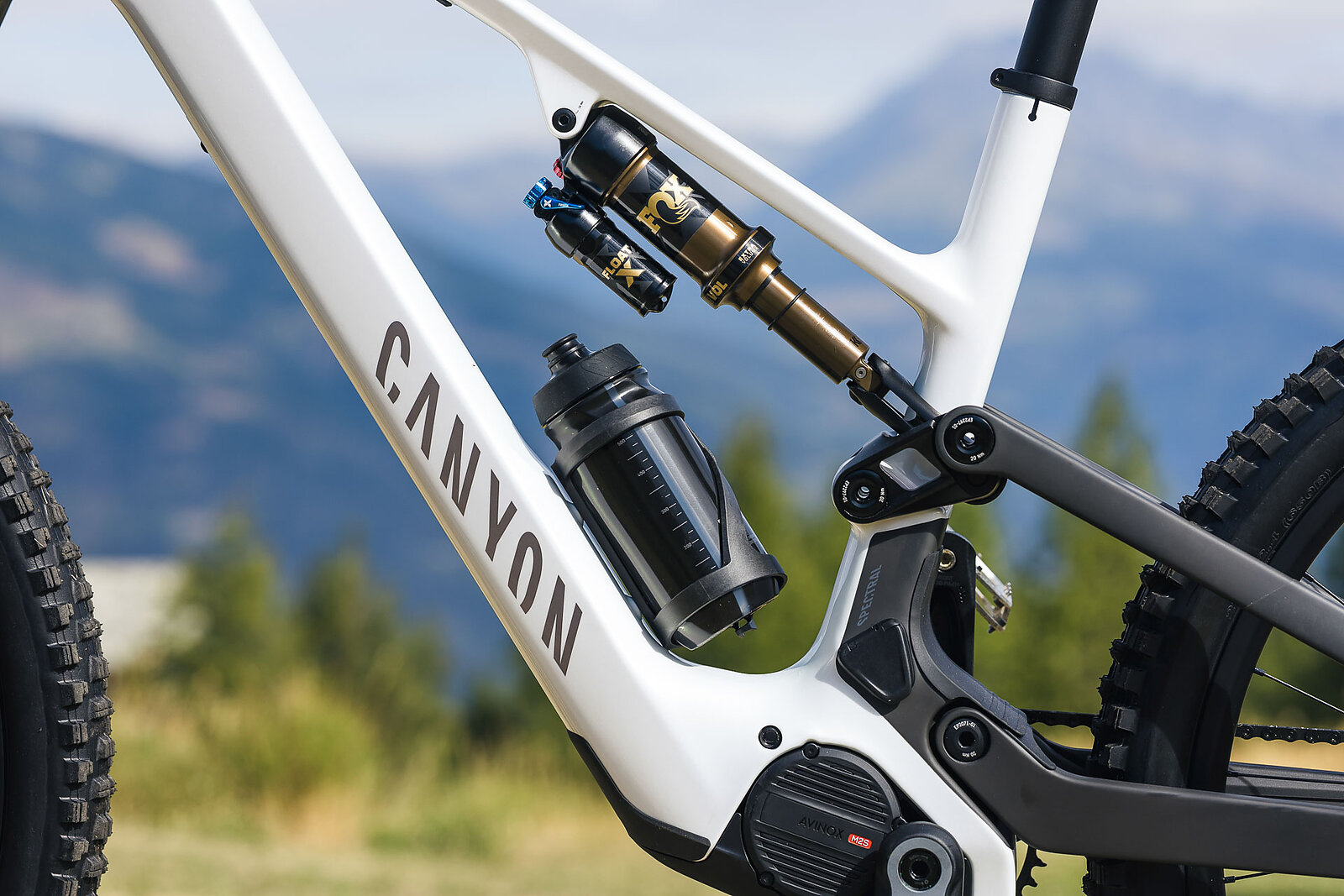
If you look at Canyon’s evolution over the past few years the bikes have been getting less and less “weird” and instead are getting cleaner and more practical. That’s very evident with the Spectral:ON. Sleek lines, no weird standards, fully guided internal cable routing, fenders where you’d want them, and a generally sorted bike.
The seat tube is 34.9 millimeters in diameter, and straight with plenty of insertion depth. The flip chip is easy enough to actuate, and the frame hardware all feels high-end. Canyon specs its own tool-free rear axle out back, and Fox’s quick release out front, so there’s no need to pull out a tool to remove your wheels. There are two bolts for more storage on the underside of the top tube, and of course there’s a UDH out back. I noticed my inner legs rubbing against the rocker link on my first lap, but then must have sub-consciously adjusted around it because I didn’t have any issues for the rest of my time on the bike, even though I ride with a very tight-legged stance.
It’s worth noting that the Spectral runs a 230x60-millimeter shock, and can be overstroked to 62.5 millimeters out back for a little extra squish, and is also rated for a 170-millimeter fork if you want to get a little more smashy.
I’m very impressed with how sorted Canyon’s frames are, especially at the price points they hit.
Canyon Spectral:ON CF 9 Build
According to Canyon's typical naming strategy, once the all the builds are announced and available, the Spectral:ON CF 9 I rode will be the second-highest-end spec, with a few more affordable models available as well. We'll see what the national availability of each spec level is as Canyon continues to roll out models through the winter.
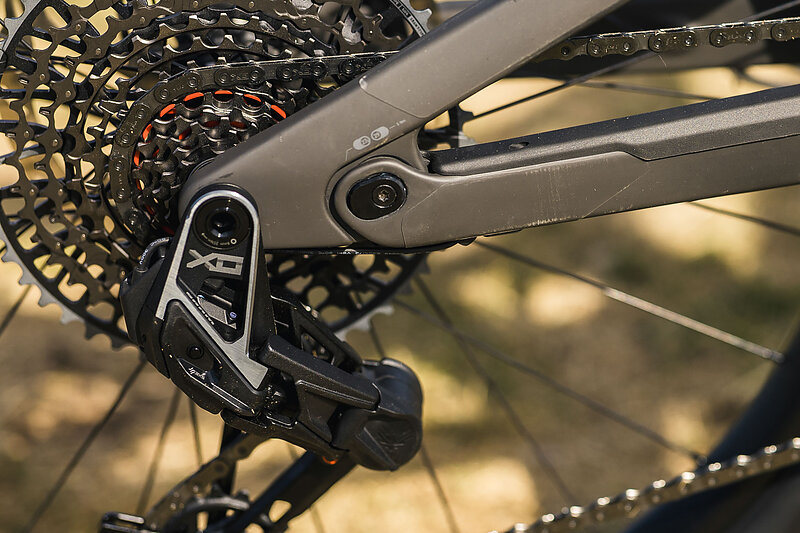
Most of this build is dialed. SRAM’s Maven Silver brakes and XO drivetrain are a great combination for a bike like this. Similarly, the Factory level Fox 36 and Float X are pretty ideal. I dig the DT Swiss HXC1700 wheels, they’re nice and stiff without feeling harsh. Those are shod with Maxxis DHRII tires front and rear, with an EXO MaxxGrip option up front and an EXO+ MaxxTerra out back. I’d forgotten how much I like the DHRII on both ends of the bike but, while I do understand why Canyon specs such light casings, I would immediately bump up to DoubleDown on both ends if I owned this bike. As we’ll get to, it’s a capable descender that deserves capable tires.
Finally, Canyon takes care of the bars, stem, and dropper, which is actuated with a SRAM lever. Personally, I wish the Canyon bars defaulted to 800 millimeters wide—it’s easy to cut bars down, but I can’t stretch 780s to my preferred width. If this was a personal bike I’d drop a higher rise bar (50 millimeters) on just to help center my weight a little better. The house-brand dropper is good and is easy to adjust travel down to fit shorter legs. All-in, it’s a rad spec for the price.

Riding the Canyon Spectral:ON CF 9
I’m going to skip most of the motor talk here. The Avinox M2s experience can be described with a single onomatopoetic word: “BRAAAAAAP!” There’s lots of power on tap, and it’s controlled very well. You’ll absolutely drop the crap out of fellow riders on Bosch bikes.
Going uphill the Spectral’s geometry feels dialed. The quite steep seat tube angle and slightly longer chainstays put me in a perfect climbing position between the wheels. I’ve noted that with other Avinox bikes the motor enables steeper climbs, and benefits from a more forward-biased stance, so it’s rad to see Canyon set the Spectral:ON up for success here. It’s easy to get your weight forward without breaking traction from the rear wheel or allowing the front tire to “hover” on steeper sustained climbs. I never once thought of touching the climb switch on the Spectral:ON. It’s got higher anti-squat than the previous version and feels very efficient. The tradeoff is that on really techy climbs you can’t just sit back and let it claw its way up, instead it benefits from a more active riding style.
That means that it works well in more rolling terrain where you’re transitioning between climbing and descending back and forth. It feels really “trail-bikey” here in a good way, in that it rewards rider input, and doesn’t encourage couch-sitting.
The more time I spend on e-bikes, the more I’m convinced that 150/160 millimeters of travel is pretty ideal for how I ride. Even on steeper, more technical trails, where on a meat bike I’d want to be on something with 170/180 millimeters of squish, I find I prefer the tighter, more responsive, shorter travel feel with a motor. It’s more predictable, and allows me to ride more actively, instead of sitting back and letting the bike smash.

To that effect, I had more fun descending on the Spectral:ON than I have had on any other e-bike. It took me a couple of laps to get used to the slightly longer chainstays—I found myself struggling to slap the rear tire around and break it loose—but once I learned the bike’s balance point I was able to transition between letting the bike tear through chunder and pushing it into holes and slapping corners effortlessly. That duality was really enjoyable. When I was tired or off my game I could sit back and point and shoot, letting the bike do the work. But, when I wanted to get weird (which was most of the time) the bike was absolutely down to party.
The geometry and kinematic, along with the shock tune get a lot of credit here. I’ve had great success with running Fox’s current generation of shocks and forks at basically their recommended settings, and the Spectral:ON continued that trend. Minimal suspension faff, maximum fun.
I think the “smash-all-the-things” gang is going to want to lengthen the chainstay, and install a longer stroke shock and 170-millimeter fork but, for me and how I ride, the default configuration is ideal. Similarly, if you’re looking for a more staid experience, you can swap to a 29-inch rear wheel (which does come with 8 millimeter longer chainstays) but, again, for how I ride, mixed wheels and shorter stays are ideal.
The Spectral ON:CF is well-rounded without being boring, and that’s a very good thing. When brands set out to make an e-bike that’s attractive to the highest possible number of customers, it can sometimes feel diluted and drab. The Spectral:ON is the opposite—I think a lot of people will not just get along with it well, but in addition, will actively enjoy it.


For Now
Before I rode it I was worried that the Canyon Spectral:ON was “just another Avinox e-bike.” And on paper it is. But, out on the trail, I was constantly impressed with how dialed and how much fun it was.
Learn more: Canyon