Madrone Jab Derailleur The third party solution.
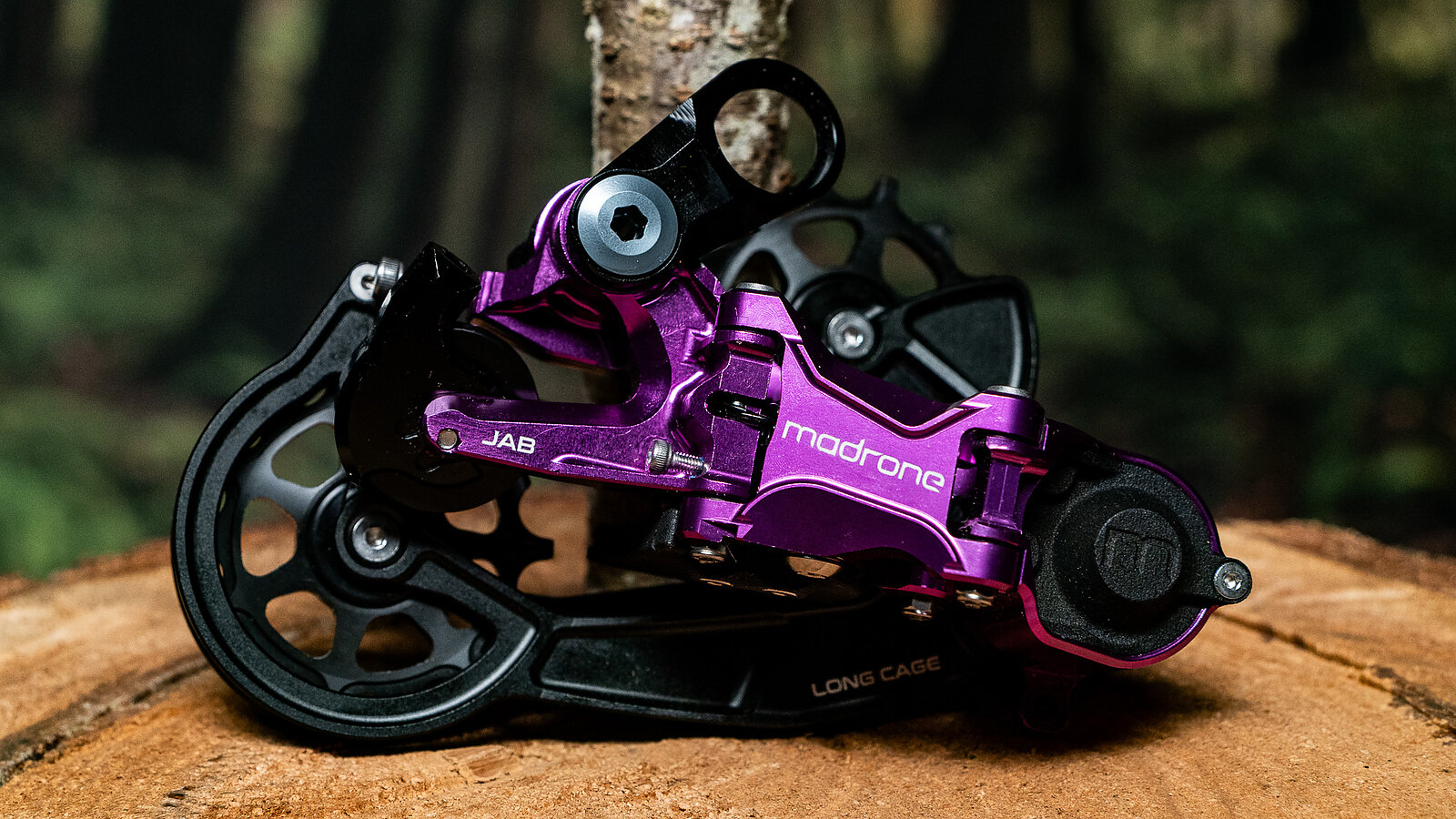
Madrone’s Jab Derailleur has been gently making waves since last July. It’s a modular, rebuildable, premium mechanical derailleur that’s assembled in Oregon, comes in a bunch of beautiful colors, and is adaptable to work with just about any drivetrain you’d like.
For a lot of the Jab’s target audience, that list of descriptors is plenty on its own. Out of the box it’s perfectly suited to a certain set of cyclists that avoids batteries, and is more focused on brand story and character than incremental gains in performance. I can relate to that ethos. There will always be a spot in my garage for a steel hardtail with a no-nonsense build.
But, for the purposes of this review, I was much more interested in finding out how the Madrone Jab compares to the current high-end crop of both mechanical and electronic derailleurs. My attitude coming into my time on the Jab was “it looks good, and it sounds good, but honestly, I don’t care about that if it doesn’t ride good.” So, how does it ride? Pretty dang good!
Madrone Jab Details
- Drivetrain compatibility: SRAM T-Type, SRAM Eagle, Shimano 12 speed, SRAM 11 Speed, Shimano 11 speed HG and LG
- Measured Weight: 328 g (stated weight is 308-326 g depending on configuration)
- Price: $327 (as reviewed, with stiffener plate)
Madrone Jab Options
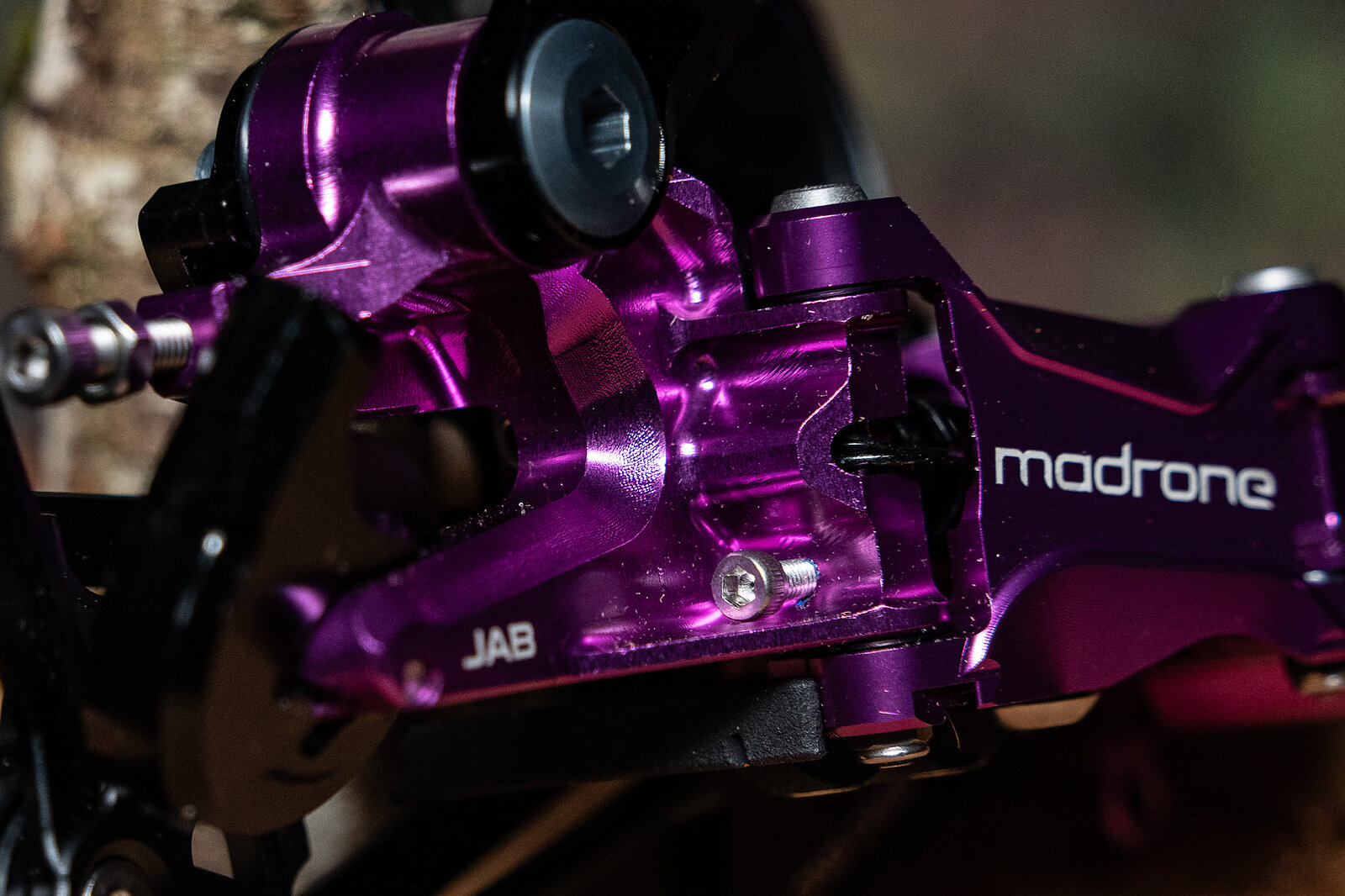
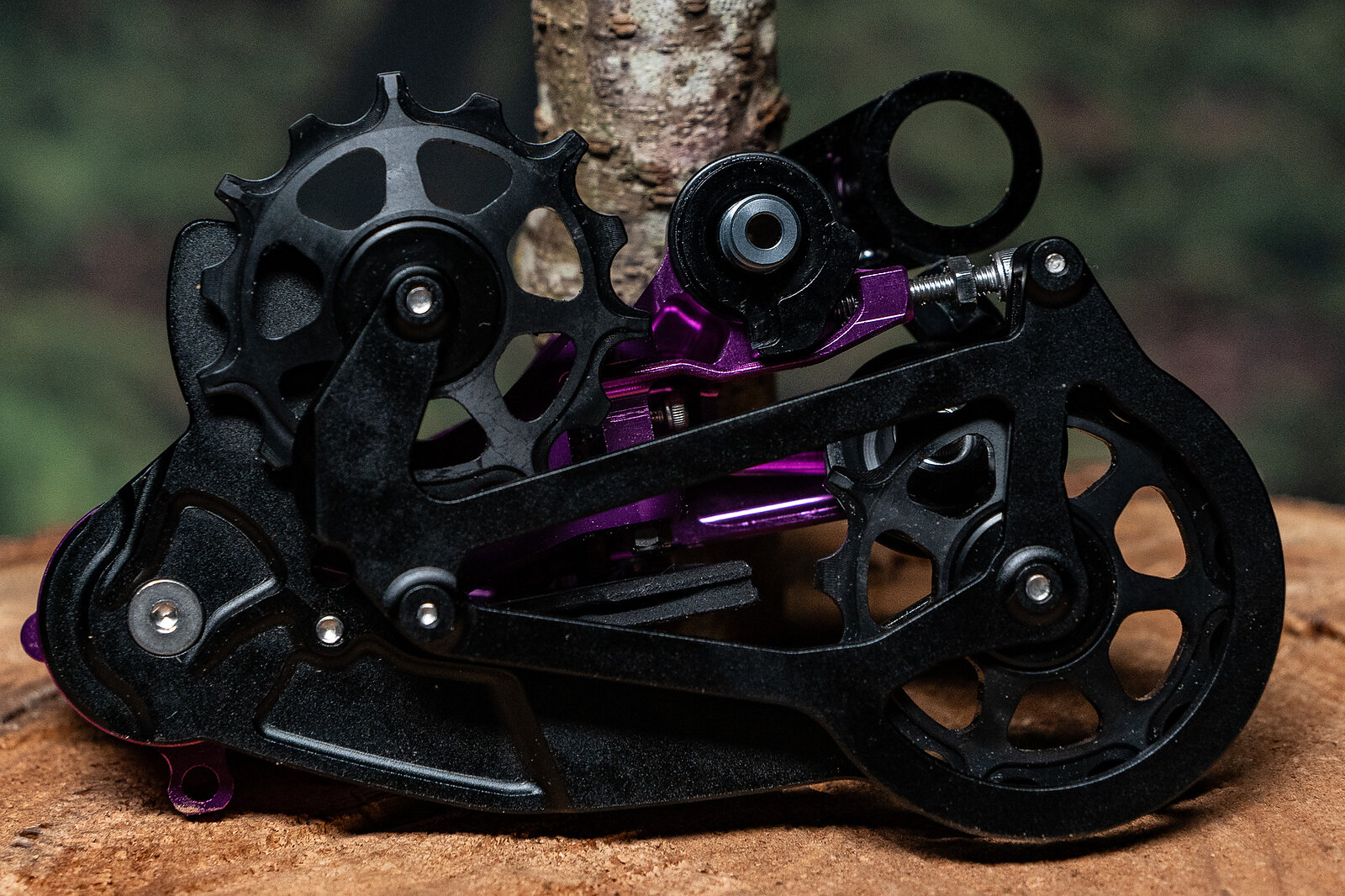
The Jab’s value proposition is centered around its adaptability. It’s meant to be modular and user-serviceable so that it’s quick and easy to set up for a wide variety of drivetrain and hanger options. There are four interchangeable elements that allow for those changes: the mount (choose between T-type, regular, and regular with a T-Type stiffener), the fin, or cam (changes the cable pull ratio to adapt to different shifters), the clutch (choose between gravel and mountain bike), and the cage (short, 44T max cog, or long, 52T max cog).
Most of those choices are pretty straightforward, but the mount can get a little confusing. Madrone offers three choices: the “standard” mount, will work on any derailleur hanger, with any drivetrain that’s not SRAM’s Transmission. You can add the stiffener to said mount as long as your frame has a Universal Derailleur Hanger (UDH)—this replaces the washer on the UDH and stabilizes your derailleur even more. And then finally, there’s the Transmission-compatible mount which has clearance for the slightly-wider Transmission cassettes.
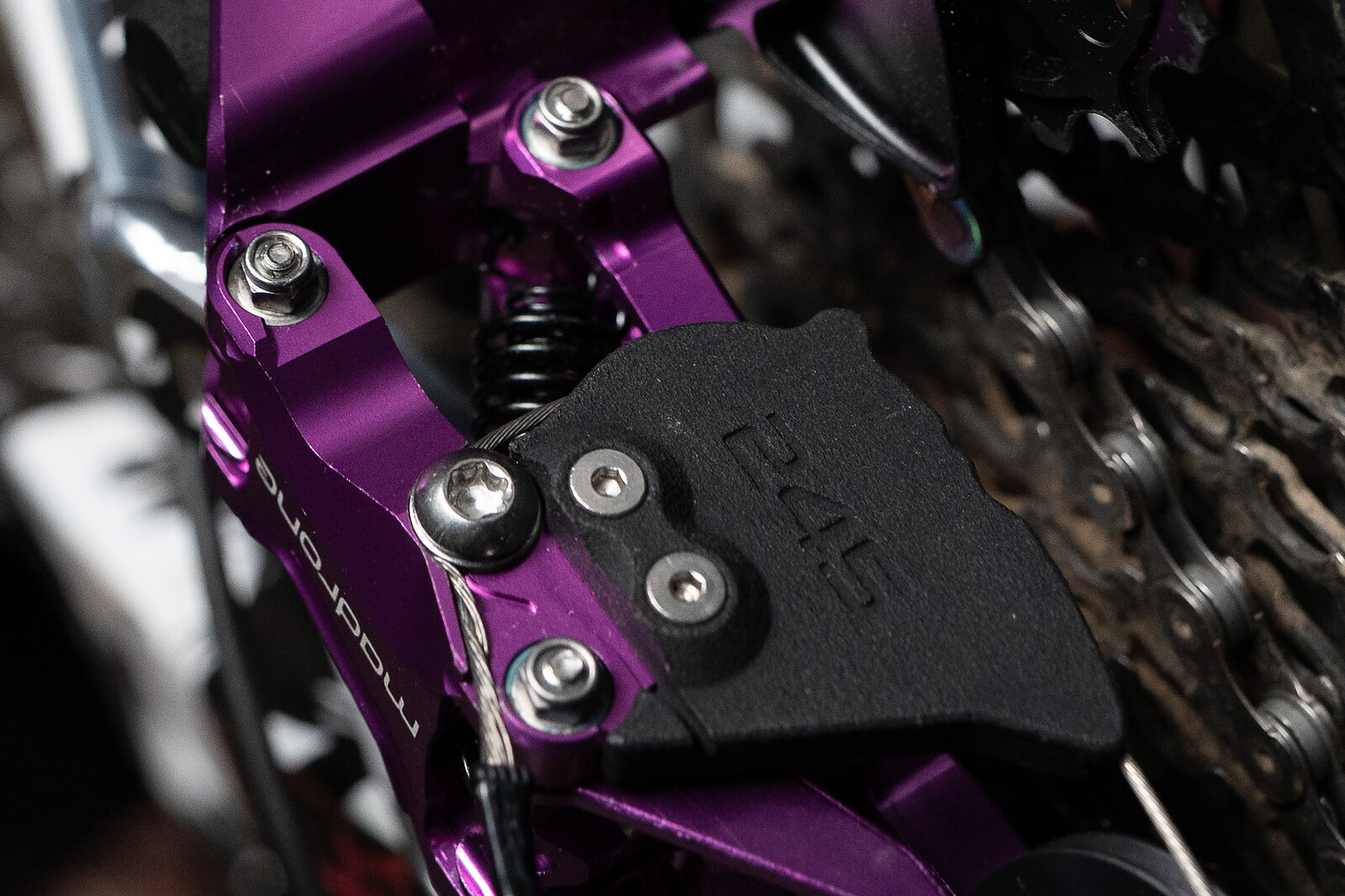
So, for example, the derailleur I received was specced with the regular mount with T-type stiffener, 12 speed Eagle cam, mountain bike clutch, long cage derailleur. I ran it with a SRAM XO1 Eagle shifter, cassette, and chain. If I wanted to run it in place of an Eagle 90 derailleur, I’d need to replace the mount and the cam. If I wanted to run it with a Shimano XT shifter and cassette, I’d just need to replace the cam. If my bike didn’t have a UDH, I couldn’t run the stiffener (and I couldn’t run it with a Transmission drivetrain).
There are a lot of options here, and Madrone makes all of them available aftermarket. You’re most likely to swap cams out, to adapt to different cassette/shifter combos, and luckily those are affordable ($20) and easy to change (two screws).
If all those choices weren’t enough, Madrone also makes the Jab available in a variety of anodized colors.
Madrone Jab Features
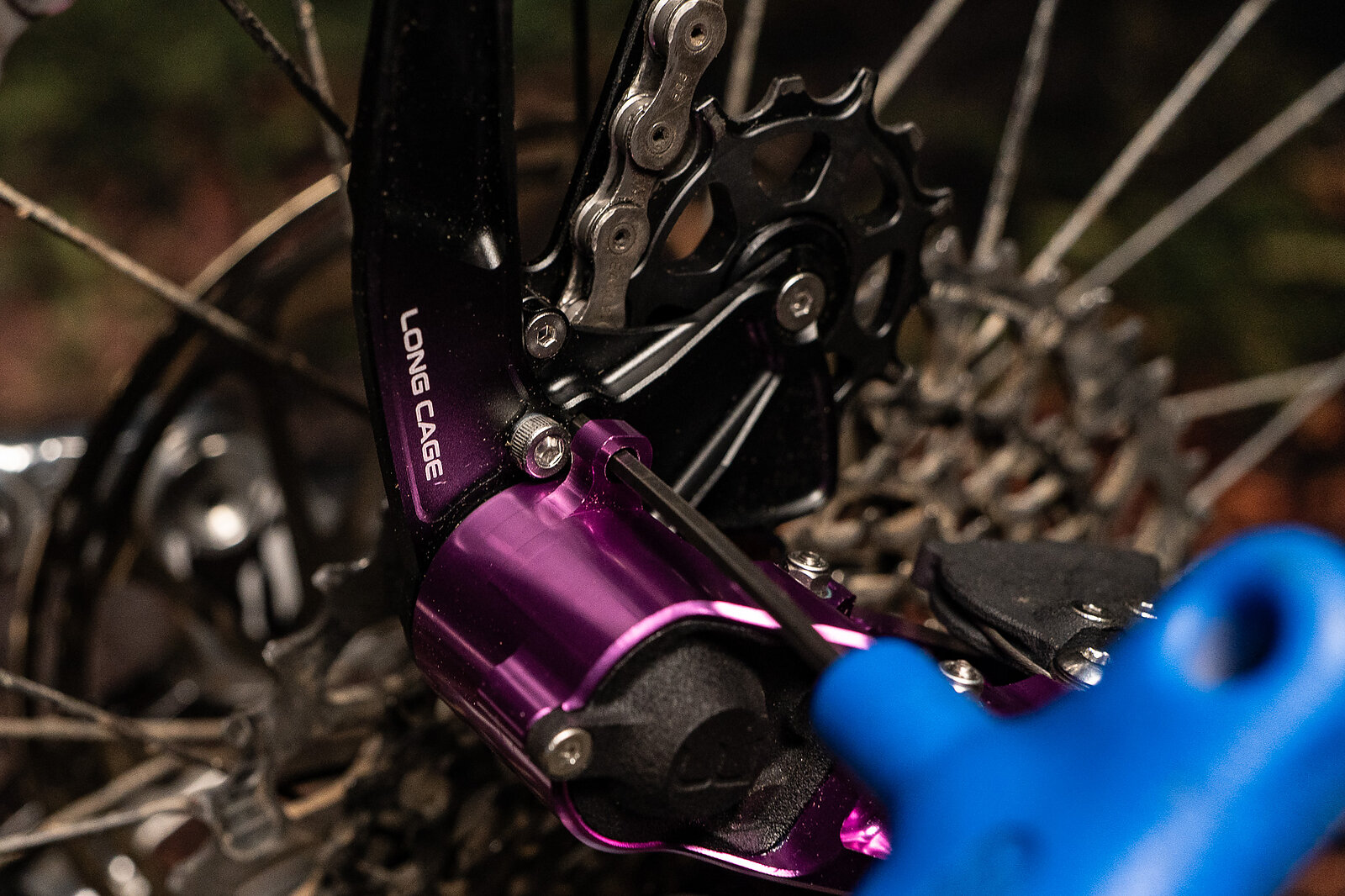
Beyond its adaptability, the Jab has the standard features you’d expect from a modern derailleur. There’s a clever allen key lock that holds the derailleur open to make for easier wheel installation and removal. The clutch itself uses an adjustable ratcheting mechanism. You can actually clearly hear the clicks of the ratchet if you pull back the cage with your hand, but I haven’t noticed the noise on the trail.
Most of the Jab is made of machined aluminum, with a plastic clutch cover. Madrone is constantly tweaking and upgrading the Jab, so it is, in some ways, a work in progress. For example, when Madrone sent me this review derailleur, they were in the process of shifting from bushings to bearings in the parallelogram. Luckily, Madrone’s super modular and user-serviceable chassis means that it’s generally pretty easy and affordable to retrofit these sorts of features at home. And, if you’ve put your derailleur through the ringer, you can send it back to Madrone, and they’ll rebuild it.
Installing the Jab
Madrone immediately endeared itself to me by offering both step-by-step written instructions and a video. I generally prefer written instructions with pictures to a video. I hate having to pause the video at the right moment while I complete a step, and my brain just doesn’t process information from videos as well as it does the written word. So it’s rad Madrone is offering both.
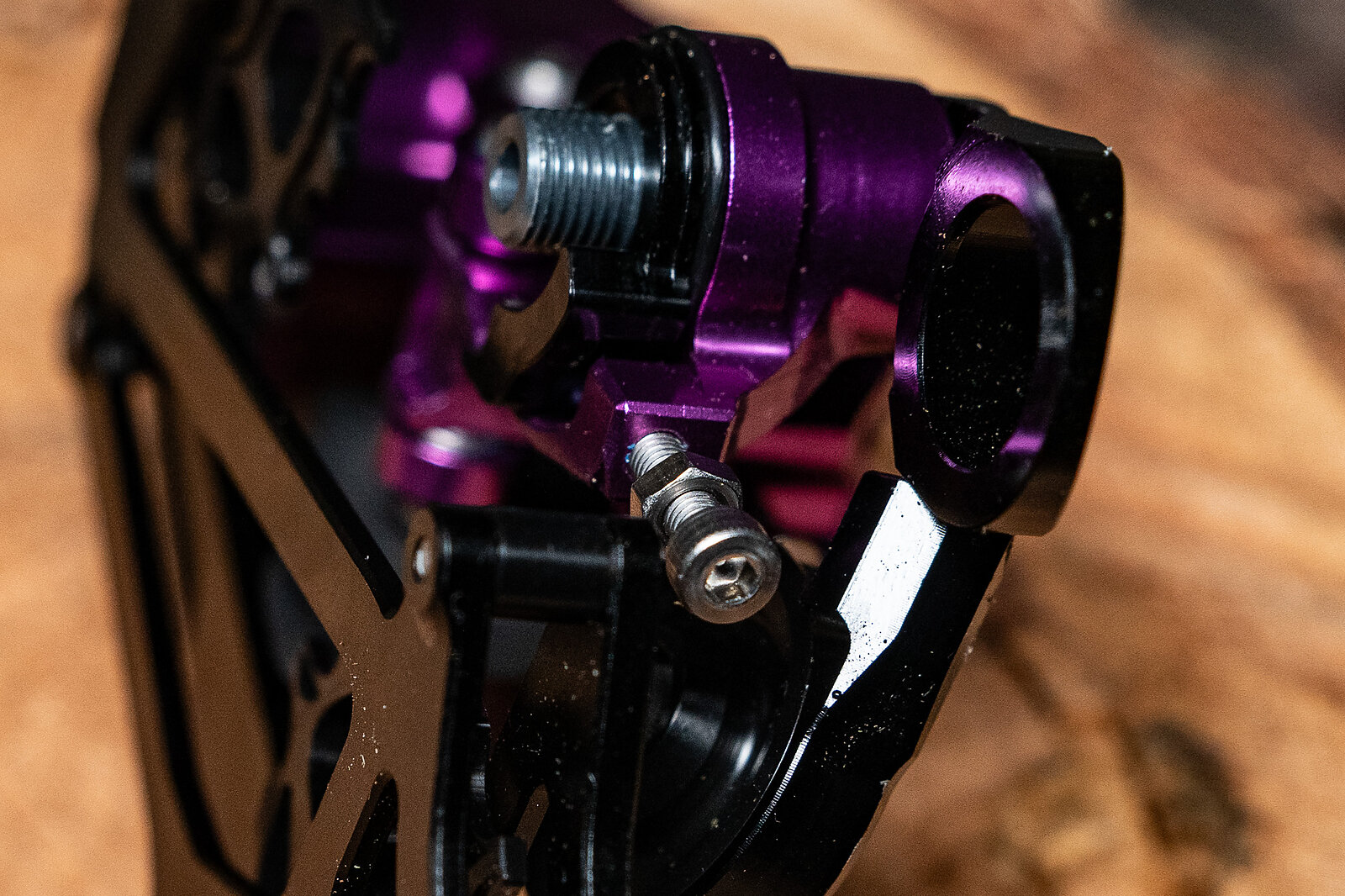
I found most of the Jab’s installation to be pretty straightforward. I’ve run it on two bikes, the Zink Vacay, and a Specialized Stumpjumper 15. The one challenge I ran into was setting the chain length and B-tension on both bikes. I found that I had to run the B-tension just a little tighter, with the cage not quite parallel to the chain like Madrone recommended. This didn’t have any impact on shifting performance though.
When Transmission first came out, I wrote about how its installation procedure used a different part of my brain than a traditional drivetrain install would. It’s much more procedural, with less troubleshooting, and fewer judgment calls than a traditional limit-screw-equipped drivetrain. It feels more like playing with Lego than setting up a traditional derailleur. And, in contrast, the Jab feels more traditional than even most traditional derailleurs. You’re making more judgement calls, especially in regard to B-tension than even Shimano’s 12 speed drivetrains because there isn’t an included plastic gap tool like SRAM Eagle used, or a marking on the cage like Shimano 12 speed uses. This isn’t a good or bad thing, and different folks will respond to it differently. For the mixing-and-matching mad scientists, this is a god-send. For the “I never want to think about or adjust my drivetrain” folks, it will be less attractive.
I do really appreciate that once you set that B-gap, there’s a lock nut on the screw so it shouldn’t self-adjust.
Otherwise, the Jab was easy to set up on both bikes, and I quickly had it slamming through gears smoothly.
Madrone Jab Performance
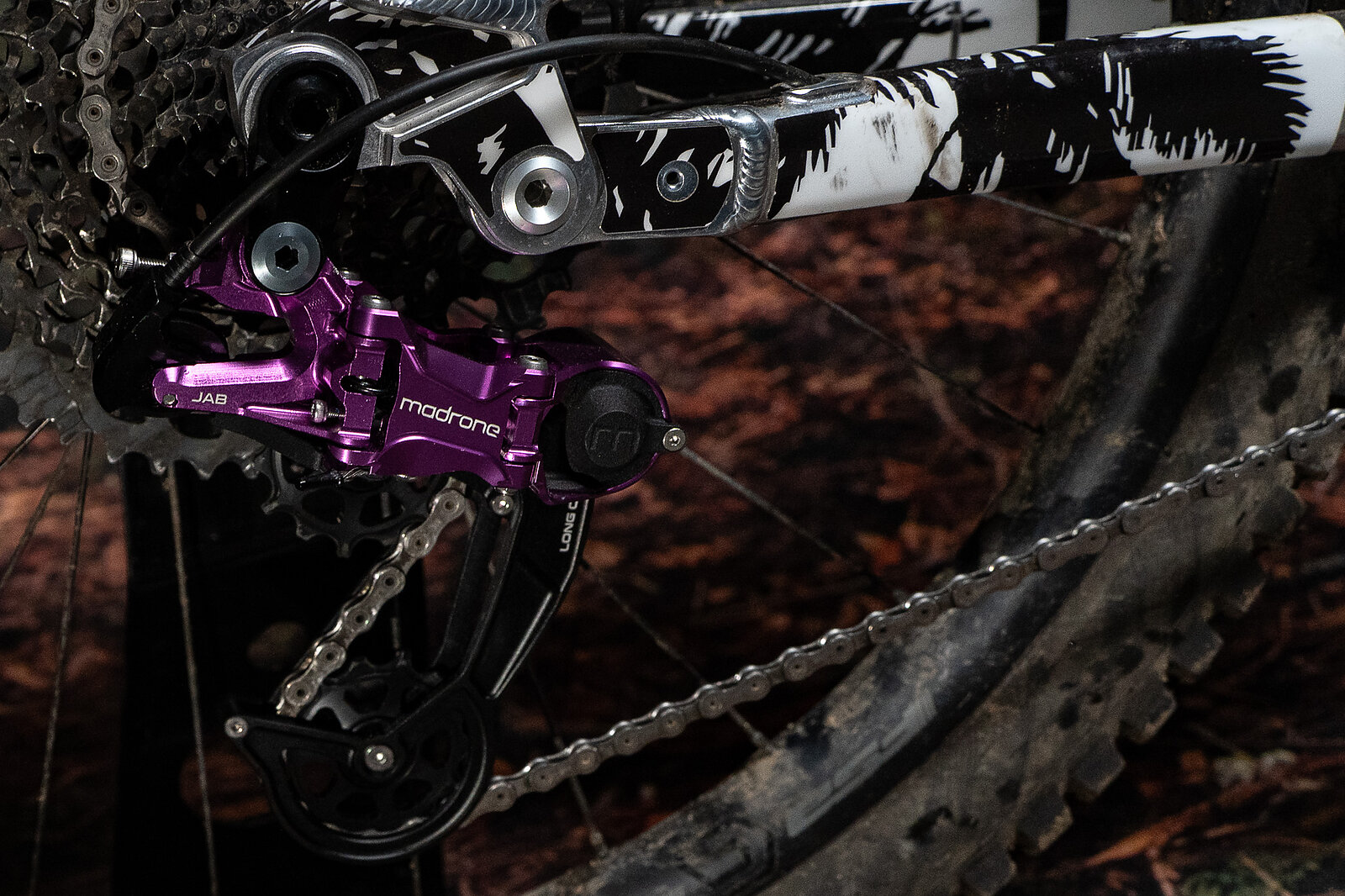
The Jab gave me an excuse to use my all-time-favorite shifter, SRAM’s XO1 Eagle option. I prefer its feel, precision, and adjustability to anything else on the market by a fair margin. The Jab replaced a (very) well-loved SRAM XO1 Eagle derailleur. That derailleur had been through a lot and was fairly loose. So I wasn’t surprised that right out the gate, the Jab delivered a much more precise and accurate shifting experience. It felt as solid, locked in, and confidence-inspiring as any non-T-Type drivetrain I’ve used. No, it doesn’t shift under load quite as well as an Eagle 90 drivetrain and, yes, I did have to consciously shift poorly to test that. For most riders, with decent shifting fundamentals on meat-powered bikes, I’m not convinced that the e-bike driven obsession with shifting under load matters that much.
Overall, I don’t see much room for improvement in how the XO1 Shifter/Jab combo shifts. It feels, and performs exactly how I want a drivetrain to.
When you’re not on the pedals, the Jab does a very good job of controlling your chain. The Zink doesn’t have a chainstay protector, and the Eagle derailleur lets the chain make a whole bunch of noise. Similarly, the alloy Stumpjumper 15 is one of the most loud bikes in terms of chain slap that I’ve ridden. The Jab did a really good job of quieting down and controlling the chain on both bikes. I’ve run six different drivetrains on the Stumpy now (GX Transmission, 90 Transmission, XTR Di2 long cage, XT Di2 short cage, TRP 12 speed, and Madrone) and the Jab did the best job of quieting down chain slap.
I haven’t gone easy on the Jab, and it’s still shifting as smoothly as ever. I’ll report back if we run into any long-term durability issues.
Value Proposition
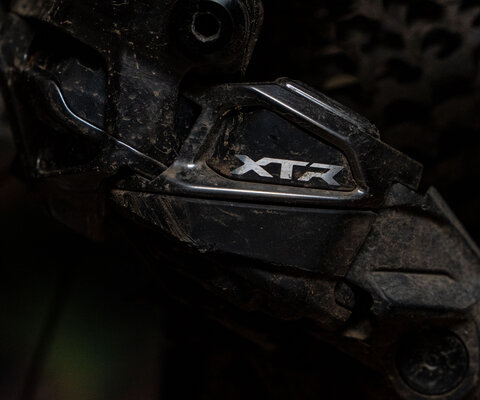
As I mentioned in the intro, I think the value proposition for a lot of folks is easy. This is a sweet-looking, assembled in the USA, future-proof derailleur. And it’s available in purple! Add to cart! For the rest of us, it’s a little more complicated. Here’s a breakdown compared to some other mechanical derailleurs: The Jab weighs 328 grams and costs $327. Shimano XTR weighs 241 grams and has an MSRP of $330. SRAM XO1 weighs 281 grams and has an MSRP of $220, and SRAM Eagle 90 weighs 395 grams and costs $190. Those MSRPs don’t really reflect actual prices though, with XTR and XO1 derailleurs available at a significant discount.
Of all those options, the Eagle 90 Transmission derailleur is the only one that gets anywhere close to the Madrone in terms of rebuildability, and none of them approach the Jab’s level of adaptability. If you see yourself owning one derailleur, and moving it from bike to bike, and from drivetrain ecosystem to drivetrain ecosystem, rebuilding it periodically, the Jab is hard to beat. It’s as close to a “forever” derailleur as I’ve used.
That said, it is worth mentioning the Ratio Technology Mech, which has a similar ultra-adaptable design to the Jab, and is meant to work with as many drivetrains as possible. I haven’t spent time on the Mech, but it weighs a claimed 377 grams, and costs a dollar per gram.
For Now
Madrone’s Jab is one of the most modular, adaptable, and good looking derailleurs available right now. It’s also a premium product aimed at a premium market. If you’re looking for a “forever” derailleur, it’s hard to ignore, and luckily its performance backs up its features.
Learn more: Madrone