Eight Degree X8-2 Pedals Do flat pedals need float?
In the pantheon of bike parts, it often feels like pedals get an outsized share of “innovation.” Perhaps it’s because they’re a touchpoint, maybe it’s due to the clipless/flats divide, and the unavoidable compromises of each, but regardless, there is no shortage of creative ideas around pedals.
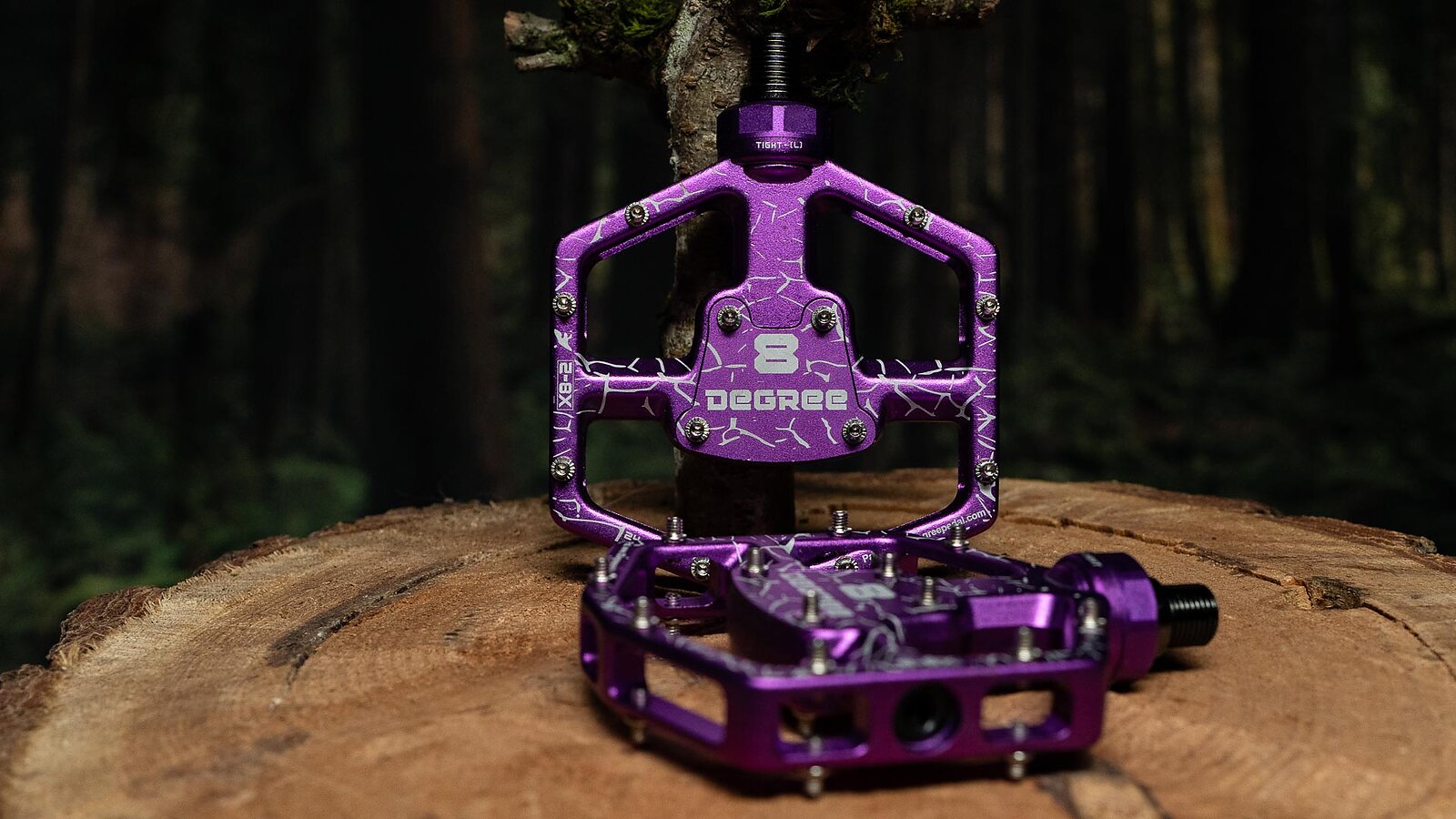
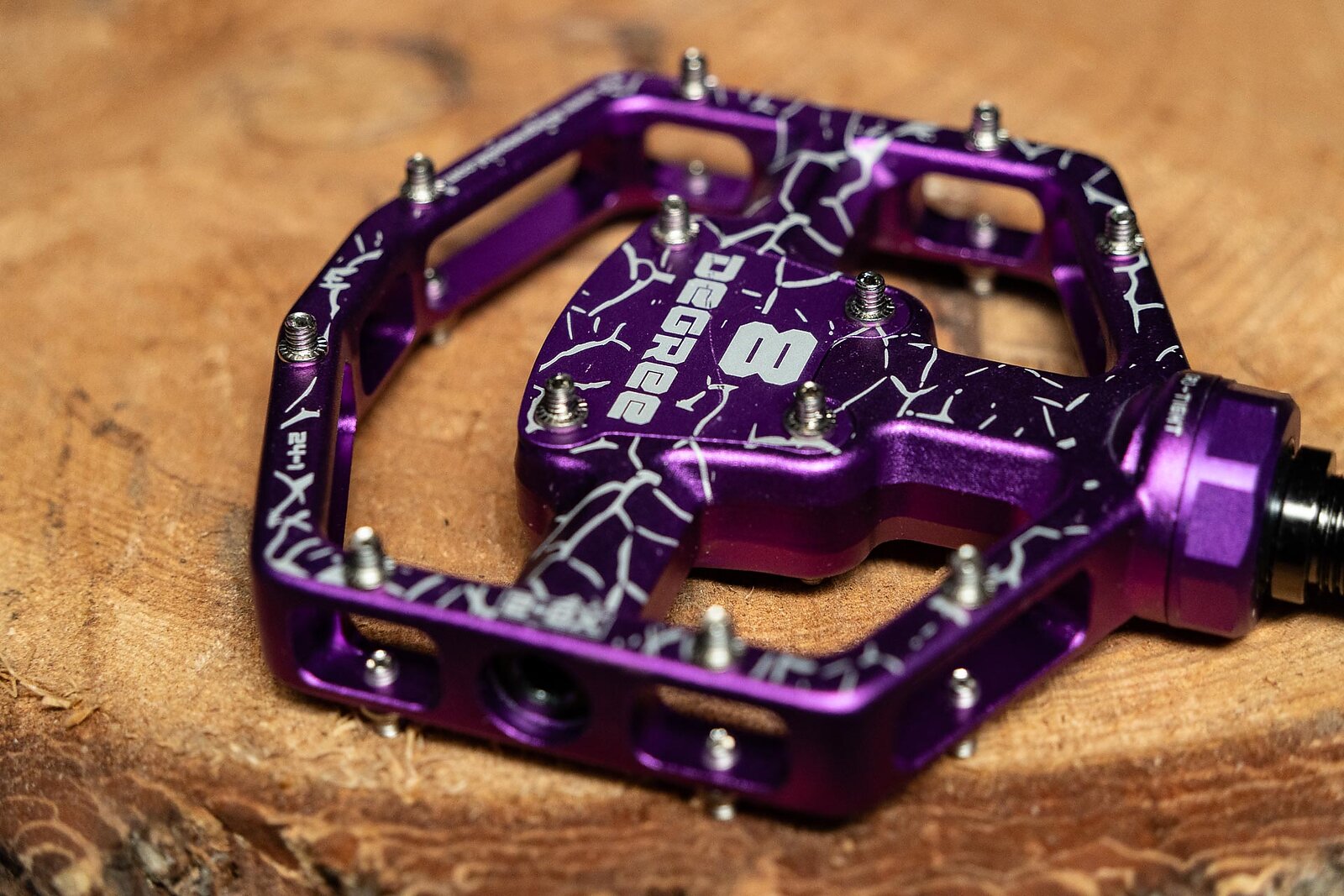
While many flat pedals try to bring the security and power transmission of clipless to flat-shoed riders, Eight Degree sets out to do something else: deliver the effortless cleat-in-clip float of clipless shoes to flat pedal riders. In pursuit of this, the brand uses a novel spring loaded system that allows the pedal to float +/- 4°. Eight Degree says that this allows for a more comfortable, more anatomically-correct pedal stroke, and that it’s especially valuable for folks with messed up knees.
Unluckily, a decade of working in the ski industry left me with dodgy knees, and I’m a big-time flat pedal connoisseur, so I was excited to try these out and test their claims.
Eight Degree X8-2 Details
- Thickness: 18.5 mm
- Size: 112 mm x 111 mm
- Bushings/bearings: 1x spherical bearing, 2x sleeve bearings
- Weight (one pedal): 236 g
- Price: $215
We all float on
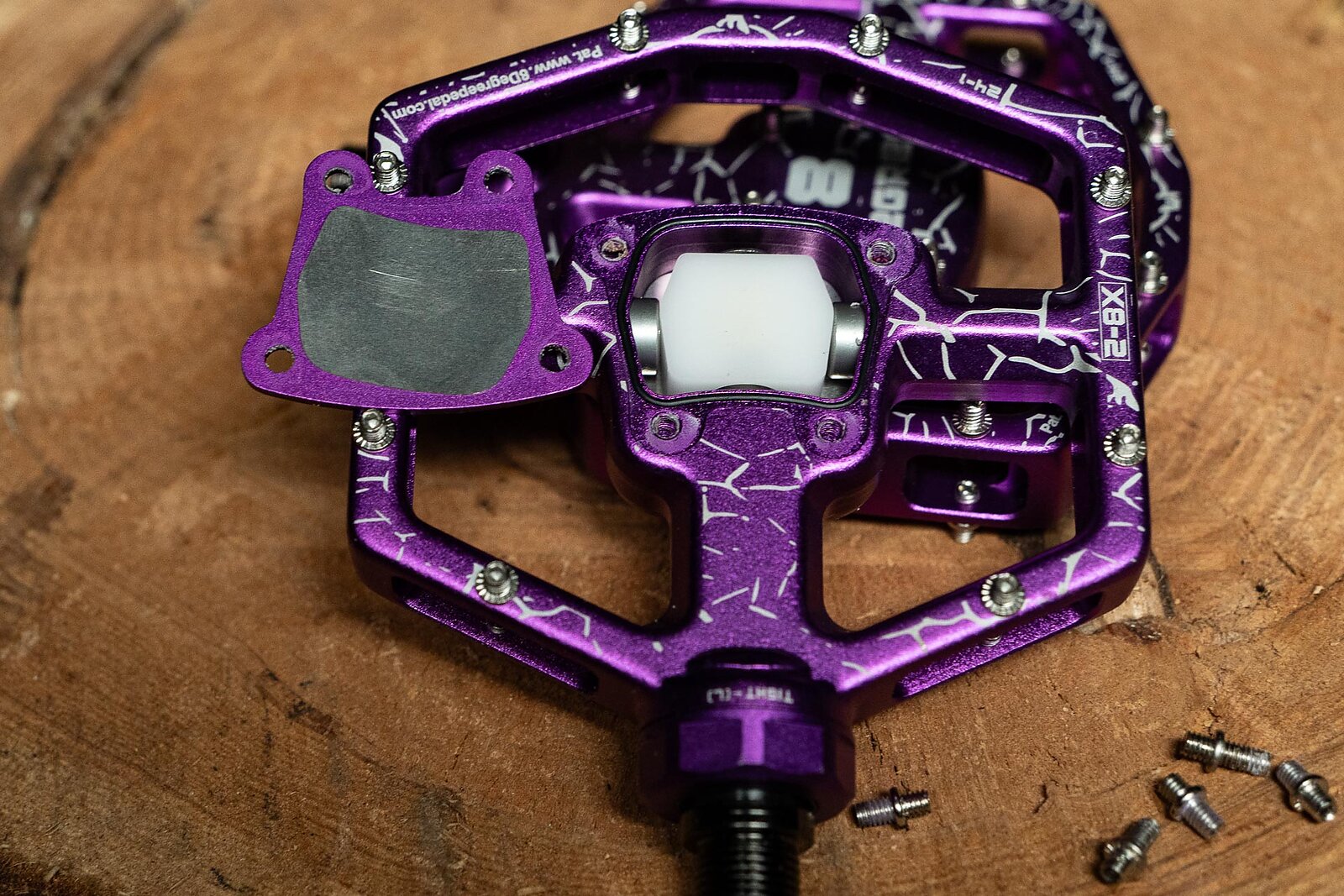
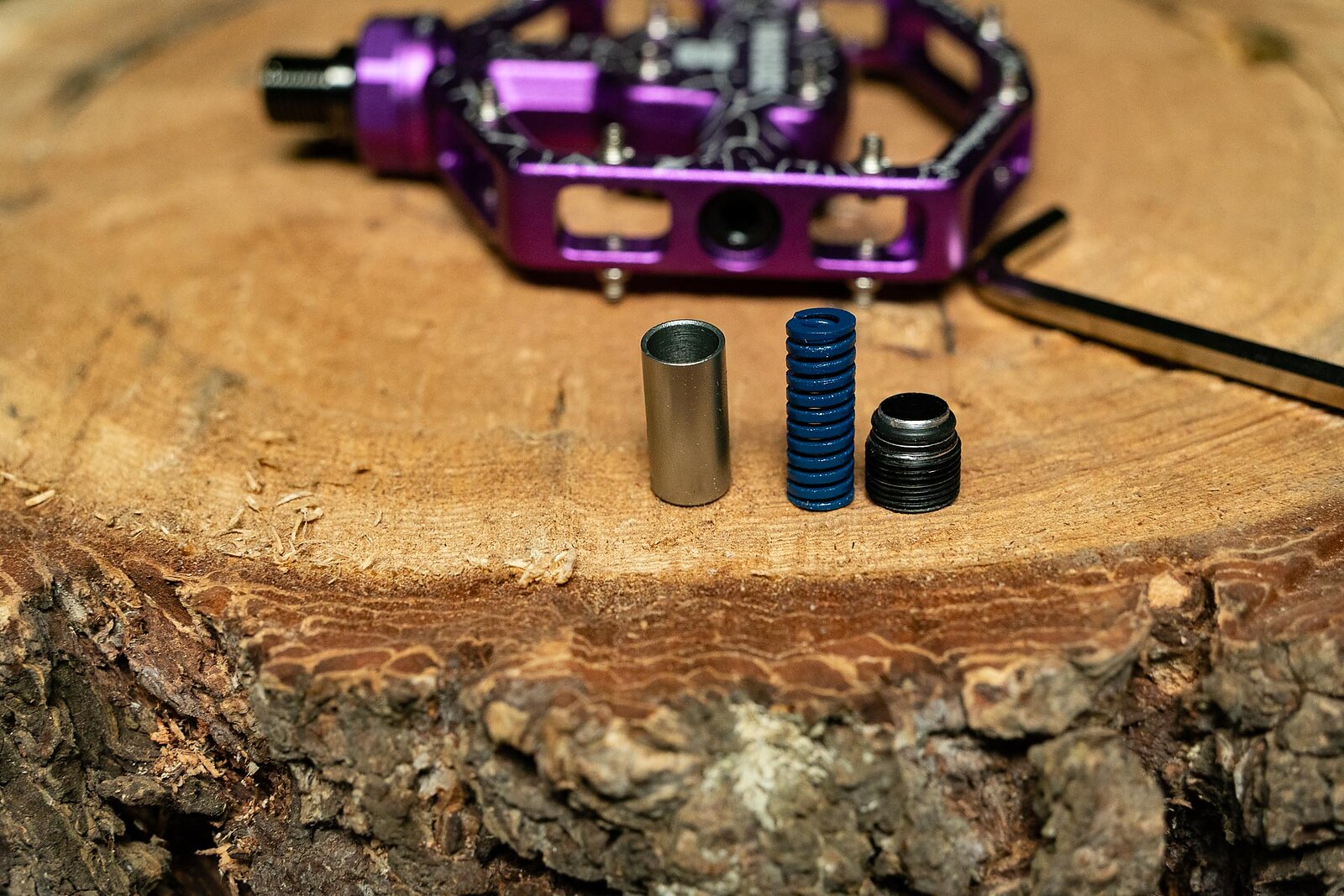
The Eight Degree pedals are available in two sizes, and I tested the bigger, X8-2 version. They use a combination of spherical bearings and a spring and block system that allows the pedal body to pivot on the axle shaft. The pedals come with the middle 30 lb spring installed, but you can easily swap to 20 or 40 lb springs, which are included, along with the tools needed to make that swap. That sounds more complicated than it actually is in practice. It’s quite easy to swap the springs, all you need is an allen wrench, and you can also shim the springs to have a stiffer preload as well. You can also remove the little door in the center of the pedal and check on the center puck.
The idea here is that your foot doesn’t naturally want to stay in one position throughout the pedal stroke, and forcing it to do so adds extra stress to your knee and ankle joints. So instead, the spring system allows it to float through the stroke, twisting naturally without adding any stress. Clipless pedals have built-in float, between the cleat and the clip mechanism, although it’s usually significantly less (4° for SPDs), and it’s not self-centering. The Eight Degree pedals have more float, but it’s more controlled, and it’s always pulling back to center, instead of allowing you to rest against the edge of it.
I started out with the 30 lb springs, and quickly moved up to the 40 lb option. The mechanism is simple, easy to work on, and does what it claims, but we’ll get into what that actually means on the trail later.
Traction
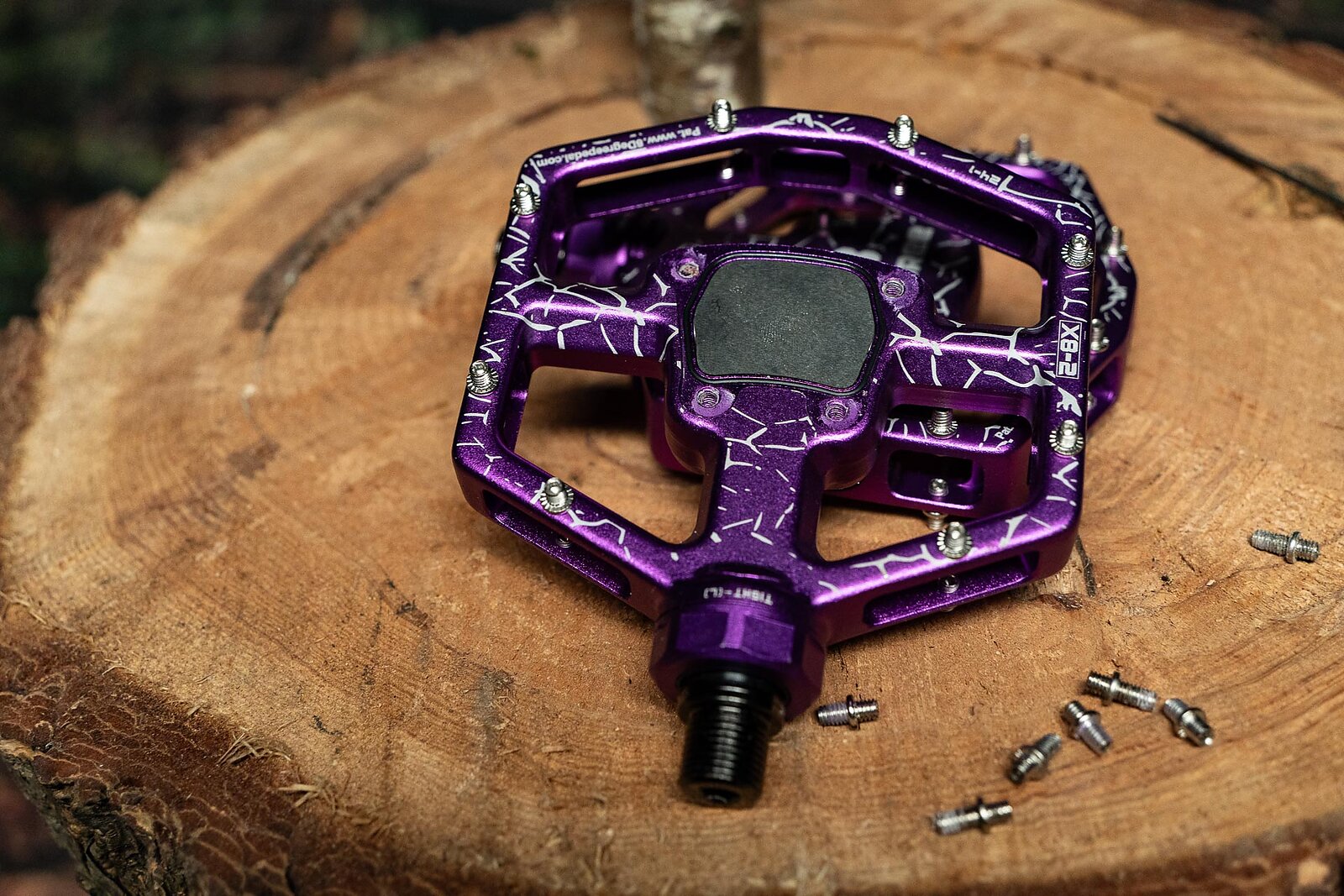
In my experience, pedal traction is the result of three things: platform size, pedal profile, and pins. A bigger platform gives you more surface area to grip, and spreads the pins out for better shoe-engagement. A concave profile allows your soul to sink in the center, and helps the pins bite better. Finally, the pin size, profile, and length matters a lot. Long, skinny pins bite better, short fat ones let you move around more.
The X8-2 uses double-sided pins that come set at the default 4.8 millimeter length, I immediately flipped mine to the 6.3 millimeter setting.
Even in that longer setting, these are far from the grippiest pedals I’ve used. They aren’t particularly big, they don’t have any concavity, and the pins aren’t very narrow and pointy, so they don’t bite very well. Even with my grippiest shoes (Specialized 2FO) I felt like they were barely grippy enough for light trail riding.
Pedal grip is a personal preference, and I definitely fall on the “give me ALL the grip” end of that spectrum, but it’s much easier to de-tune a pedal’s grip than add it. I’d love to see the next generation of these pedals come with a little concavity, or longer, narrower pins so that they can deliver a level of grip that’s comparable to other high-end flat pedals.
That’s especially true since the whole point of the X8-2 is that the pedal can float on the spindle, instead of your foot floating on the pedal. Give us all the grip so that we can eliminate that unpredictable foot float, and keep all that float in the pedal mechanism where it can be controlled.
Clearance and weight
At 18.5 millimeters thick at the edges, these aren’t the thinnest flat pedals around. OneUp’s Waves and Crankbrothers’ Stamp Evo are both quite a bit thinner, but the Deity Deftrap, one of my favorite flat pedals, has a very similar thickness. I didn’t have any clearance issues here in Bellingham with the X8-2, but I do think that would change somewhere like Pisgah, Whistler, or the Rockies, where the climbs are chunkier, and require more careful pedal placement. I’d love to see Eight Degree develop a thinner float mechanism so that the center of the pedal can get thinner, while leaving the edges the same thickness, and creating some concavity for better grip.
Finally, at 236 grams each, these are fairly heavy, but not absurdly so. Yes, you can save 50 or so grams per foot fairly easily, but that’s not really the point here.
Performance
My knees and ankles are an abomination. I spent too long reviewing ski gear, and it left me with tattered joints. And I have a pretty weird pedalling gait, that requires a quite different foot position from my descending stance. So on paper, I was a perfect candidate for these pedals.
From the first pedal stroke the float was quite evident, in a mostly negative way. It felt like I was wasting effort making the pedals wiggle, instead of spinning the cranks. I’ve bent a few pedal spindles and crank arms in the past, and this gave a similar “you don’t have your sea legs” sensation. I felt like a drunken sailor on pavement climbs. On singletrack it was less aggressive, but still there. It felt like the bike was wiggling under me, like I wasn’t connected as securely to it as I expected to be. And, while this diminished a little after spending more time on the pedals, it never went away completely. That’s probably partly because I literally wasn’t as secure as usual - all the flat pedals I normally ride deliver a significant amount of grip that these lack.
Going downhill was even more disconcerting. It made me realize how much I rely on micro-pedal-imputs to initiate turns. I’m pressuring my feet into the pedals every time I get the bike on edge, and with these pedals, that input goes nowhere. They wiggle, return, and the bike keeps going straight. It felt like skiing in too big of boots, where my foot was swimming without providing input. Similarly, on landings and compressions, it felt like the pedals were squirming underneath me, almost like a too-soft rear tire. This, combined with my already-bad ankles was disconcerting.
I experimented with running stiffer springs, and with shimming the preload. The pedals felt best to me with the spring system almost locked out, which negates the whole point of the product.
That experience prompted me to examine my relationship with flat pedals. My conclusion is that I personally get more than enough float from shoe deformation, and I don’t need to get it from my pedals. I’m a bigger guy, and can tell a huge difference in how a flat pedal shoe feels brand new, vs. after being ridden for a few months. New shoes are stiffer, and allow less float, but also make the bike feel more precise and locked in. Once they break in, they allow more float, but also less efficient power transmission. This is one of those places where I’m jealous of clipless shoes which often have stiffer soles, more robust constructions, and a more precise, secure fit.
My foot position changes quite a bit through the pedal stroke, but it does so naturally. When I lift my heel I rotate my contact patch a little bit, and keep the stress out of my knees. Similarly, when I descend, I rotate my heels in, and lock into the crankarms.
To me, riding the Eight Degree X8-2 feels like riding in too-big, worn-out slip-on shoes. It’s sloppy, imprecise, and uncomfortable. But that doesn’t mean I think they’re useless. I’m looking for more foot security than a lot of riders, and for other folks, the added float might be a game-changer.
For Now
Pedal “innovation” usually comes in the form of novel axle systems or new shapes. Eight Degree completely throws out the rule book when it comes to the X8-2, and delivers a drastically different feeling ride. How that works for you is a deeply personal question, but it’s cool to see experimentation happening in this space.
Learn more: Eight Degree