Long Time Coming Riders Stake Their Claim in The New River Gorge
West Virginia holds some of the most rugged singletrack riding in the country. While the New River Gorge region offers a slight respite from some of its more gnarly terrain, it still boasts a few of the most iconic rides in the Mountain State.
“It’s on a plateau, so there aren’t going to be super long climbs or descents,” said Andrew Forron, who lives in Fayetteville and has been riding in the New River Gorge for three decades. “I wouldn’t call the terrain super hard. There are some legitimate blacks and some hard trails around. It has amazing traction—even when it’s dry. It’s a special spot in West Virginia. It’s got good dirt, and it doesn’t beat you to death.”
That “good dirt” has seen a lot of history. Hundreds of years ago the Shawnee people hunted along the New River Gorge plateau and its steep canyon rims. More recently, Henry Ford’s mining operations hauled coal down to the river. Today, trail riders rip through dense rhododendron tunnels and jump downed trees. The Kaymoor Miners Trail used to be the only noteworthy piece of singletrack. Now mountain bikers in the area enjoy some 90 miles of trail spread out amongst rolling hills and cliff s long popular with rock climbers.
“Kaymoor [Miners Trail] was a big deal,” said Forron about the region’s scene in the ‘90s. “They were kind of similar to the structure of trails here now—at least in the same areas. Town Park had some trails and it connected over to Kaymoor. There were sketchy old log roads and doubletracks and some motorcycle trails in there.”
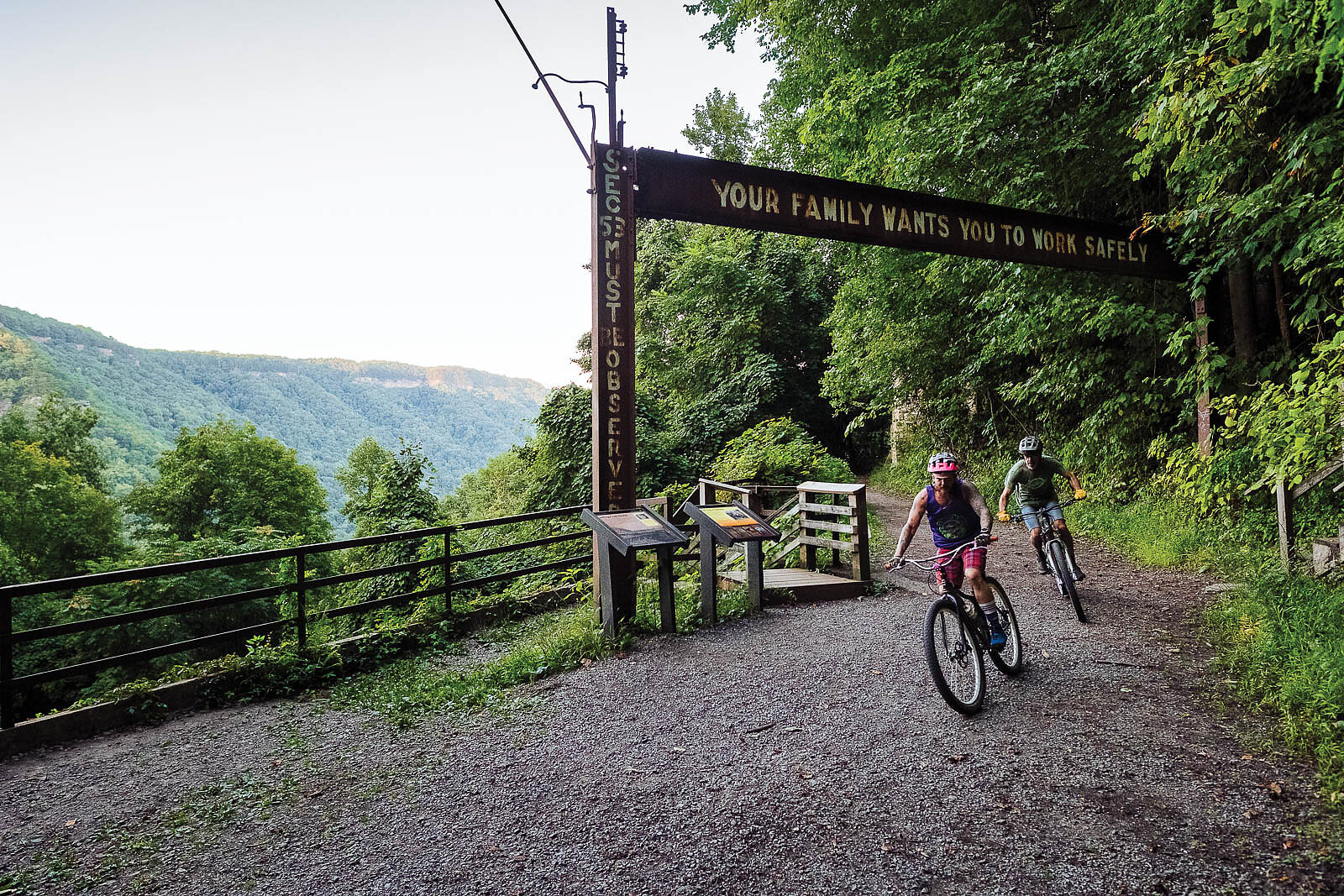
Kaymoor, as it’s referred to locally, is an 8.7-mile trail that spans partially up one side of the Gorge and runs from Fayette Station Road just outside Fayetteville to the small town of Cunard, a once-booming coal town. It’s a mix of singletrack and access road with a few hard little punches, but without too many highly technical sections. What makes Kaymoor so captivating is its numerous viewpoints and trailside artifacts of a bygone mining era—sealed-off mine entrances and a stark sign riders pass underneath that reads “Your Family Wants You To Work Safely” offer sobering reminders that this area hasn’t been a recreational haven for very long.
In fact, it wasn’t until 2021 that New River Gorge National Park and Preserve was named the nation’s 63rd national park. Prior to this inception, the National Park Service (NPS) had it run as a National Scenic River since 1978. With its fresh park designation, “the New” was solidified as a world-class destination for tourism and outdoor recreation. That designation, coupled with the boom in remote work that sprung from the COVID-19 pandemic, has sparked new growth and energy in the small town of Fayetteville—population 3,000—which sits at the entrance to the New River Gorge.
While the abundance of federal land has boosted the New River Gorge’s sightseeing and casual tourism appeal, it hasn’t always made things easy for local mountain bikers, especially those wanting to build trails better suited for bikes.
“It took a long time for trails to get here,” says Forron from his house in Fayetteville. “We had one trail, then we started cutting our own.”
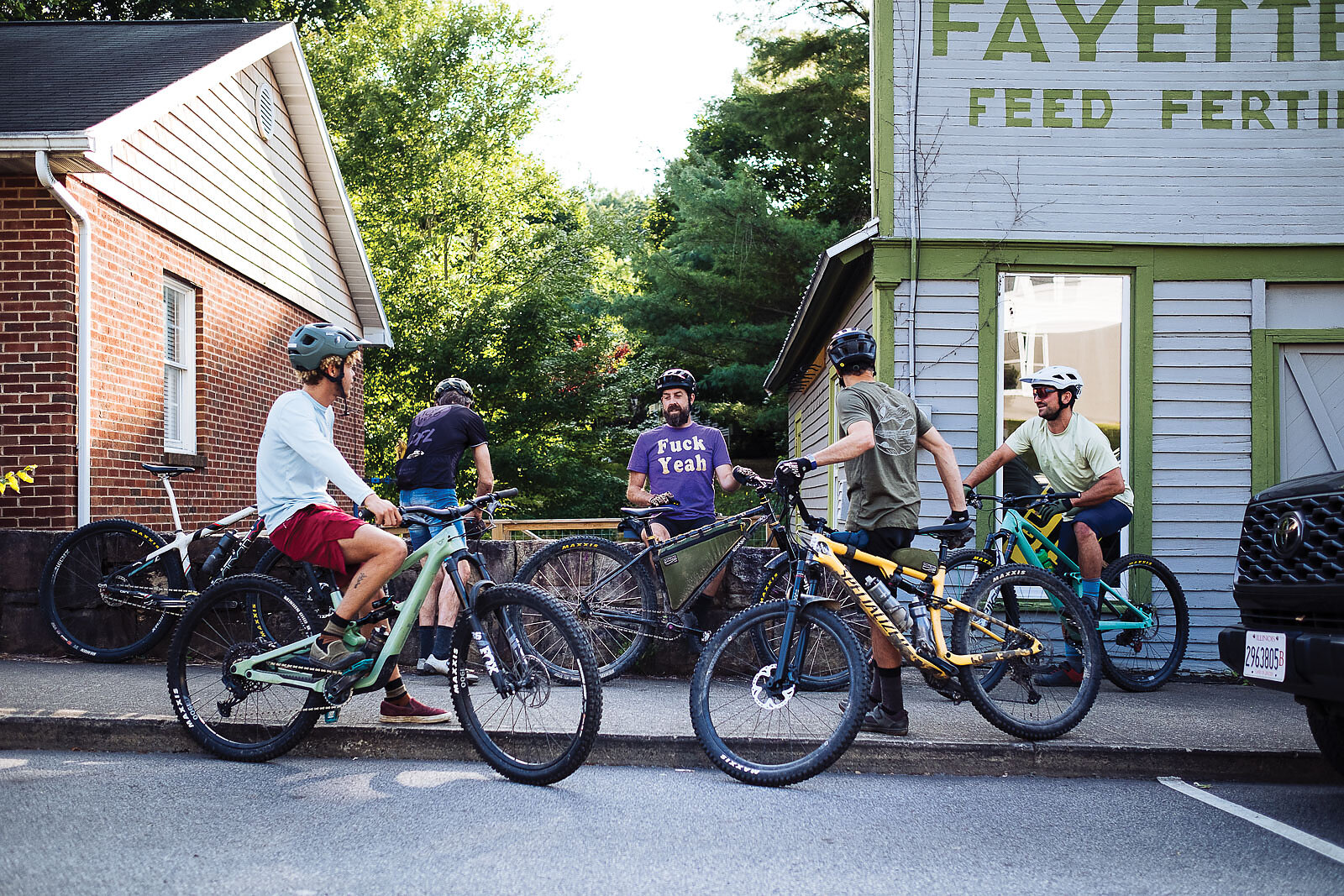
Forron has been at the center of the mountain biking scene in the New since its start. His bicycle shop, New River Bikes, which he worked at in his youth under its former name, Ridge Riders, is a bicycle museum. The space is full of character—mounted animals, Eddy Merckx bikes hanging from the walls and ceilings, baby doll heads, and figurines of the late Motörhead frontman, Lemmy Kilmister, make it a must stop for any mountain biker. Mention Forron to just about any rider in the state and they’re likely to have a story about him.
Unsanctioned trails, also known as “pirate” or “social” trails, Forron says, were an integral catalyst to bringing about more singletrack in the New. Park service employees would routinely stamp out bits of trail discovered on their land, but word was already out among riders across West Virginia that the area had some gems.
“There was a great little scene here,” Forron says about the riding in the ‘90s and the 2000s. “There were some pretty fast people. There were people winning the West Virginia Mountain Bike Association series and the 24- hour races going on. There were a couple scenes around the state and it [the New] was one of them.”
The region’s growing mountain biking scene and general appetite for outdoor recreation legitimacy in the New was finally met in 2011 when more than 1,000 members of the Order of the Arrow (OA), the Boy Scouts of America’s National Honor Society, partnered with the International Mountain Bicycling Association and the NPS to create the Arrowhead Trail system, a 12.8-mile stacked loop trail network in the area of Craig’s Branch. This purpose-built mountain bike system—the first ever on National Park and Preserve land—was one of the largest youth service projects in NPS history. The scouts provided 78,544 volunteer hours, valued at $1.6 million, to build the trails that year.
Morgan Hartsock, The New River Gorge National Park and Preserves Road and Trail Maintenance Supervisor, says there are 40 National Parks that allow some form of bicycling on their properties, but that the Arrowhead Trail Systems was the first of its kind.
Fayetteville native and bike industry professional, Josh Feazell, recalls those early days of Craig’s Branch before its acquisition by the NPS. He remembers back when the area was owned by various private landowners and when dirt bike and pirate trails were scattered all around what is now Arrowhead.
“A lot of the trails here started off as being dirt bike trails,” Feazell says. “A bunch of bootleg stuff became Arrowhead.”
Feazell says one trail in particular, LeCroy, was pieced into the machine-built trail system of Arrowhead. LeCroy was worked into the system after decades of being burnt in by kids riding dirt bikes behind houses to visit their friends. Now it’s one of the most iconic trails in the New and acts as a connector to Arrowhead from the Timber Ridge and Fayetteville trails. LeCroy spans 1.8 miles and is an intermediate blue trail with fun rock features and a couple of descents to get rowdy on. There are alt-lines to get around rock features and some chill climbing—about 328 feet when heading south.
“It’s a good connector trail and good intermediate-level singletrack,” Feazell says. “It has natural sandstone features.”
The Arrowhead Trail system was a way to legitimize and get more people interested in mountain biking in the New, said Abbie Newell, who moved in 2011 from central New York, and then started mountain biking.
“For me, as a newer rider, it was an awesome opportunity to check out a new area and get my feet underneath me,” says Newell, who is the president of local trail advocacy group, Fayette Trail Coalition. “Arrowhead helped me and others get a little bit more experience on a mountain bike and I think it brought more people here for that purpose.”
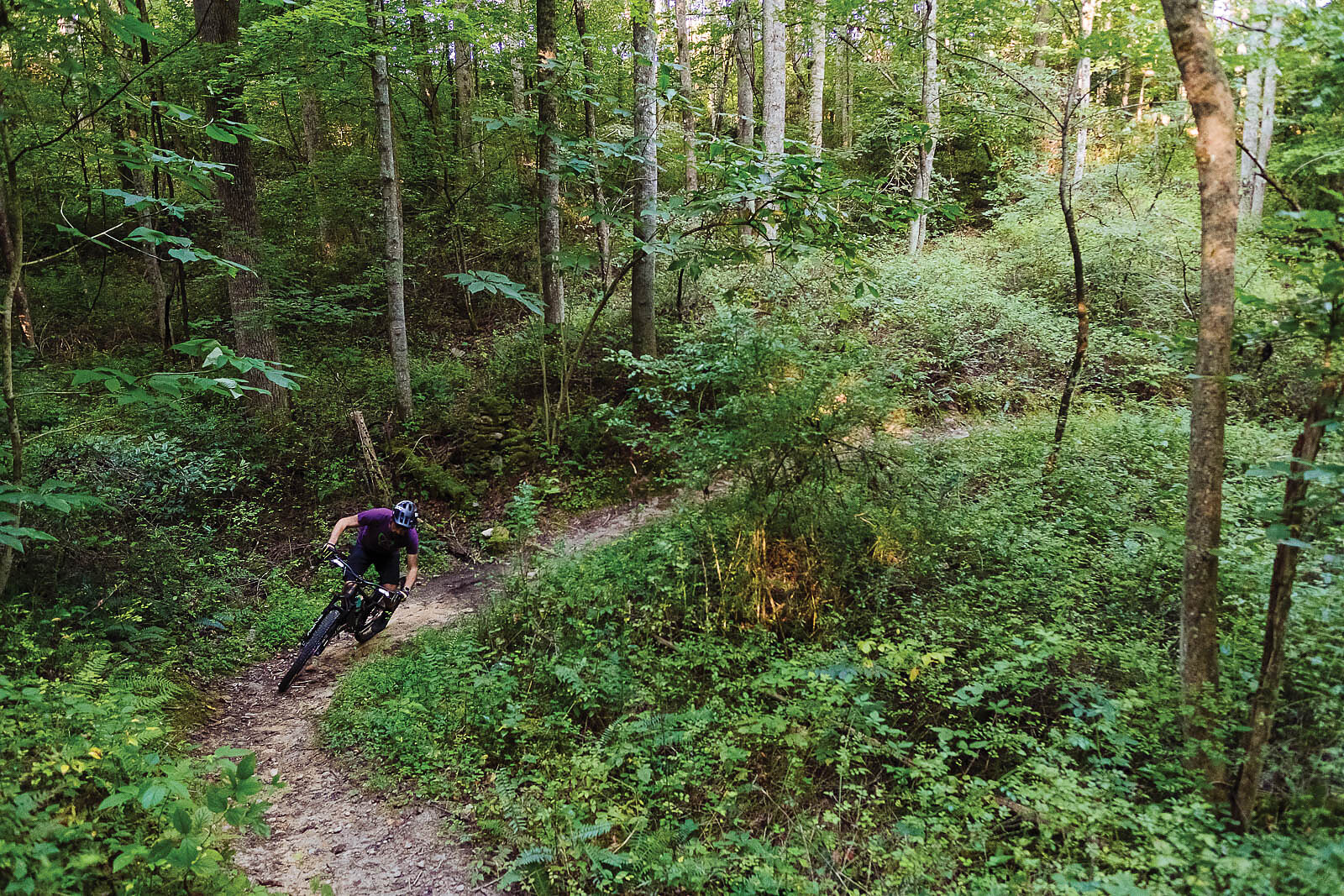
In a growing trail scene, the opening of Arrowhead was a massive leap forward. The system was ideal for introducing the sport to people due to its beginner and intermediate levels of trail riding. It was also a great way to link the trails in the park to a system made for mountain bikers.
“Once those trails went in there were a number of people who got really into bikes,” said Forron. “It’s a purpose-built mountain bike trail system—first one of those we’d ever had—and it certainly opened the door for a lot of people.”
The Fayetteville Trail is one of the oldest in the New. It’s 3.7 miles long with 1,227 feet of descending and 482 feet of ascending if riding from Kaymoor Top heading east to west. From the top of Kaymoor a speedy descent on wide, rocky trail comes before narrow singletrack through shrubs and hemlocks. There is a small creek crossing on Butcher Branch with a newly built bridge by the NPS. The following ascent is one of the hardest in the New with a climb through hemlocks to a tight switchback and back up. Once at the top, riders cross Long Point Trail which offers one of the best views of the Lower New and the New River Gorge Bridge—the longest steel span in the western hemisphere. Crossing that trail, Fayetteville Trail continues to a fun descent and another creek crossing before the eventual thrill of descending Chicken Wire, an especially fast section of trail. The climb up Fayette Station Road is paved and crosses U.S. 19 before popping back into Fayetteville.
“One thing I think that defines the culture here is the challenge of the terrain we have,” said Mike Boyes, a veteran rider since the early ‘90s who moved to Fayetteville to get closer to its mountain bike scene in 2015. “Mountain biking is hard in these conditions, so you really have to be pretty damn good to try to bike here.”
Boyes’ svelte frame is unassuming, but he is hands down one of the strongest riders around. He is known for shaping social trails and riding things most people couldn’t walk let alone ride. There is an ongoing local joke that if someone mentions his name three times he will appear anywhere. It’s people such as Boyes—solely focused on riding mountain bikes and bettering their scene—that lay the foundation for strong bike communities.
“Social trails are one of my desires I seek to ride a bike on,” Boyes said. “I try to find time to myself to shape and ride them. I think a lot of social trails, if they’re not used and legitimatized, are just going to disappear. Trails need users.”
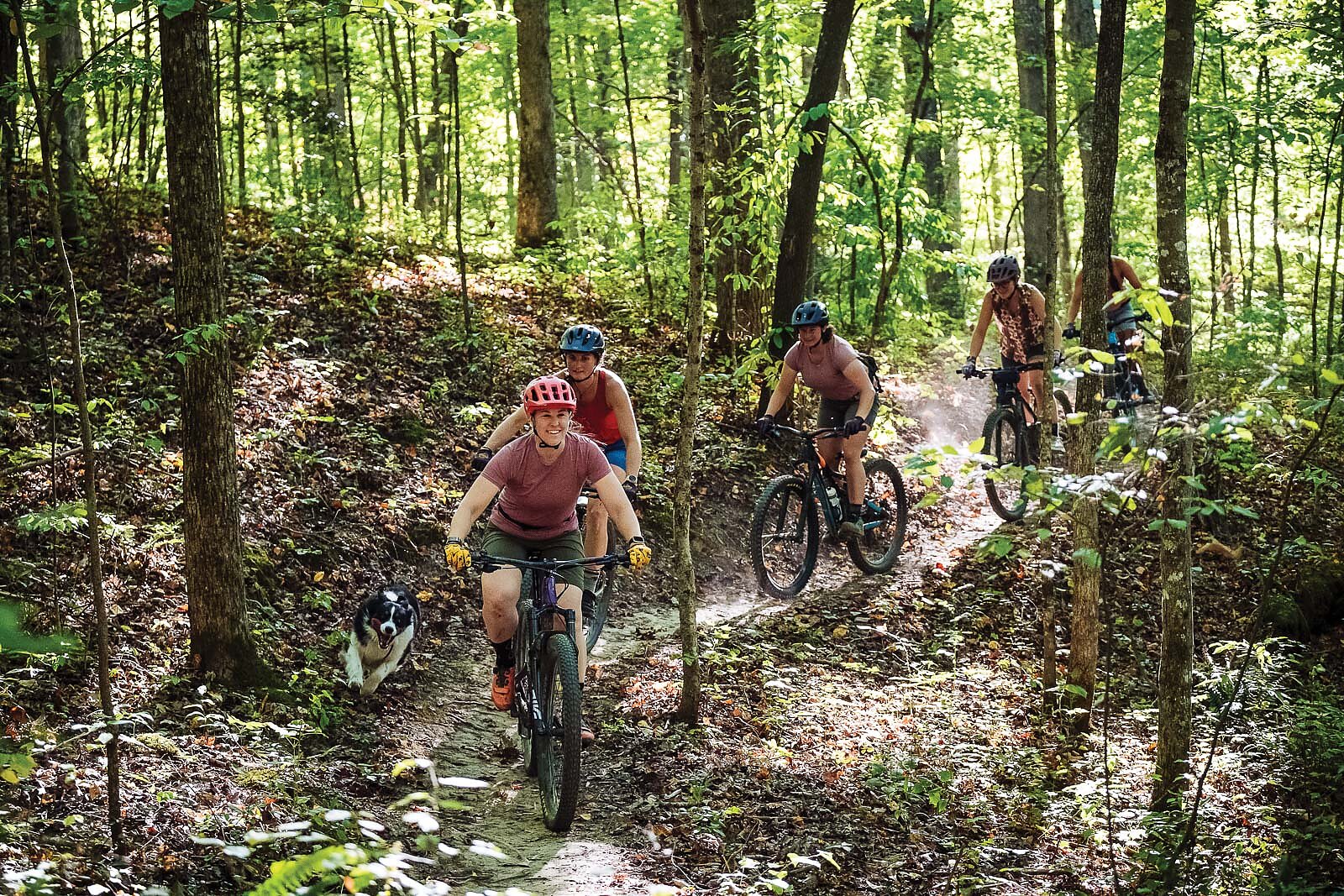
Part of the challenge of maintaining a steady stream of users on trails in the New is the fact that residents have a cornucopia of other outdoor activities to choose from right out their backdoors. Summersville Lake holds amazing deep-water soloing (free climbing above water), endless bouldering and climbing routes can be found scattered across the gorge, and the New and Gauley rivers both sport sections of class V whitewater. With so many ways to get outside, it’s only natural that a fair share of athletes will gravitate toward other pursuits besides mountain biking.
Forron said mountain biking is something most people in town did, but that it was never truly anyone’s main sport, except for a few. After the whitewater boom in the ‘90s, the region is gaining rapid notoriety as a one of the best climbing spots on the East Coast.
“Now we’re in the midst of this rock climbing thing,” Forron said, “But [mountain biking] has always been something that everybody that showed up in town did, which is kind of cool—there’s mountain bikes in every garage.”
In the late 2010s, nearly a decade after the grand opening of Arrowhead, a feeling that mountain biking could be on the cusp of its own boom began to take hold. This underlying fat tire latency sparked local trail advocates Gene Kistler, Andrew Forron, and Sam Chaber, along with a host of other residents, to begin packing county commission meetings in support of a new purpose-built mountain bike trail system.
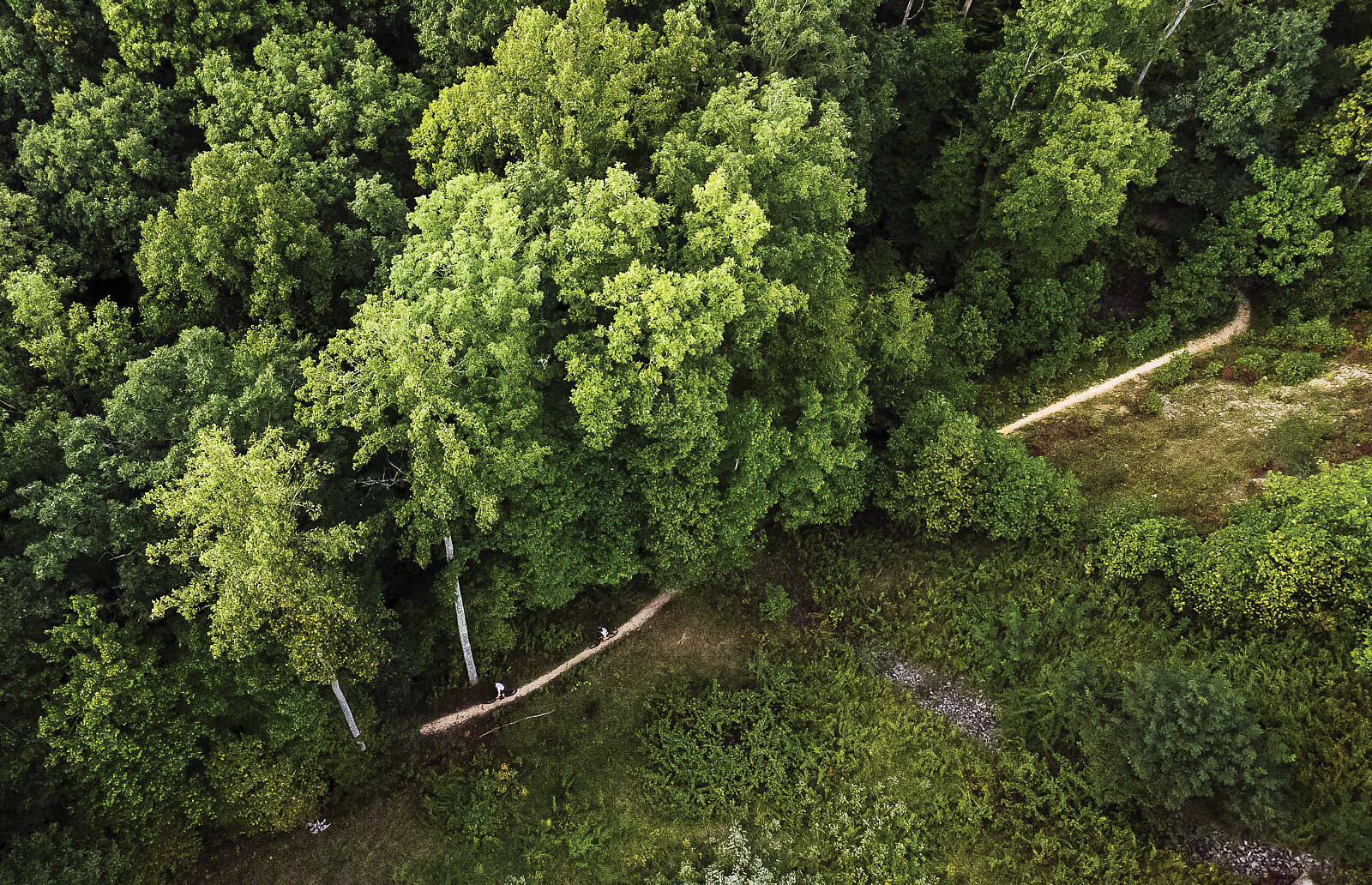
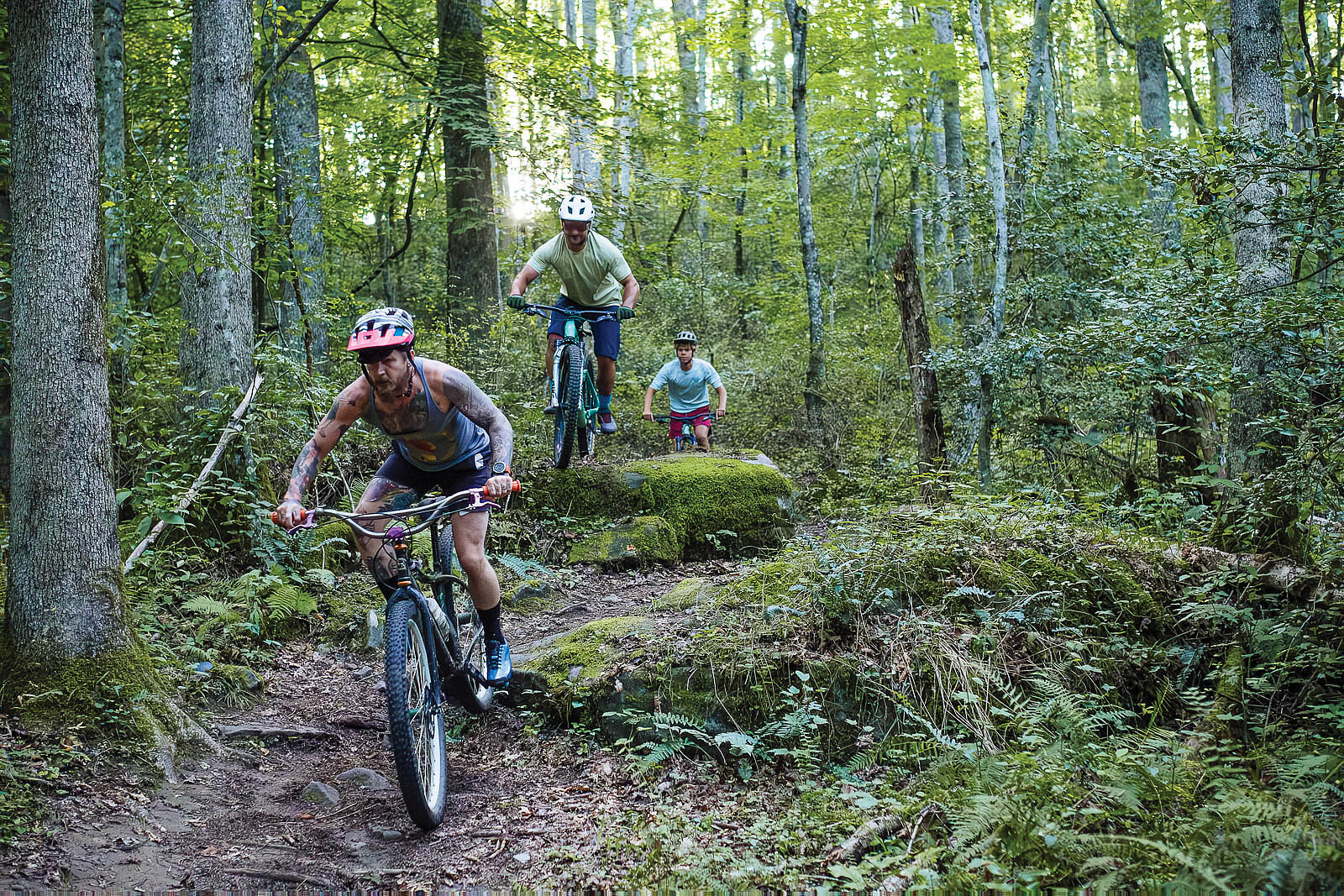
These community members pushed Fayette County’s Urban Renewal Authority to get behind a proposal for a new trail network built on a piece of land owned by the county called Wolf Creek Park. This area would eventually become home to a business park, residential houses, a brewery, and rolling wooded terrain with purpose-built mountain bike trails. For many in the local riding scene, the opening of the Wolf Creek system was the defining moment that legitimized the New as a modern destination for mountain biking. Today, Wolf Creek Park Trails is a 14- mile stacked loop trail system with features ranging from the green beginner trail of Marauder to the endless rock garden black trail of Moonshine Hollow.
“Wolf Creek bumped the riding up even more,” Forron said. “We’ve always known that we had the terrain, we just didn’t have the access to build trails or make them legal.”
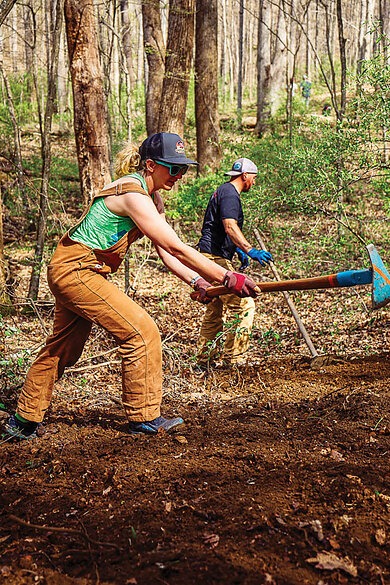
Fayetteville resident and longtime trailbuilder Sam Chaber was awarded the bid to build the Wolf Creek Park trails, which cost $150,000 from reallocated coal funds. Chaber said he and his dedicated team saw an outpouring of support from the community during volunteer trailwork days while building in 2020.
“By building Wolf Creek Trails, we stepped it up a little bit for this area of what we had to offer,” said Chaber while sipping a beer at Bridge Brew Works near the Wolf Creek Park trailhead. “We always had a lot of trails, but nothing was very mountain bike specific. And I think with this build and design we kind of brought it to the next level of thinking about mountain bikers—how they want to ride, what they want to ride—and trying to use the terrain in our favor and make things fun and exciting and hone your skills and better yourself as a rider.”
Wolf Creek has brought a massive influx of mountain bikers to town, Chaber says. He notes that, on most weekends, there’s a noticeable number of out-of-state plates on cars at the trailheads. The challenge now is keeping up the momentum.
“Wolf Creek trails changed things,” Newell says, adding that Fayette Trail Coalition was formed after Wolf Creek’s trails opened to ensure there is a focused measure on continuing what the new county trails started. “It’s awesome to be able to drive downtown and see more cars with bikes on them and have that visibility and hopefully that’s planting seeds in people’s brains."
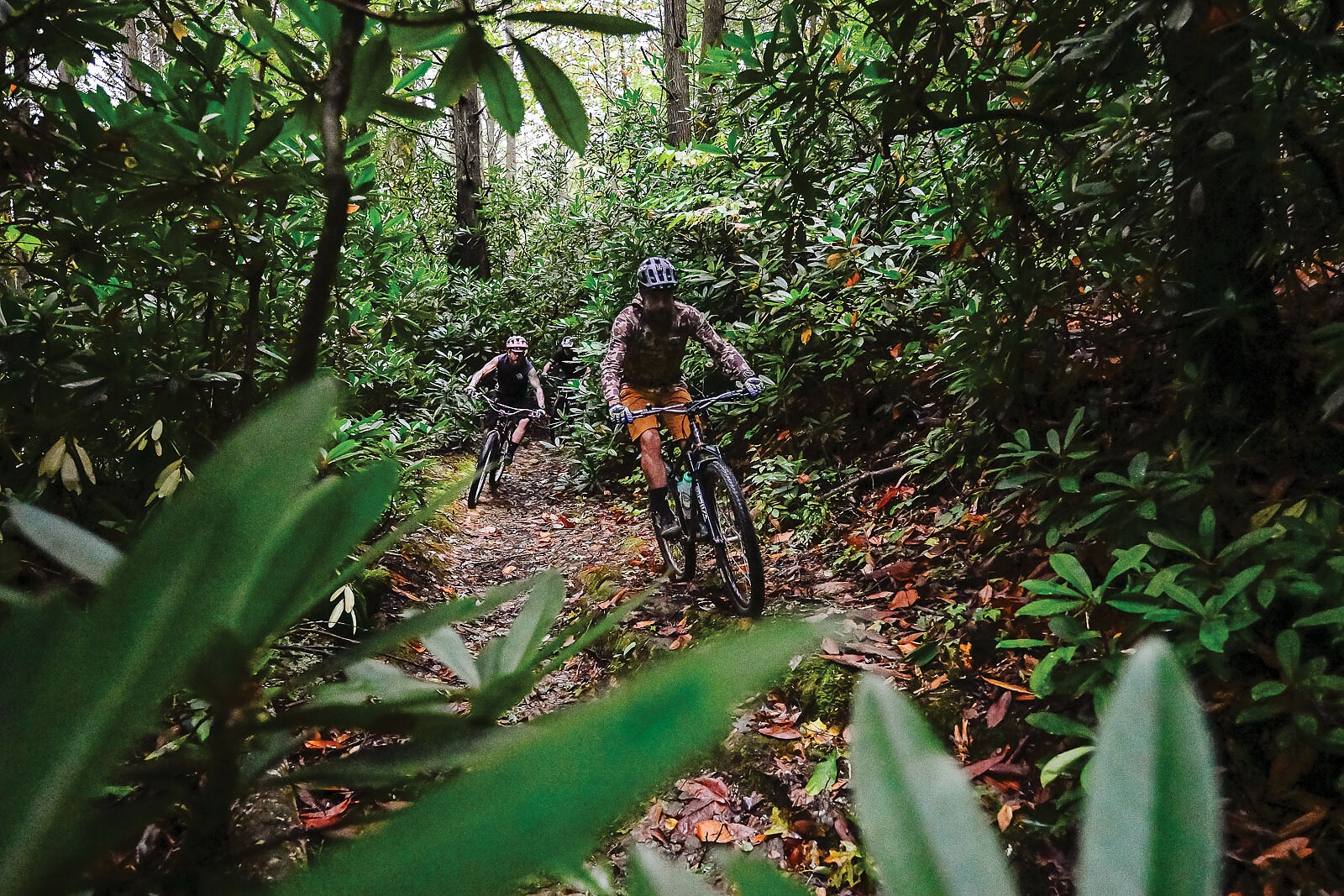

Farther from town, about an hour’s drive from the New to the gold dome of the West Virginia state capitol building, the riding at Kanawha State Forest (KSF) acts as a perfect counterpoint to contemporary trails. In fact, KSF remains one of the state’s best kept secrets. It’s a classic—a brute system of old-school singletrack. One trail advocate and local rider, Josh Harrison, defines the terrain as “rustic.”
“It’s a very dynamic trail system with steep ups and steep downs,” said Harrison of the over 50-miles of trail at KSF. “There’s very rarely a time on singletrack that you can sit back and relax and it makes the trail system fun and exciting.”
The KSF scene is solid, Harrison said, with a good mix of riders. This is evident on the decades-old Thursday night group ride that usually sees at least 30 people consistently show up from spring through fall. Harrison said due to the steep and rocky terrain the folks who attend all tend to be more advanced.
One must-ride trail at KSF is Black Bear. It’s a 1-mile-long black downhill trail that has seriously steep turns and rocks—lots and lots of rocks.
“The best and worse thing about Black Bear is its completely dynamic,” said Harrison. “The lines change pretty much every ride. You have to be on your game and see the line and keep up right. I ride a hardtail and I like it because it makes me really have to focus on how the trail can change which makes it epic.”
Despite its colorful history, it seems like riding in the New is still just getting started. Nowadays, a four-property county plan is in place to continue developing trails. FTC has begun construction on a volunteer- built, green 3.5-mile trail at Fayette County Park, which has a couple thousand acres of mountainous terrain. FTC also helped facilitate a pumptrack build by Velosolutions at Fayetteville’s Town Park and is waiting for an additional skills park to break dirt there. The group also secured funding for Rock Solid Trail Contracting’s build of an 8-mile green trail with some progression lines at Oak Hill’s Needles Eye Park (7 miles from downtown Fayetteville) that should be finished by spring of 2025. There are also plans for a second phase of trails at Wolf Creek Park. The mountain biking community itself also continues to thrive.
The local National Interscholastic Cycling Association league is only getting more popular, which Forron and Newell help run in the county. The team has grown since its inception a couple of years ago and now some parents are getting mountain bikes, riding more, and traveling to check out other trail areas.
“We’re at a moment when everything is kind of exploding,” Newell said. “There’s also a huge tourism push in the state for outdoor economics and the development that comes with that. We have the natural rock climbing and the whitewater—you can’t build that. But you can build trails.”