A Beautiful Beginning Bhutan’s First Female Riders Learn the Ropes
The stray dogs can’t believe their luck. Minutes after we skid to a stop on this remote mountain shelf, the air fills with the aromas of spiced dahl, beef stew, and a concoction made of cheese and chilies called Ema Datshi.
Instead of lounging in the dust or bothering birds, the dogs get to beg for scraps from 13 riders and their support crew as we sit on lush grass and enjoy this mid-ride feast. We’re not at a cafe or restaurant either—this meal has been lovingly cooked several miles below, driven up piping hot, then served onto real plates from the bed of a truck. The dogs might be happy, but we’re in heaven. Welcome to mountain biking in the Kingdom of Bhutan.
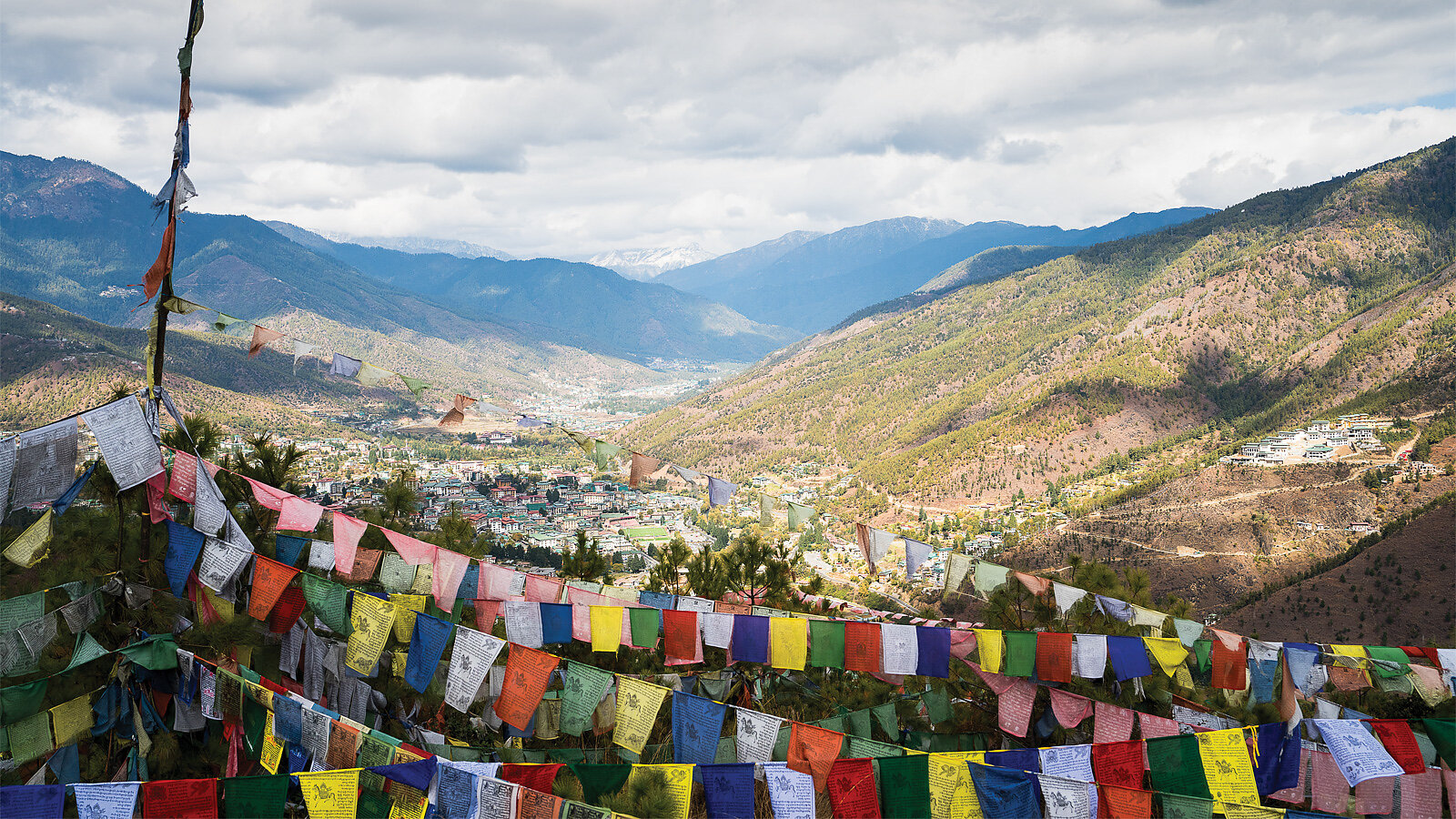
You’d be forgiven for not knowing exactly where Bhutan is, or perhaps not even knowing it exists. This is one of the world’s smallest and most remote countries. It’s a land of steep, mountainous forests, crisscrossed by powerful rivers and capped with the imposing peaks of the eastern Himalayas. Just fewer than 800,000 people live in an area slightly larger than Kentucky and this modest, profoundly Buddhist society is a world away from the commercial cacophony of, say, Kathmandu in neighboring Nepal.
Thankfully, that leaves hundreds of miles of raw, ungroomed mountain singletrack for adventurous riders to explore. Bhutan’s local mountain bike scene is tiny, with perhaps only 30 or so serious riders, but the prospect of descending multiple Himalayan peaks that have barely been touched is drawing more and more people here every year, and companies like our hosts, Bhutan Rides, are sending international visitors home with huge grins on their faces and tall tales to tell. You can’t just show up and start riding though. Prospective visitors must apply for a visa through a registered tour company, and Bhutan’s government charges $100 each day, per visitor, to help offset the impact of tourism. (Full disclosure: Visit Bhutan waived our fees to aid in production of this article as well as an upcoming short film about our trip.) As demand for tours and guides grows, it presents a unique opportunity to shape the kingdom’s riding culture from scratch.
Julie Cornelius is a veteran mountain bike guide and skills coach based in Moab, Utah, as well as the founder of a nonprofit called World Ride. For the past eight years, she’s used mountain bike tourism as a force for social change. From Tanzania to Chile, Botswana to Nepal, Cornelius’ mission is to train as many local women as possible to be guides so that local people can recognize the economic and social benefits of mountain biking for women, and international visitors can experience new destinations through a female perspective.
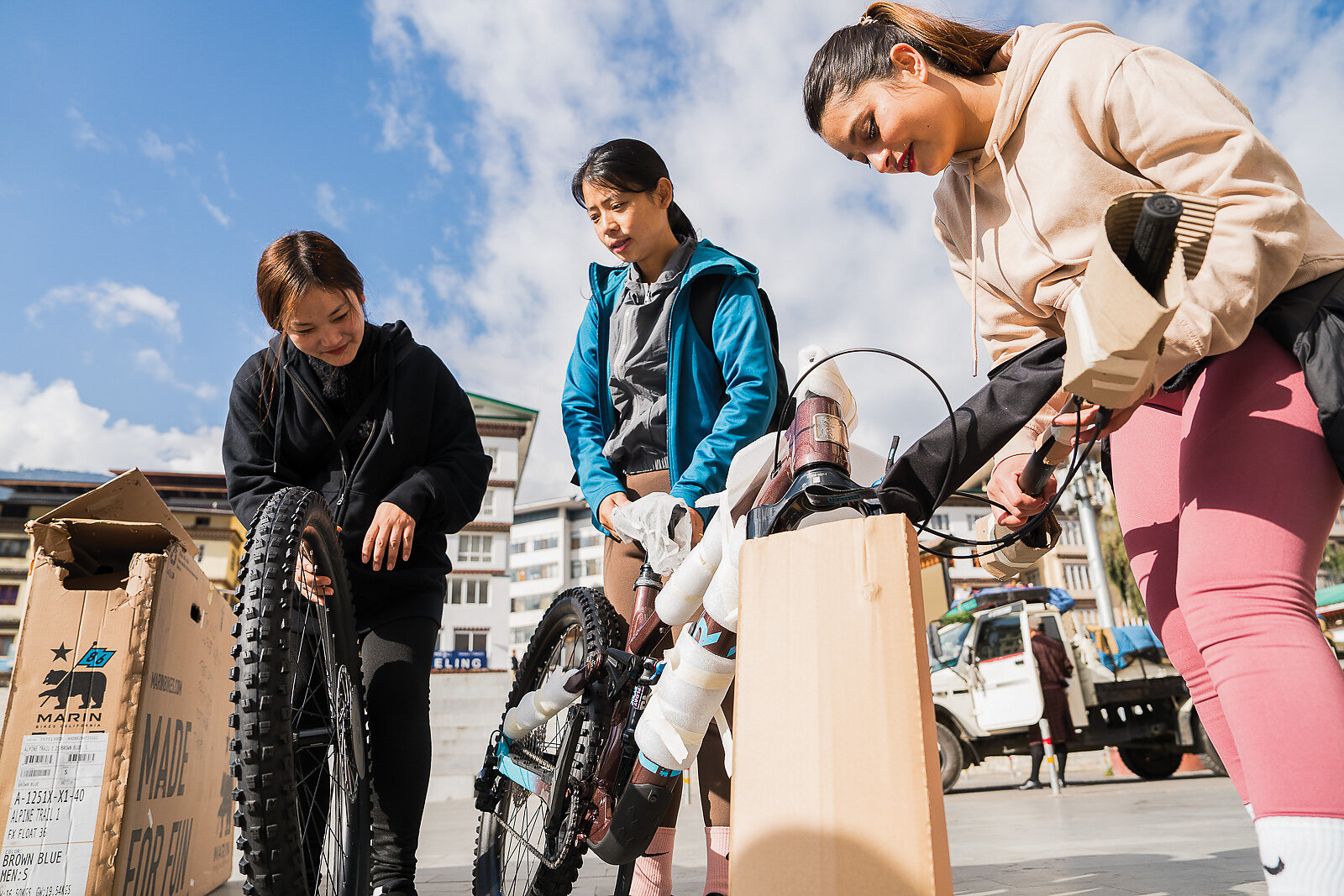
This is her first official trip to Bhutan, and she’s due to meet four Bhutanese women who hope to become qualified mountain bike guides. On our first morning in the capital, Thimphu, we wait nervously in the frosty sunshine, sharing a town square with some sleeping dogs and curious old men. We’ve never met or spoken to any of the four women who’ve volunteered to start training as guides, and we know next to nothing about them, except that they’re absolute beginners. When Dawa, Khusala, Tshering Dolker and Tshering Zangmo arrive, there’s a lot of nervous laughter and bright smiles. They only know one another slightly. Us, not at all. But when Cornelius brings down two brand-new, boxed Marin bikes and a bunch of donated gear from Shimano and Osprey, things really kick into gear.
She asks the women to help her build up the bikes, and it instantly breaks the ice. They forget about the cameras and pounce on the components like a Formula One pit crew. They’ve never seen a brand-new mountain bike before, let alone worked on one, but Cornelius transforms the foursome into an instant team as they unbox the bikes, admire their beauty, and immediately start putting them together.
Pelden Dorji is our host and guide for this trip and worked with Cornelius to find and recruit the four Bhutanese women. As we watch them fit bars to one of the bikes, he leans over.
“This is the beginning of women’s MTB in Bhutan,” Dorji says. “Right here.”
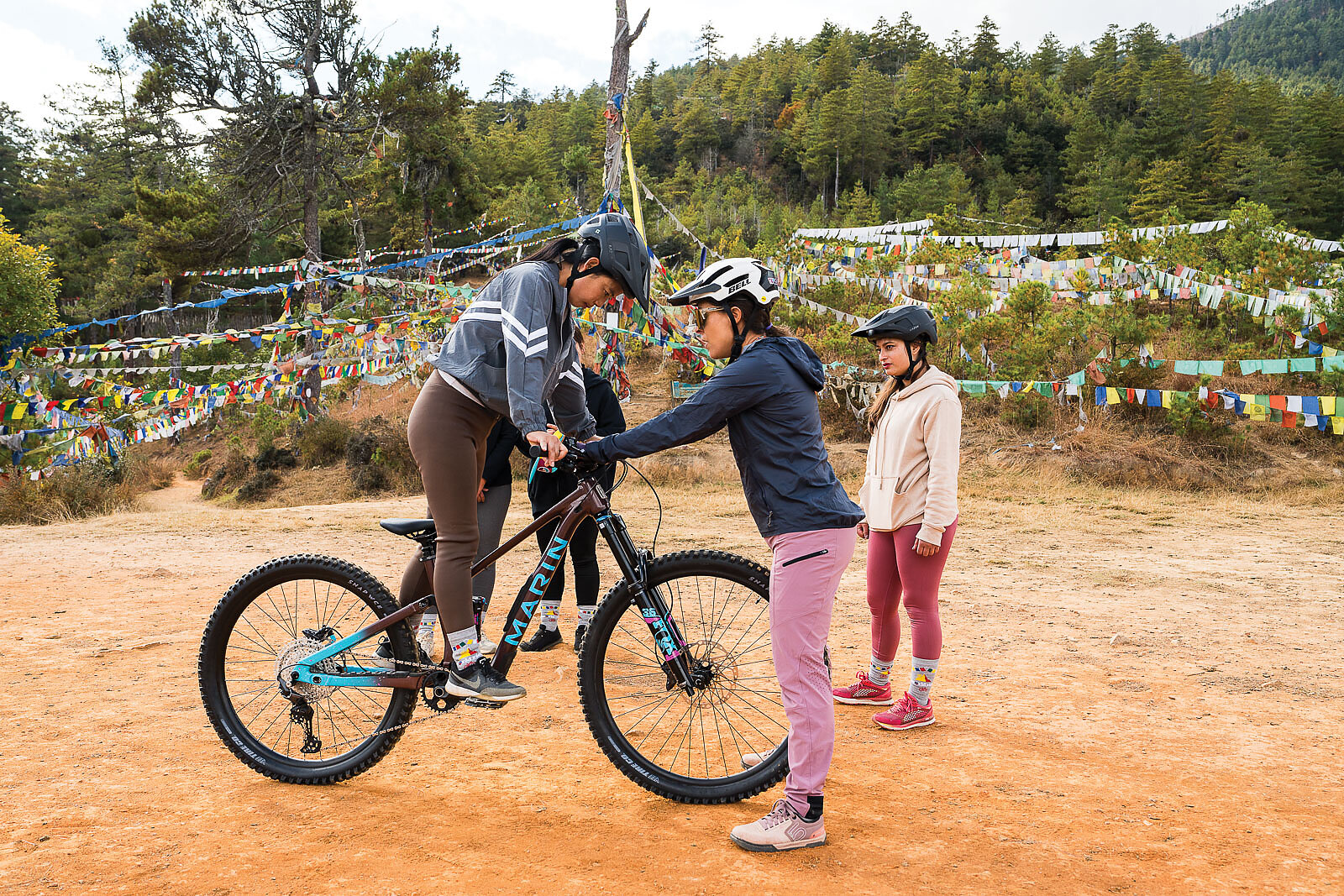
Cornelius’ passion for teaching is infectious. Within minutes, our volunteers start coaching each other, running alongside as they take turns on the bikes, shouting encouragement and instruction, hands hovering over saddles like nervous parents. Every stumble, every false start, every abrupt stop just gets soaked up as they push each other on and, by the time we stop for lunch, we’ve got ourselves a team. Cornelius is grinning from ear to ear.
They may be taking their first mountain biking baby steps, but Cornelius is determined that they all get to feel some dirt under their wheels on day one, so we throw everything into a couple of wheezing diesel trucks, leave the town square behind, and head up to a trailhead just above Thimphu for an off-road skills session. The progression is fast-paced as Cornelius demonstrates proper body position, braking technique, and how to stand up on the pedals while rolling. A giant, 150-foot-tall Buddha gazes down on us from its position in the crook of a mountainous valley, and the setting sun catches dust thrown up from tires—it’s hard to imagine a better start for any beginner. All four volunteers are buzzing, and when we reflect over a cup of tea later in the evening, Kurshala’s joy is evident.
“Today, when I was in the mountains, I was so proud of myself,” she said. “Especially when I was coming downhill, I was so nervous—I could hear my heart beating so hard. That was the greatest achievement of my life today, honestly. It was so much fun.”
In an ideal world, we’d have spent the whole of our trip with Dawa, Kurshala and the two Tsherings to provide an intensive 10-day masterclass, but they’ve all got full-time jobs and families. Cornelius finances this type of hands-on training by bringing a gang of paying, foreign guests along for a mountain biking holiday of a lifetime, and they need looking after too. So, we join them on day two, with plans to meet up with the volunteers for one more day of coaching at the end of the trip.
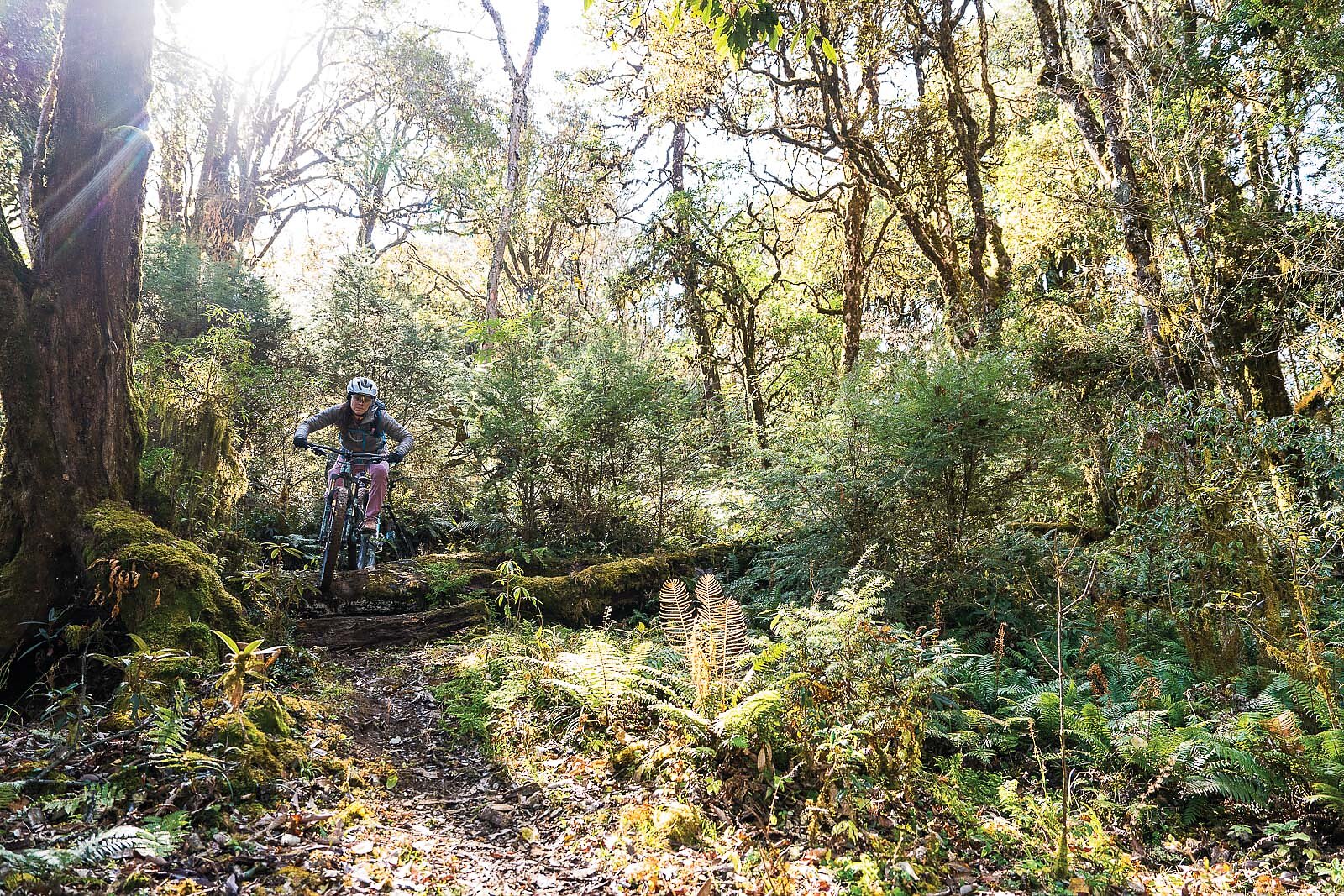
If watching people learn to ride in Bhutan is a privilege, getting to ride here is a dream. More than 70 percent of Bhutan is mountainous forest, with temples nestled in the folds of hillsides and wheat and rice farms forming jagged patchworks at lower slopes. There are hundreds of miles of natural singletrack in this small section of the country we’re touring between Paro and Punakha, and we’ve been promised descents of 9,000 feet or more in a single run.
Those promises come true. For the next eight days, Pelden and his crew lead our merry band of bikers down many thousands of feet of raw, wild, and natural singletrack that never seems to end. We ride through 20-foot spider webs slung between ancient cypress trees, and slide from ice patch into snowmelt mud, through slimy rock chutes in the cold mornings that become dusty red bowls of dirt by sundown. We burst from dense forests into sweeping valleys festooned with prayer flags, as smoke from cooking fires drifts across the skyline.
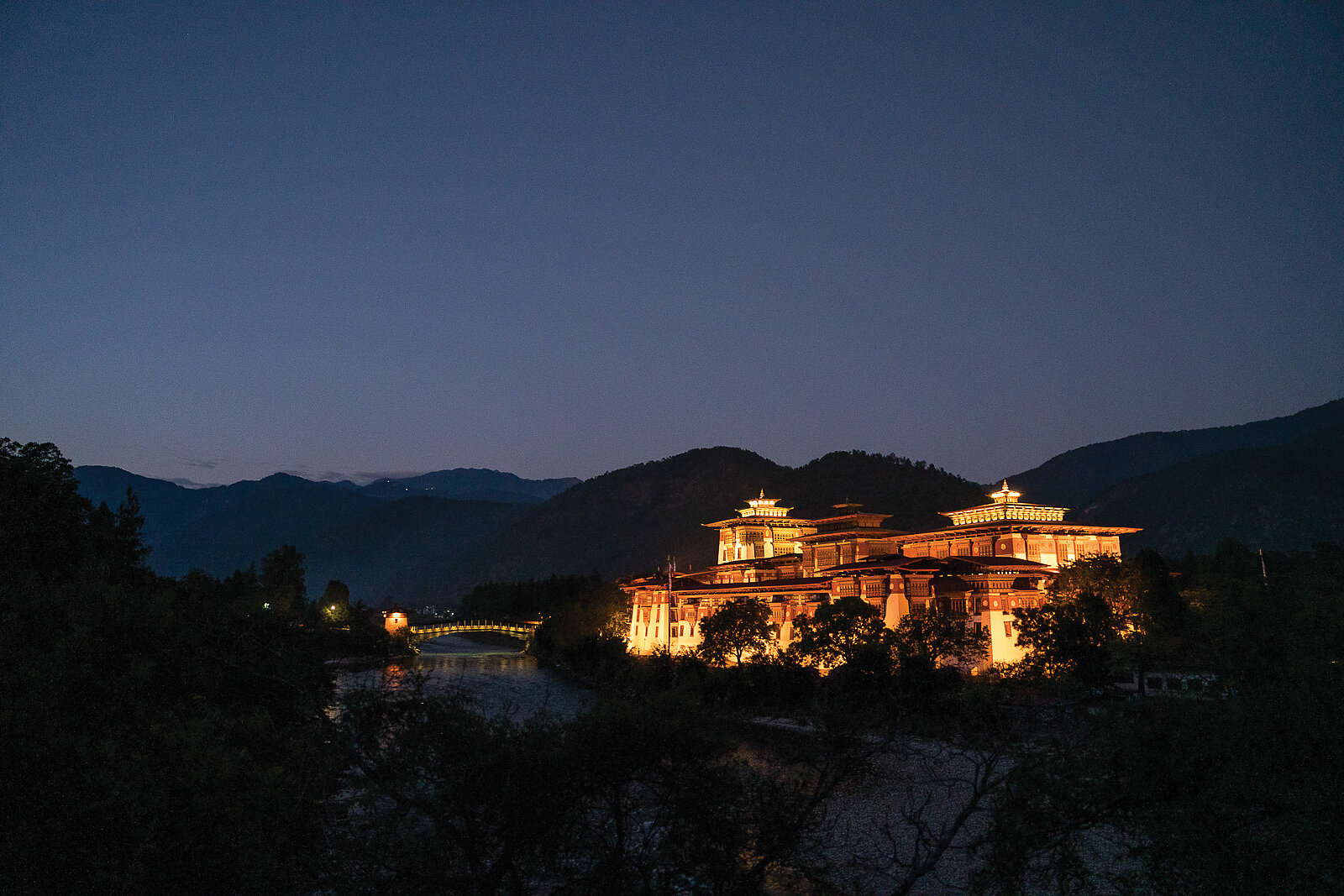
Our rotors sizzled and steamed under splashes of cold water as we paused for breath at 5,000 feet of elevation with nothing but a mournful cow for company. Each descent seemed to get faster and steeper and more breathtaking. One night, as we broke out at the bottom of the trail, we were greeted by the sight of the magnificent Punakha Dzong, a 17th-century fortress, lit up like gold bullion in the fading light.
On our final day with Khushala, Dawa, Tshering Zangmo, and Tshering Dolker, Cornelius is determined to cram in as much skills training, encouragement, and enthusiasm as possible. Since first meeting them, each rider has carved out two hours every day around work and family responsibilities to practice on the streets and at the local skatepark with the two bikes supplied by World Ride. Their progress is truly heartwarming.
All four can already stand up on their pedals, control their braking, and change body position when they corner. One by one, with Cornelius’ help, they spend the next few hours building their confidence on small slopes, keeping their balance at lower speeds, and learning to stop smoothly. It’s as plain as day that none of them are pretending to like this for the sake of appearances—they’ve all got the bug.
After a few intense hours of practice, Cornelius is able to lead this brand-new crew of riders in a close single-line formation, riding in a tight circle around the park, including a roll off a decent-sized curb onto a downward slope, over and over without a single stop, tumble, or hesitation. When the time comes to say a last goodbye and head back to our hotel, the tears and hugs flow freely. It’s only been two days, but Cornelius knows how powerful even a small amount of visibility can be when it comes to changing perceptions of women and bikes.
“It’s a really big thing for me that these ladies become role models for other women in their country,” Cornelius says. “We want to inspire them to bring up the next generation and show women what they can do.”
It’s impossible to predict whether any of these novice riders will eventually lead visitors down a steep, 25-kilometer descent. After all, this is just a tiny beginning—a couple of quality bikes, some decent riding gear, and two days training. Khushala, Dawa, Tshering Zangmo and Tshering Dolker have received a first taste of how alive and powerful mountain bikes can make you feel.
The real work that every new rider must go through—the falls, the mechanicals, the screaming legs and lungs—is still ahead. But if Bhutan’s mountain bike tourism future is going to be more female, it’s hard to fathom that these four women won’t be part of it.