A Nation's Pride Usha Khanal's Ascent to Acceptance
Jagadol Ridge descends from the thick jungled slopes of Shivapuri National Park, dissecting the urban sprawl of Kathmandu like a gigantic green tail of a sleeping dragon. Along its dusty spine, racers battled through oppressive humidity for two-wheeled national supremacy.
A tired but elated Usha Khanal walked to the top step of the podium for the second time during the 2023 event. Earning commanding victories in both XCO cross-country and DHI downhill, she made Nepalese history but also international history as the only athlete to ever sweep the podium in a single national championship event. Becoming national champion was a career goal for Khanal but also bittersweet as the reigning national champion was absent from the event and Khanal, a true competitor, yearned to beat the best to prove that the years of training, sacrifice, and dedication were worth the fight.
A basic understanding of Nepalese society is required to grasp some of the immense challenges Khanal overcame to build a life in cycling. Nepal’s graphic history reads like an epic saga of battling dynasties, warlords and rebels, and cultural revolutions set in a mysterious impenetrable mountain kingdom closed to outsiders until the 1950s, remarkably avoiding colonization. Populated by tribes from Pakistan’s Indus Valley, Tibetans from the interior plateau, the Licchhavi Dynasty from northern India, along with later British influence creates the cultural milieu of modern Kathmandu. Known as a fierce, proud, and tough nation, 81 percent of the population identifies as Hindu—its traditional social practices dominate alongside Buddhist, Islamic and local Indigenous beliefs. Khanal’s typical patriarchal Hindu upbringing reinforced traditional gender roles wherein a woman’s focus is around her home and family.
“Nepal is a country where women are not very much active going outdoors, so what families think is going outdoors is risky,” Khanal says. “What families want is for girls to stay at home and do desk job[s] and get married by latest 25.”
But Khanal is not your typical rule follower. “I’ve always been that kind of child that never listens to anybody,” she says. “My brothers, they still take many opinions, whereas I just listen to myself and take my one opinion.”
A good student and a natural athlete, Khanal was top of her school in athletics and found her place in trail running. Sports were not a priority in her family and like most Nepali women, she was pushed toward focusing on studies and away from running.
“If [women] don’t get support from the family, they feel helpless. I think it’s a women nature here,” says Khanal.
Her independent attitude and love for sports provided the drive when support was lacking. At 17, even her academic career was put in jeopardy through an arranged marriage proposal.
“I’m very lucky that my maternal uncle stepped in and said I was too young. It’s illegal for women to be married in Nepal before 18,” she said.
It wasn’t until the 2015 Himalayan Ultra Festival that Khanal first saw mountain biking. “My mouth was open for probably a minute when I saw mountain bikes flying through the air … I didn’t know there was a sport for mountain bikes,” she said.
Something deep inside clicked when a lone female rider flew past on the downhill course. Khanal describes that moment as a “turning point.” But, as a Montessori kindergarten teacher, her free time was limited. Borrowing bikes from friends and riding every spare moment, her new passion quickly reached obsession.
“When I first started biking I felt really happy and really free,” Khanal says. “I could picture another life because weekends were for biking and during those days I really found myself … it was a different world.”
Only one year after seeing mountain biking for the first time, she quit her job and began working in sales and as a mechanic at Himalayan Single Track—a bike shop and guiding outfit. Bonuses were access to discounted gear, full immersion in the grassroots mountain biking culture that was taking seed, and getting to know other riders. Her confidence was growing and stoke was high, but struggles were constant.
Bicycles carry their own stigma in Nepal and are seen as a utilitarian form of lower-class transportation. With few trails and expensive equipment, the adoption of mountain biking has been slow with its recreational and economic value or legitimacy as a competitive sport unrecognized by the general public. As a female, for Khanal to forge an unconventional life and career dedicated to cycling was like driving a wooden wedge through the stone foundation of Nepalese societal values. Personal successes and failures are intrinsically linked to the family and reflect favorable or poorly on the multigenerational unit. Boldness is not rewarded, so Khanal’s choices carried additional responsibility, pressure, and stigma. When crashes sidelined her for weeks at a time, she remembers her mother saying: “I’m going to sell your bike. It is of nothing, it’s just giving you scars and that is not good for a girl.”
But cycling was a gateway to an exotic community, travel, and was a beacon of light from a normal and uninspiring life.
Tourism is one of the main economic drivers in Nepal, contributing roughly 6.7% of the national GDP. More than one million tourists arrive each year to experience the bustling cacophony of aromatic Kathmandu streets, ancient temples, and to explore the tallest mountains on Earth. Himalayan Single Tracks supported Khanal in gaining her guiding qualifications in 2017. Now, Khanal is one of only five female mountain bike guides in Nepal. Despite the overwhelmingly male-dominated industry, she found her place quickly. Seasoned guides were welcoming and helpful.
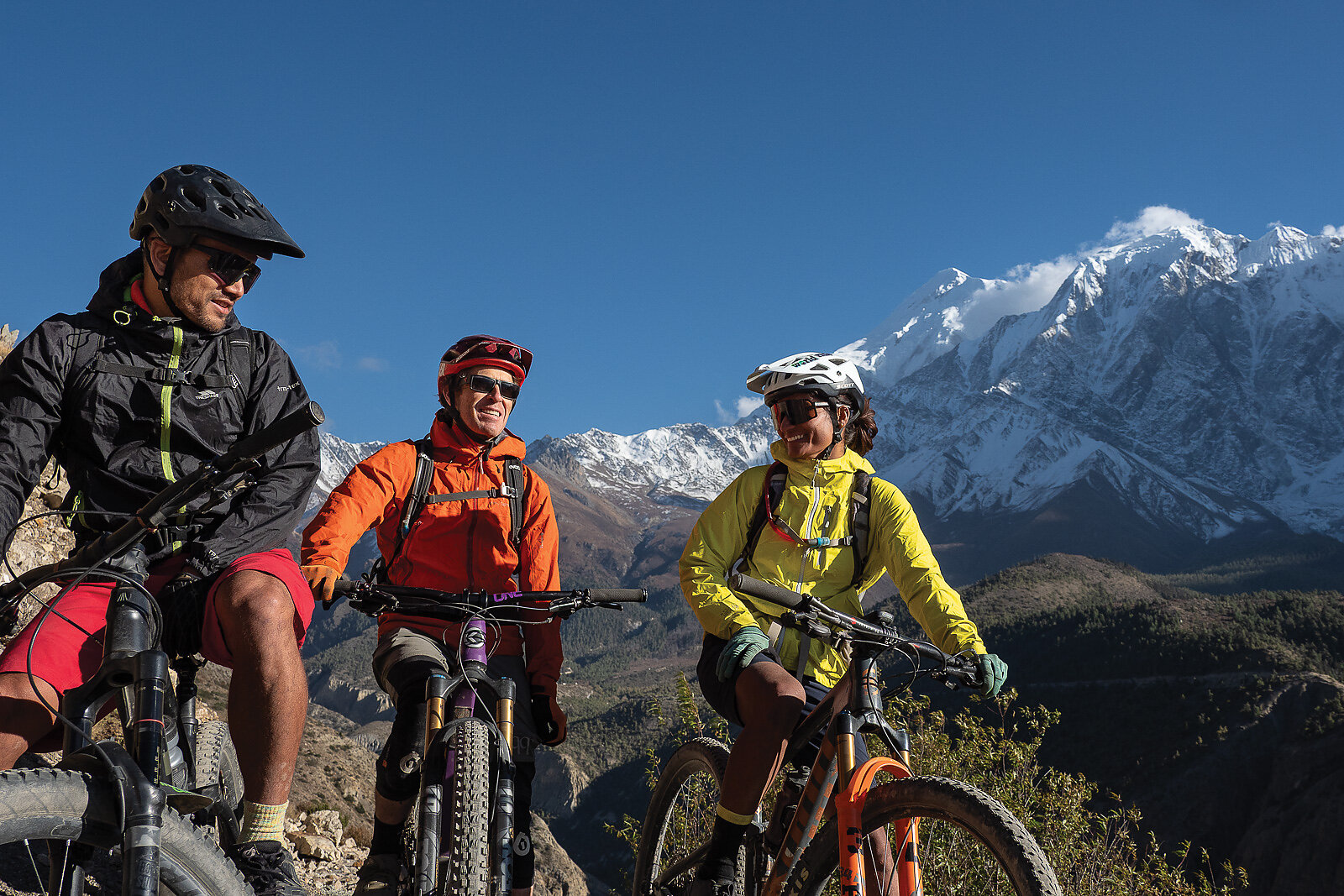
“I feel extra safe being a female mountain bike guide because wherever I go [guesthouses] give me extra priority over male guides who have to sleep in the dining hall in high season,” says Khanal.
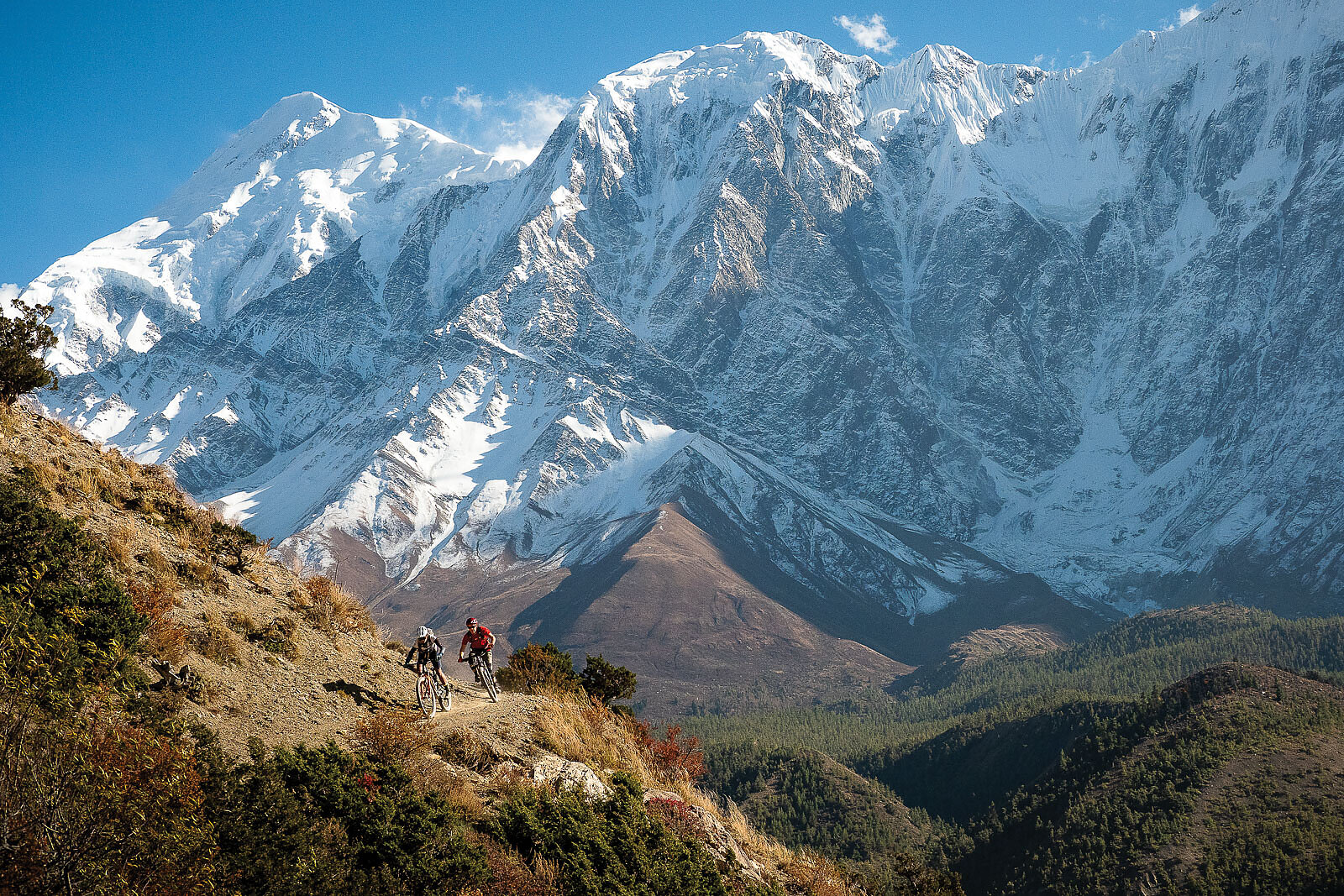
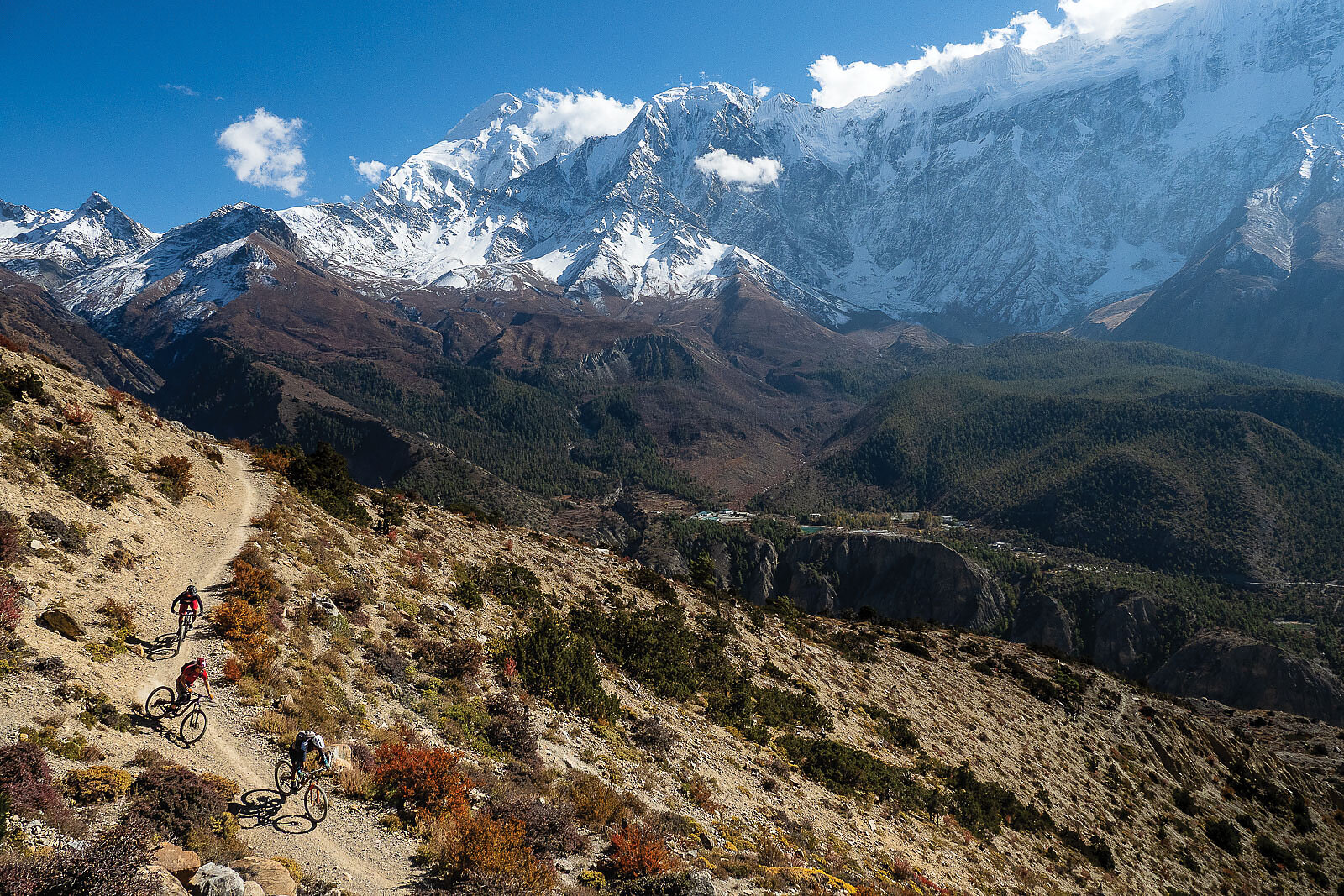
Pedaling over 5,000-meter passes, spending long days in the saddle, and working weeks straight at altitude with no days off is grueling, but right up Khanal’s alley.
“When you work you don’t feel like you’re working because you’re doing the thing you love,” she says. “If you don’t have any hard times when you are working it doesn’t give you any satisfaction.”
Guiding allows her more time on the bike in the high mountains and her three months on, three months off schedule enables her to compete further afield. Ultimately, though, Khanal says her goal is to dismantle preconceptions about the guiding industry and entice more women to the vocation.
“I call that my success for life if I can get more women into this industry,” she says.
Between guiding contracts, Khanal is steadily climbing through the ranks on the Nepalese cross-country circuit as well as in international cycling competitions. “I want to be training more but at the same time had to work as well,” she says. “More racing meant more training, which obviously [means] more bike parts and more expenses. So, financially, it’s always tricky and has to be in limit without proper sponsors.”
Her breakout year was in 2019, when she won her first gold and silver in the South Asian Games in India. Seeing her name in the papers, her family began to realize that mountain biking was more than just a distraction. Suddenly, her mom switched from referring to the sport as “nothing” to “everything.” But it wasn’t just her family taking notice. Five-time Nepalese XCO champion Ajay Pandit Chhetri volunteered as her personal trainer to bring her physical and mental fitness to the next level.
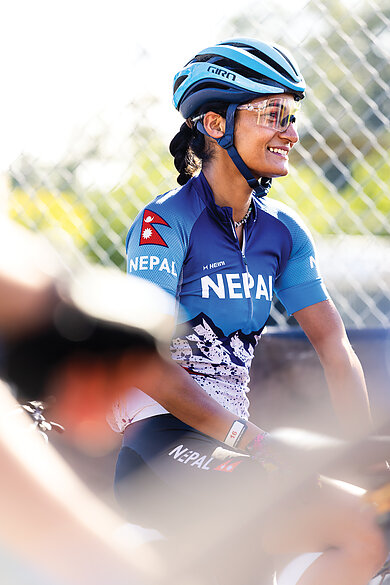
Khanal’s personal reckoning came in sweltering Bharatpur, Nepal, during the Pragya Memorial Cycling Marathon. The 65-kilometer race came down to a sprint finish in which Khanal edged out the eight-time national champion Laxmi Magar, proving that she could beat the best. An elated Khanal received prize money from and took photos with the former Prime Minister Pushpa Kamal Dahal, which was a major bragging point for Khanal’s family. The momentum continued as Khanal was invited to be the first woman to race for Nepal in the 2023 World Championships in Scotland. Before her passing, Khanal’s mother told her: “You always continue what you are doing … no matter what people say, you stay in this. You are doing a very good job for the country and yourself and you are making us proud. We are very proud to have a daughter like you.”
Despite her incredible successes, it’s difficult for a self-funded rider to compete on the international circuit. Injuries sidelined Khanal from retaining her national title in 2024 and internal strife in the Nepal Cycling Association has prevented a 2025 championship from taking place. Khanal is taking it all in stride. “
If it’s going to go smooth, I feel like that would be a very boring life,” she says. “I think I’ve got a very interesting life as there are so many ups and downs.”
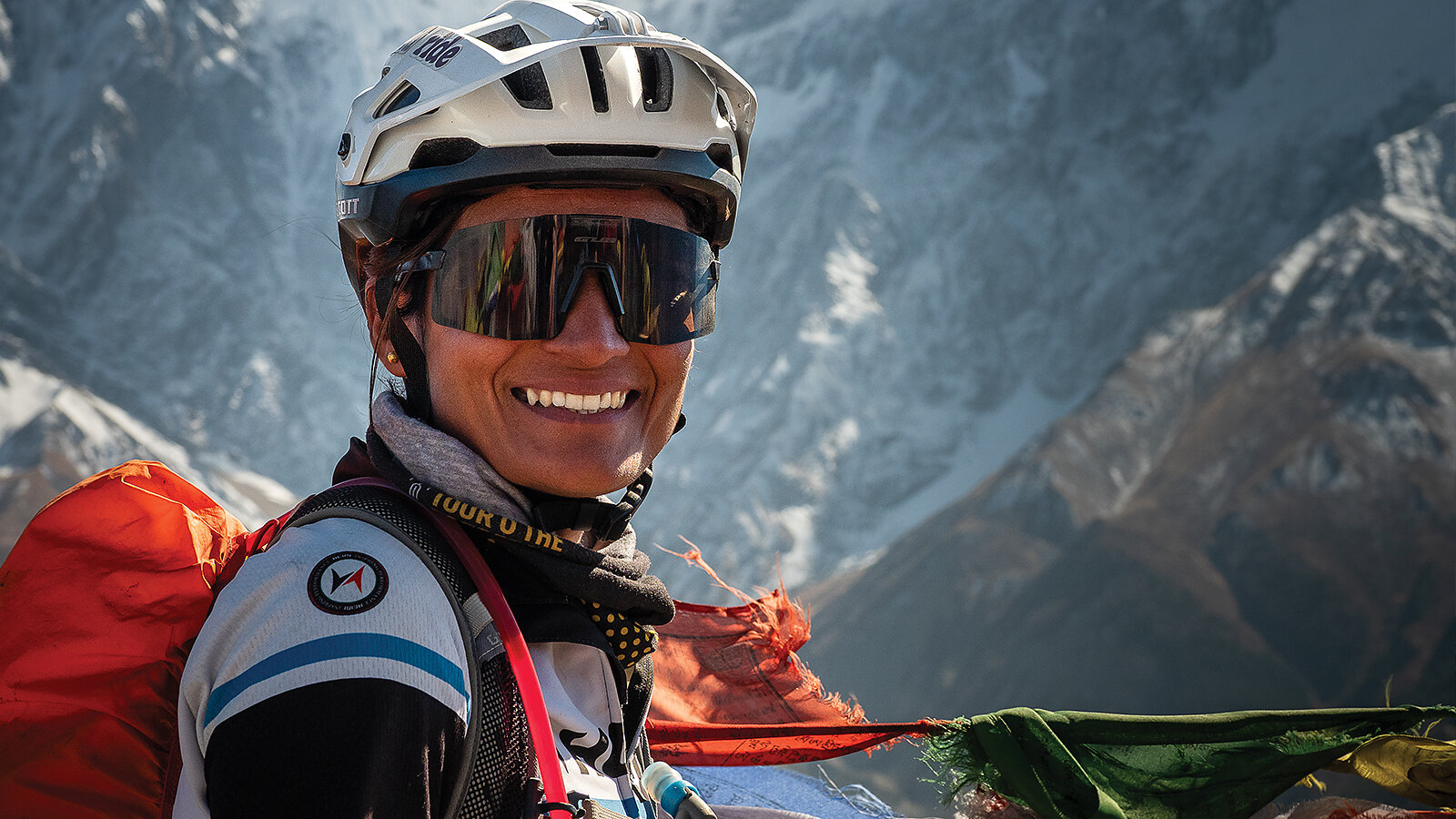
After taking third in the 2025 BC Bike Race, the 33-year-old has no plans to slow down. “[Mountain biking] has given me the name that I have,” says Khanal. “The Usha Khanal earlier, she was just a normal girl leading her life but after starting mountain biking, this Usha Khanal is a nation’s pride.”
These days, her guiding schedule is full and she has big dreams for continued international competition and regaining her national title.
“The world I have right now, I have so much freedom,” she says. “If I go back to another job and another life, I will never have a freedom like this.”