The Subculture New York City's Mountain Biking Renaissance
Across the churning waters of the Harlem River from Yankee Stadium, New York City’s ultimate temple of sport, lies Highbridge Park. Here, on the tallest, steepest hills in Manhattan, a heavily forested slope above the river is home to a twisting network of purpose-built mountain bike trails.
Highbridge is gritty and emblematic of the working-class neighborhood surrounding it and, if you didn’t know about its trails, you’d be easily forgiven for missing them. First carved into the hillside in the early 2000s, Highbridge’s bike trails came to be after years of negotiations. Namely, its advocates were seeking an answer to mountain biking’s most classic question: “Why can’t we ride here?”
Despite years of challenges, these trails have proven resilient and now come to represent a respectable and honest effort at integrating singletrack riding into New York City’s dense urban landscape. In the decades since Highbridge’s trails were dug in, a flourishing mountain biking subculture has developed alongside the city’s myriad of other niche worlds—the generations-old Washington Park plein-air chess scene, explosive two-on-two handball matches at city parks, an infinite continuum of obscure music, art, and food.
I grew up in Manhattan and lived there until moving to Colorado for college. I never dreamt of returning home with a mountain bike in tow. Despite having now lived across much of the Mountain West, I still call myself a New Yorker at heart, even just for the fact that I still know where all the subway trains go and am not fazed by the gruff attitude many locals display. So, in late 2023, I returned home with the goal of exploring what had happened to the Big Apple’s mountain biking scene in the 12 years since I left.
Early in my riding career, I had become familiar with a few trail networks in and around the city, including upper Manhattan’s Highbridge Park, Westchester County’s Blue Mountain Preserve, and North Jersey’s Mountain Creek Bike Park, as well as riding whatever bits of unsanctioned singletrack I could find in between. Even so, there wasn’t much to talk about back then—just janky trails in ignored areas. But it was dirt, and it was close to home.
After hearing rumors of new zones close to where I grew up, my curiosity was piqued. I reached out to a few of the local mountain biking groups and quickly made friends with folks eager to show me around. That’s how I met Mike Vitti, the head of Concerned Long Island Mountain Bikers (CLIMB), the sister organization to the local International Mountain Bicycling Association (IMBA) chapter, NYCMTB. He was instrumental in getting the Highbridge trails funded and built.

In 1992 and without much pretext, New York’s city council quietly voted to ban mountain biking in any city park. At the time, unsanctioned trails existed in a few places like Cunningham Park in Queens and Inwood Park on the northern tip of Manhattan. Outside city limits, several communities on Long Island were already home to legal riding areas with dozens of miles of trail.
After a run-in with a park ranger in New York, Vitti learned that mountain bikes were forbidden in city parks and requested a meeting with the parks department to find out what he could do to change that.
“They said that mountain bikers destroy the environment,” Vitti said, recalling his meeting. “I said, ‘That’s weird, because that’s never been my experience. Have you guys ever actually ridden these trails?’”
Vitti learned a lot about how the city’s politics worked in the early years of his involvement through CLIMB. In typical trailbuilding politics fashion, he quickly realized it came down to appeasing the powers that be while still finding ways to create exciting trails that cater to real riders, especially those who would go out and build illegally. Highbridge and Cunningham Park were eventually selected as two areas that the city would permit a pilot program of legal trailbuilding.
“I think they chose those two because they were some of the dirtiest, least visited places in the city,” Vitti said. “I had never heard of Highbridge and looked at it on the map and was like, ‘Wow, wasn’t that the murder capital of New York just a few years ago?’”
Under the new pilot program, Vitti was hired to manage and build the trails at Highbridge. He would personally build the singletrack portions, while famed trailbuilder and rider Jeff Lenosky came in to put in the jump and freeride sections.
“I walked into the park, and folks grabbed baseball bats and started approaching me,” Vitti said, recalling his first visit to the park. “There weren’t any homeless structures or tents, it was just the place where people went during the day to shoot up and hang out.”
He went back to the parks department and requested a police escort to continue his scouting and planning work. It was an edgy place to move dirt, but he wasn’t intimidated.
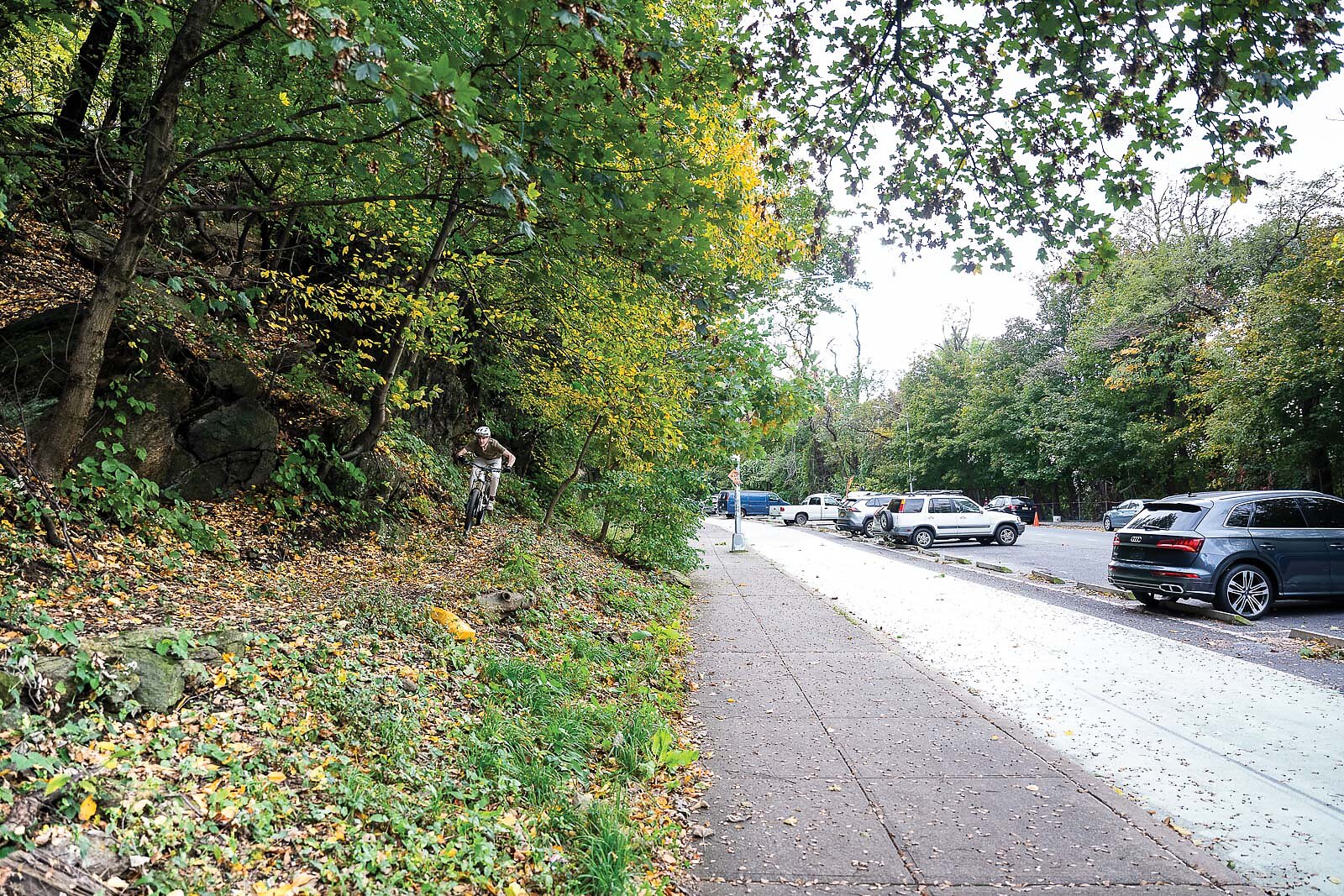
Once the planning stage was finished, Vitti was given access to city and federal funding through a Recreational Trails Program grant that added up to nearly $125,000. Highbridge and Cunningham were built simultaneously, by hand, over the course of two years using this money to pay for supplies. Both projects relied heavily on volunteers from the Green Apple division of AmeriCorps. While Vitti played a vital role in getting new trails in the ground and laying initial groundwork for ensuring the legality of future development with the city, a crew of passionate local riders have taken the reins in the time following the COVID-19 pandemic.
Joshua McMillan, a local racer, mechanic, and all-around bicycle polymath, has led this new charge and keeps Highbridge’s trails up and running for the community. The mild-mannered ex-BMX racer, originally from Texas, spends whatever time he’s not working at the Upper West Side’s Hilltop Bicycles or racing cyclocross and downhill keeping the trails alive. During the pandemic, McMillan spent hours lapping the short but very gnarly downhill track at the park to train for the upcoming season. He ended up winning his age category at the U.S. National Championship at Mountain Creek Bike Park in New Jersey the following spring.
To McMillan, being a mountain biker in New York City is a unique prospect filled with its own set of challenges. Storing multiple bikes in a tiny apartment is one, getting around to different riding areas another, but finding ways to grow the community is perhaps the most challenging task. Without dedicated trails there’s not much of a reason to buy an expensive mountain bike. Without a riding community there’s no incentive to build trails. It’s a chicken and the egg conundrum, McMillan says. Organizing shop rides and demo days at Highbridge has helped cultivate interest from potential mountain bike buyers, but it’s an ongoing struggle to get folks riding on dirt.
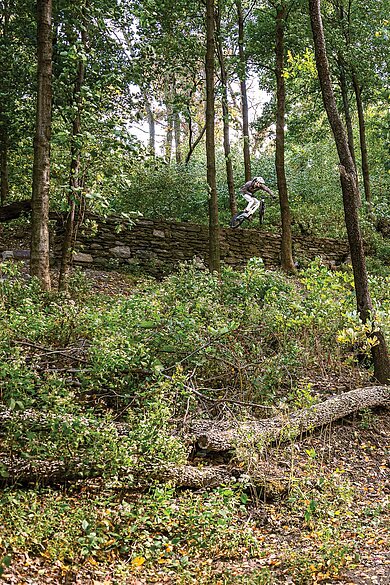
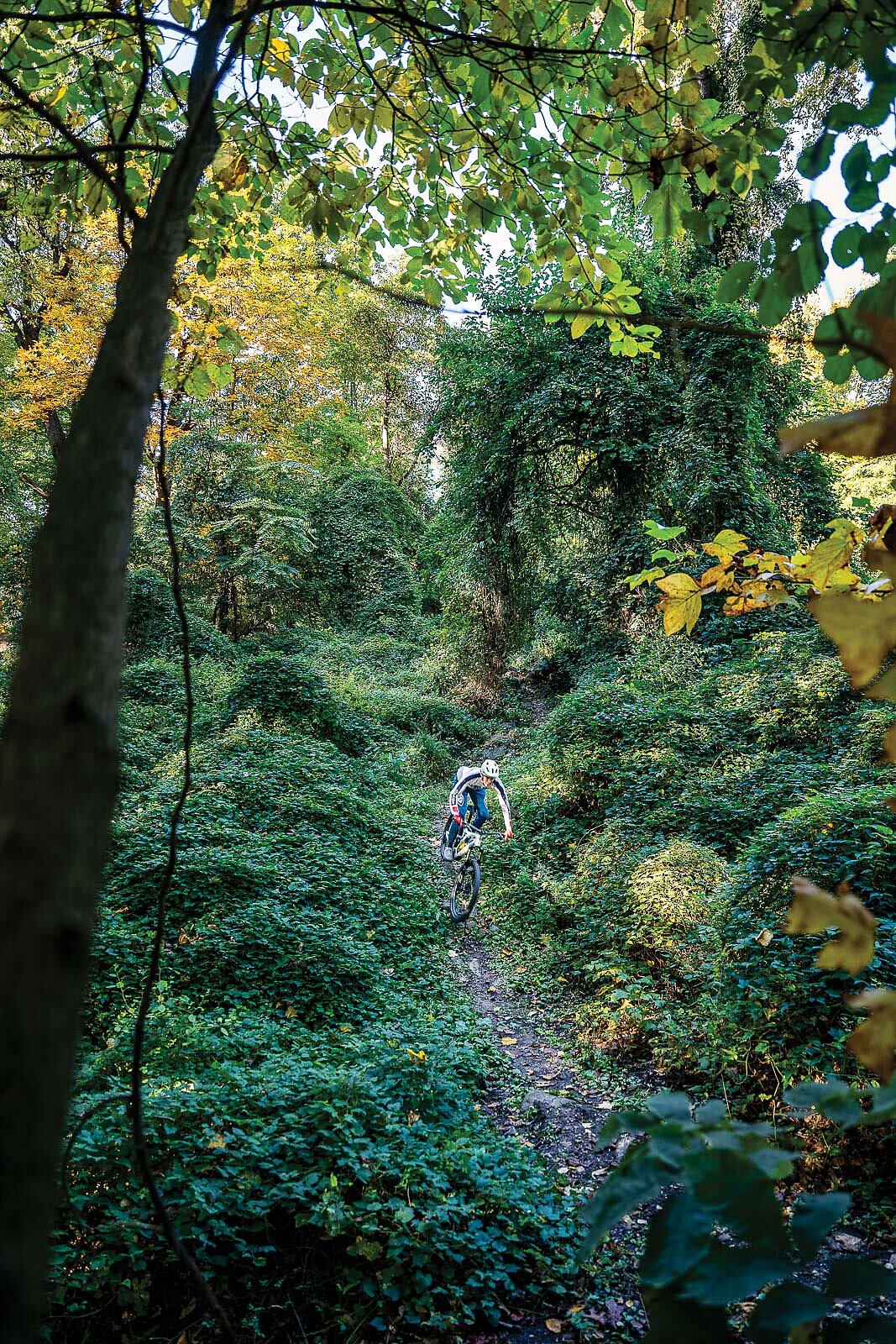
Today, surrounded by a vibrant Dominican-American community, Highbridge Park is the crown jewel of New York City’s mountain bike trails. The trails aren’t usually busy, but on sunny days, you’ll find locals of all ages sessioning the upper jumps or finding new lines through rugged tech sections in the woods. Featuring nearly three miles of steep, raw trails, a pump track, dirt jumps, and a downhill track complete with rock rolls and an eight-foot drop off a historic stone wall, this is the place to go for gravity riding in the five boroughs. It’s a far cry from what existed here a decade ago, when a few sketchy berms and some awkward jumps were all that existed.
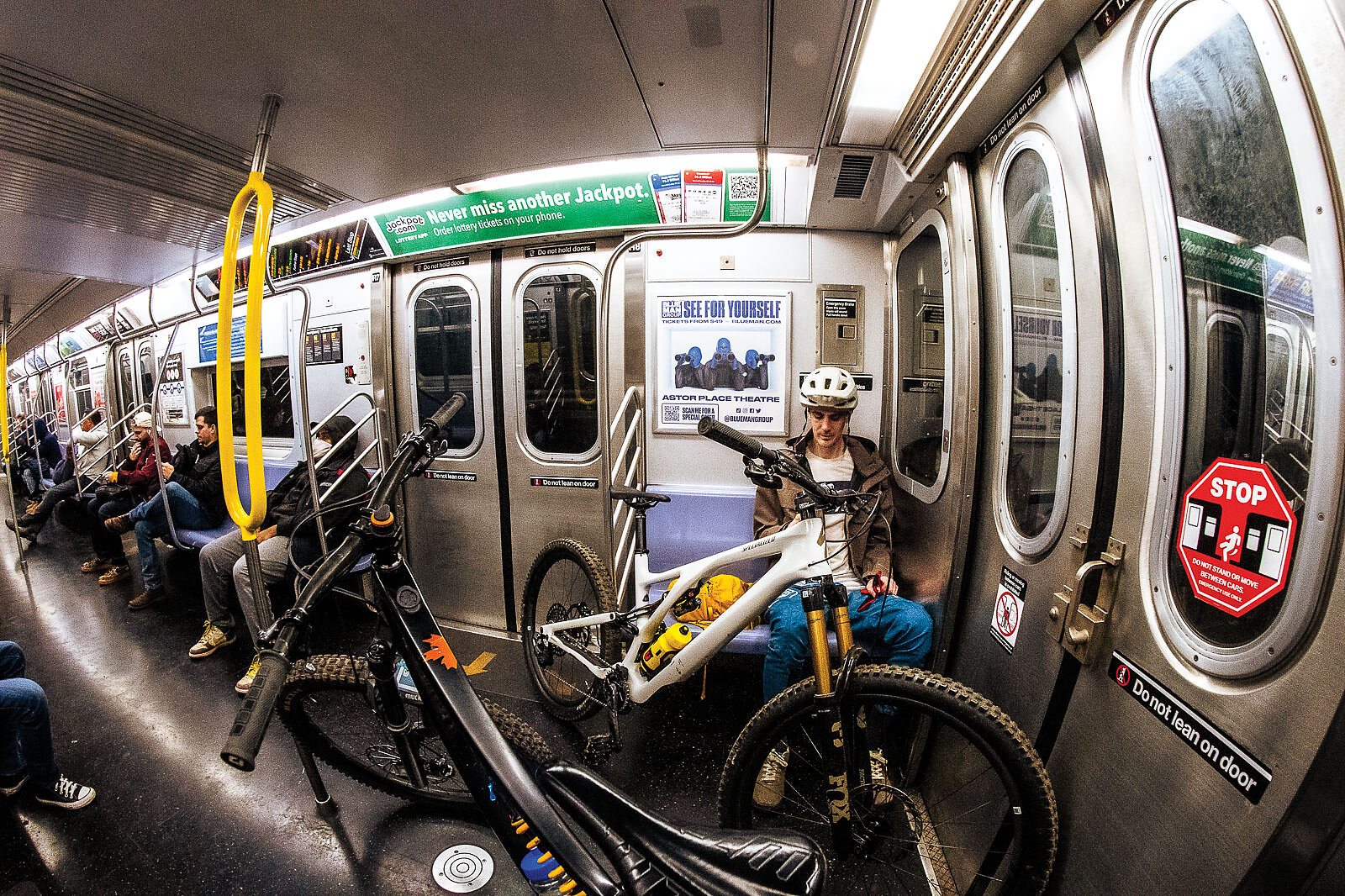
One afternoon, following a ride with McMillan, I skipped the usual local tradition of dipping into one of the many nearby bodegas for an amazing Caribbean dish like mofongo, pernil, or sancocho, and instead hustled to the closest subway station as a rain squall blew in. As I made my way down to the tracks, I hoped it wouldn’t be too packed to fit on a downtown-bound train with my bike.
The funny thing about taking your bike onto the New York City subway is that while it might seem like a crazy idea on a busy day, nobody really bats an eye. New Yorkers seem immune to the chaos of their commute and don’t really mind the inconvenience of having to step over a bike as they vie for a coveted spot with a handhold. Thus, the utility of the subway as a way for mountain bikers to quickly cover many miles of ground within the city cannot be overstated. The 1 Train’s Dyckman Street stop is only a block away from Highbridge’s north entrance.
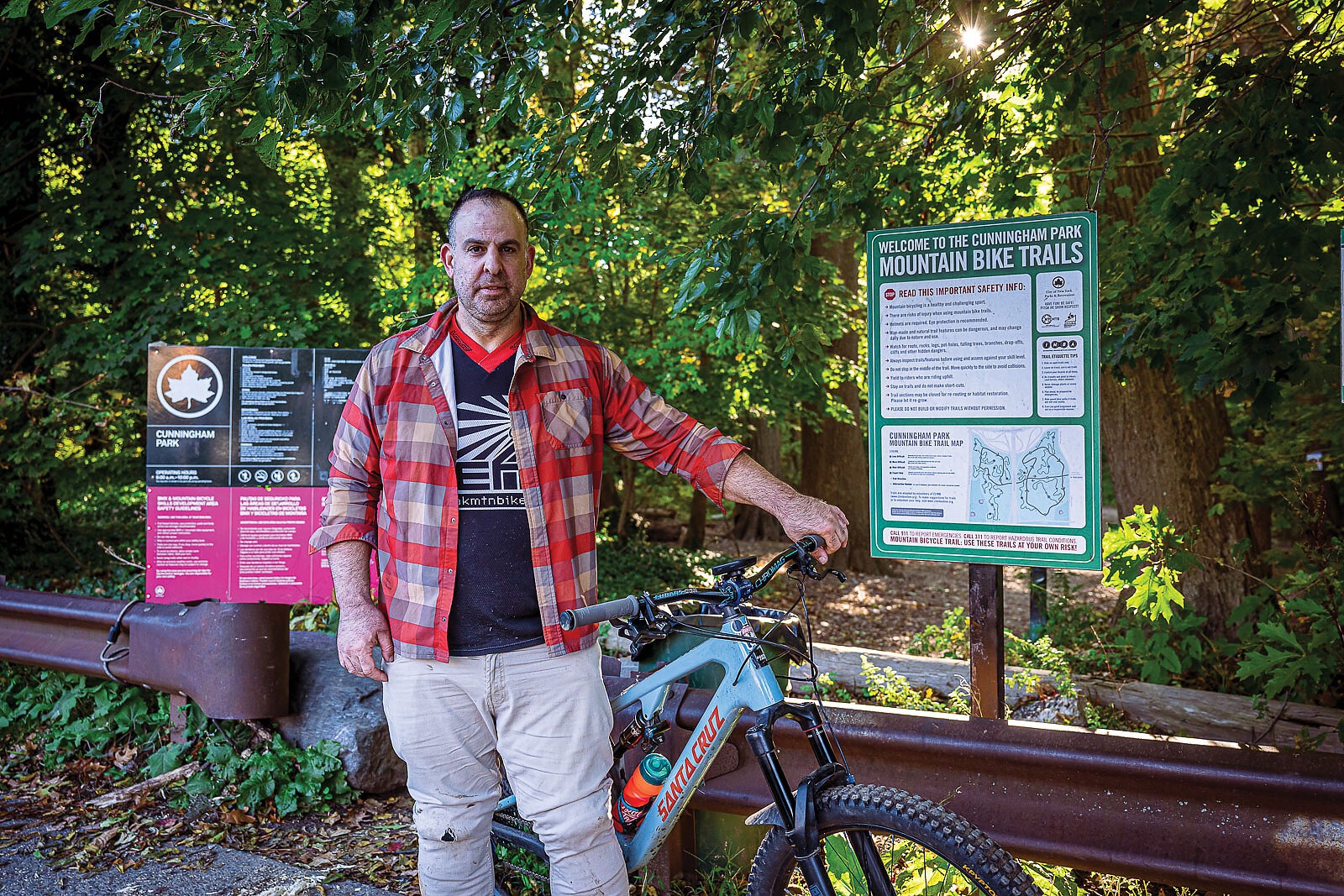
Later in the week, on a stunningly beautiful and crisp October day, I skipped the subway ride and pedaled across Queens along New York’s network of paved Greenway paths to Cunningham Bike Park. McMillan meets me there, along with a few locals including Augustus “Gus” Franzoni, a jovial Queens native who’s ecstatic to show us around.
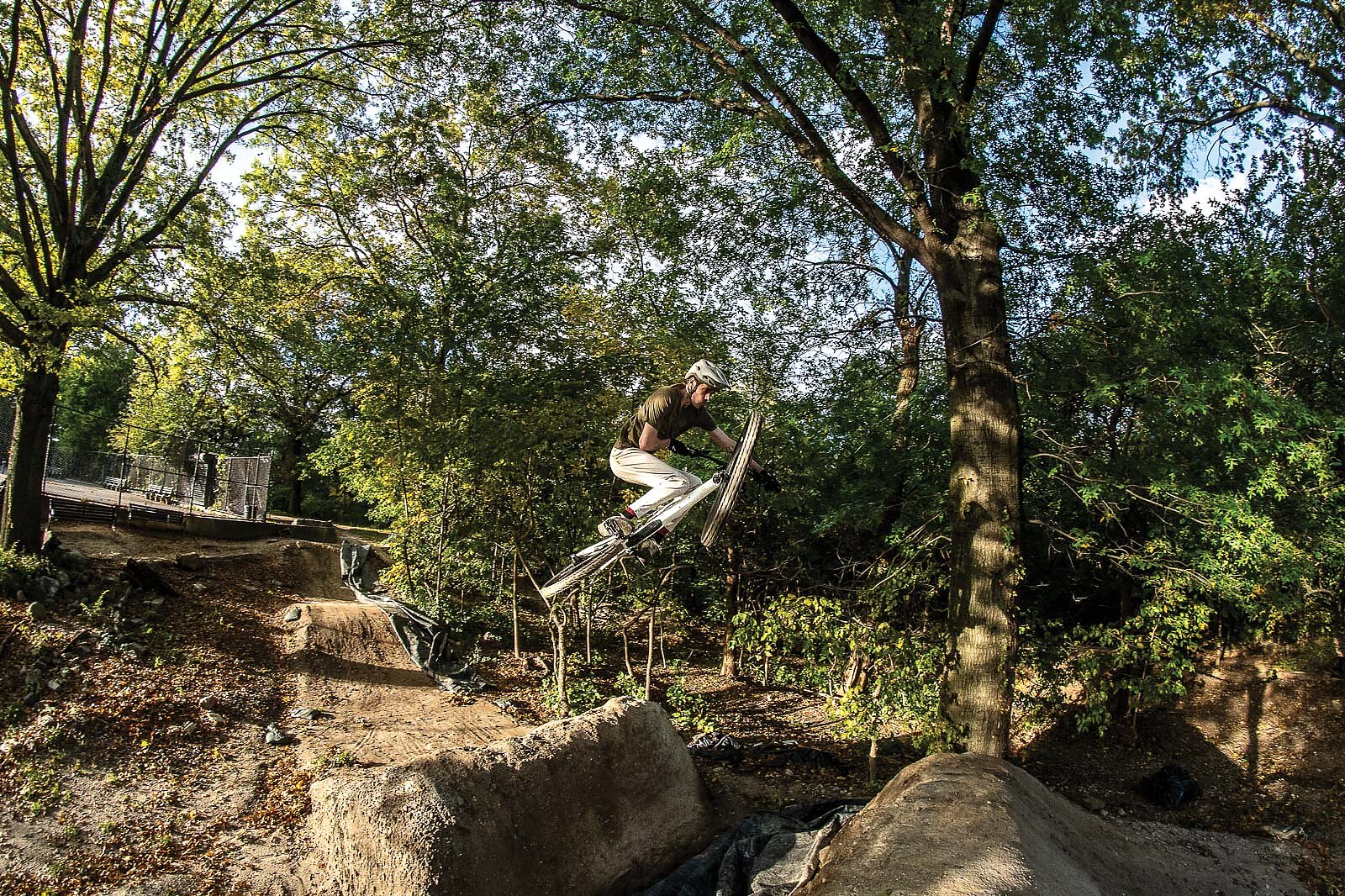
Cunningham is grassroots mountain bike trailbuilding at its finest. Situated beneath the interchange of the Long Island and Clearview Expressways, the park is almost completely flat—dense forest hides some small hills and an extremely compact network of winding singletrack that links together two distinct areas: Jet Line and Playstation. Franzoni is responsible for many of the features found in the park, and eagerly tows us into the BMX-style tables and doubles of Jet Line. While much less steep and raw than Highbridge, Cunningham still possesses the same character of taking the city’s lemons and squeezing out a signature brew of lemonade; the trails here pack as much fun as possible into a plot of land that most mountain bikers would otherwise ignore.
But twisting labyrinths don’t tell the full story of NYC’s mountain biking scene. Much more expansive options lie just a short drive (or train ride) outside the city. Hop aboard the Metro North commuter train and it’s possible to access dozens of miles of trail in Westchester County, most of which are managed by the Westchester Mountain Biking Association. The dense woods of Peekskill’s Blue Mountain Reservation hide enormous rock slabs on trails such as Ned’s Left Lung and Stinger, and punchy, technical climbing that perfectly showcases gnarly East Coast riding. A few miles south, Graham Hills Park is home to more handbuilt flow trails littered with features that follow the small but mighty theme that is so prevalent in this region.
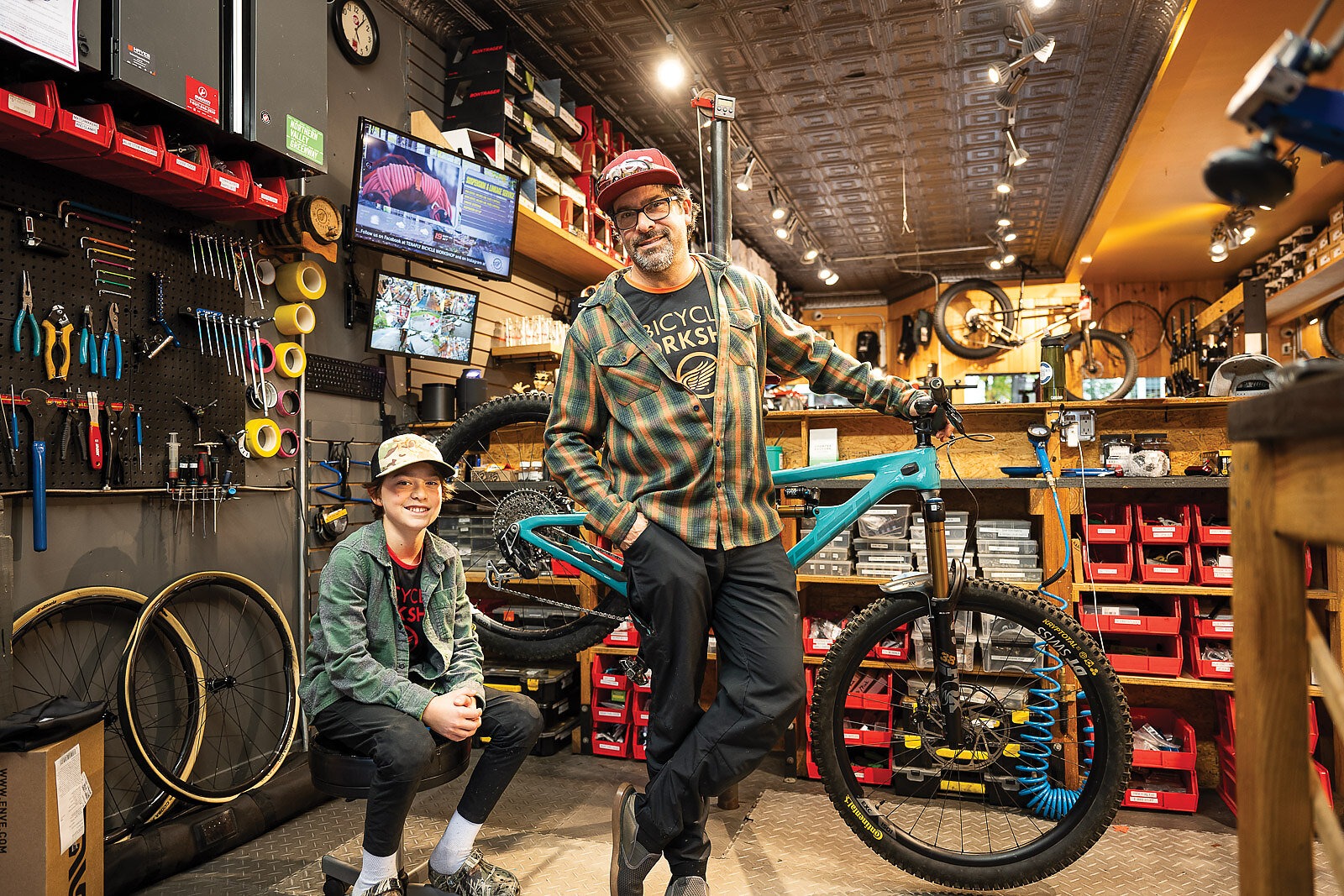
However, the real highlight comes when I hop in the car and head across the George Washington Bridge into northern New Jersey. Fifteen minutes past the bridge, I arrive at Tenafl y Bicycle Workshop, the area’s only dedicated mountain bike shop. Owned by Shepard Grinker, this community-driven shop offers everything from custom builds to demos. Grinker and two business partners started the shop in 2013 with a dream to bring what they call a “western-style” mountain bike shop within a few miles of New York City. Inside, custom builds from obscure, high-end brands hang from the walls. An espresso machine and beer taps line the back. Grinker is also the co-chair of Palisades MTB, a group that stewards trails on the west side of the Hudson River.
“Back in the day, living in the city as a mountain biker involved pedaling 50 to 60 miles round-trip just to go ride a few miles of illegal singletrack in the Palisades Park,” Grinker says.
Those trails, now closed to bikes, still exist for hikers and offer a beautiful vista of Manhattan from the top of large cliffs towering above the rough, brackish waters of the Hudson. The area paved the way for an entirely new trail development 30 minutes north.
After loading bikes at the shop, we drive north on the Palisades Parkway, crossing back into New York State, and soon find ourselves in the rolling hills of Sterling Forest State Park. A massive work in progress, these are the newest trails in the area and feature several stacked loops of singletrack that showcase some truly classic New England-style riding.
Long an area favored year-round by hikers, Sterling Forest has a rich history that still harbors remnants of the American Revolution. Pedaling through the forest, I notice the landscape dotted with iron mines, many of which were used to extract and forge metal used to defend against the British Navy back in 1776. Grinker’s son Noah, a precocious 13-year-old shredder, takes a day off school to join us on a ride through Sterling’s loops. “It’s pretty cool to know that the metal found here helped us win the war back then,” Noah says, grinning as he pedals.
Besides being an expert on local history, Noah already knows more than most adults do about bikes. He has a deep understanding of all the components on his own mountain bike and just about every product and service available at his dad’s shop too. It wouldn’t have surprised me if he bled my brakes and rebuilt my fork while we chilled at the shop for post ride beers.
From a building perspective, Sterling is an anomaly in the area. Unlike the rake-and-ride and handbuilt trails elsewhere in the area, nearly everything in this state park has been constructed with the help of machines. And, unlike out West, where it’s less common for multiple land managers to oversee larger plots, here things are a bit different. Large parcels of private property intersperse state and county land and much has already been designated as protected— albeit not with access to mountain bikes in mind. Mountain biking here is still seen as a fringe sport and most land managers haven’t agreed on how to handle and integrate it into master plans. The New York- New Jersey Trail Conference, a nonprofit agency in charge of nearly all the hiking and horse trails in the area, had never even considered bringing a machine to build a trail in the Sterling Forest area until it was proposed by Palisades MTB and its partner organization, Jersey Off Road Bicycle Association.
Grinker believes that finding money and executing trail builds aren’t the biggest challenges to trail development. Instead, it’s convincing those in charge that new methods of building mountain bike trails even exist. Despite the fact that modern methods now allow trails to be more sustainable, require less maintenance upkeep, and cause much less long-term environmental impact, it has taken years to educate local land managers about the building standards and principles that other areas of the country adopted decades ago. Nowadays, Palisades MTB is hard at work not just building more trails in the Sterling area but focusing on getting new riders set up to succeed in the sport.
The urban trails of Highbridge and Cunningham and the suburban escapes of Sterling and Westchester County are a true testament to the fact that, despite still existing on the fringes of society, mountain biking is alive and well in the Tri-State area. The final key to the puzzle, however, has for years lain in plain sight. It would be remiss to not include a trip out to Vernon, New Jersey’s Mountain Creek Bike Park, barely an hour’s drive from Manhattan.
It’s a strange sight to leave the bumper-to-bumper traffic of Manhattan and arrive in a parking lot filled with tailgate pads, shuttle racks, and kitted-out long-travel rigs. The scene is chill, like a sleepy morning at a mom-and-pop ski resort, with riders hanging out and waiting for their friends to get in line for an uplift on the cabriolet, a unique open-air gondola that whisks you to the top of nearly 50 individually named trails. It’s not Whistler on a midsummer Saturday, but the riding here rivals the best of it.
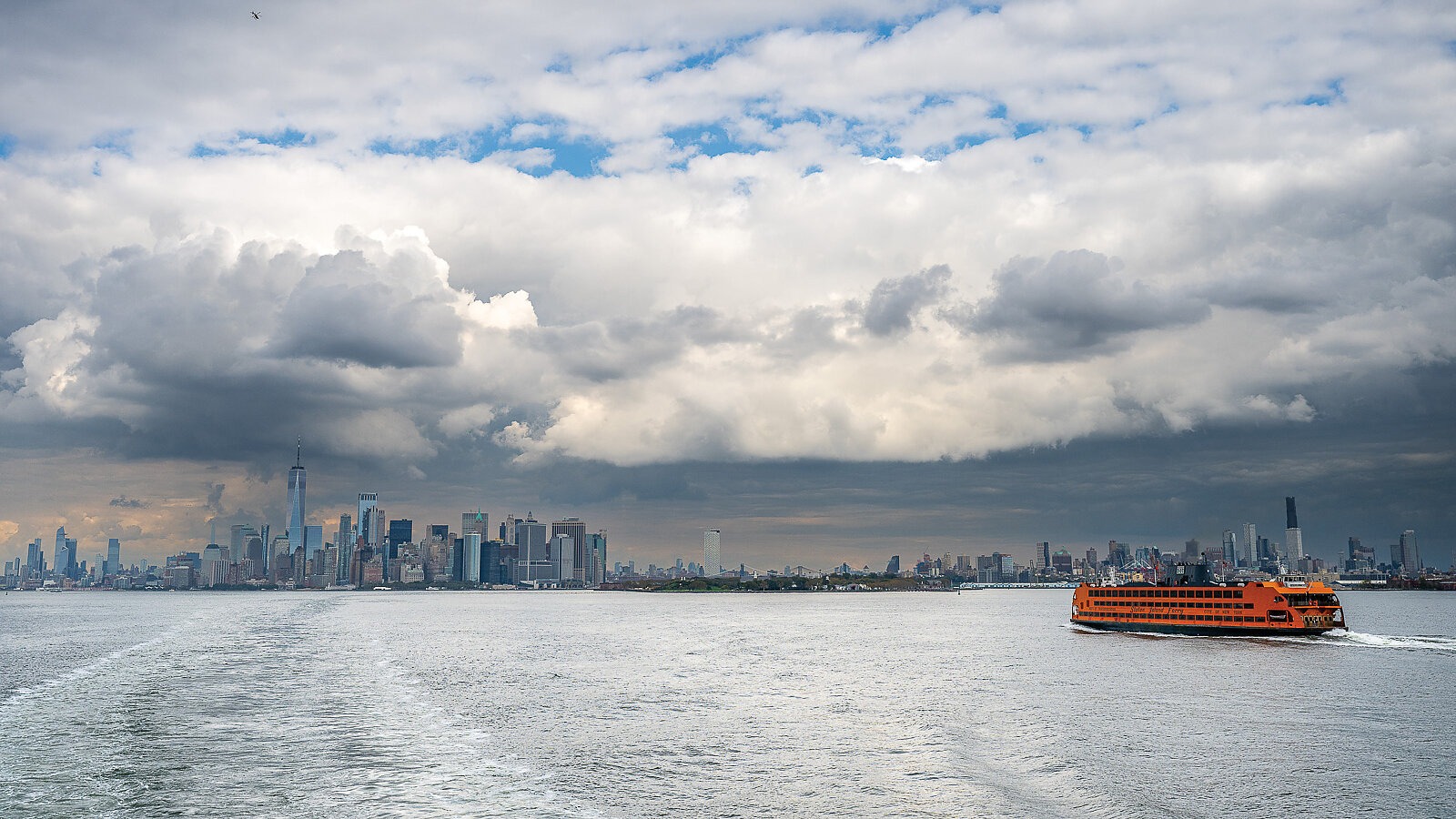
In the distance, off the back of the mountain, Manhattan’s skyline looms on the eastern horizon. The proximity to the city is key to the success of the operation here, something the park’s developers capitalized on from the get-go, knowing there was limitless potential with the nation’s largest population center just a few miles away. In the early 2000s, the original lift-access trails were established under the name Diablo Freeride Park and came to be thanks to the trailbuilding expertise and patronage of pros such as Aaron Chase, Eric Porter, and Jeff Lenosky. It hosted the first few rounds of the U.S. Open of Mountain Biking, fostering an early freeride competition and downhill racing scene on the East Coast. After changing hands in 2012 to its current owners and operators (which also run the water park at the base and the ski area in the winter), it was renamed to Mountain Creek. The trails are now under the command of lead builder George Ryan. Based on how they ride, they’re clearly in good hands.
Hailing back to its Diablo days, Mountain Creek might be best known for its reputation as one of the gnarliest racing venues in series like the Eastern States Cup, Pro GRT, Downhill Southeast, and even for USA Cycling’s Downhill Nationals. The high-speed tech of Exodus or Bob Gnarley keeps racers honest, allowing the venue to have acted as a proving ground for some of North America’s fastest downhillers.
Despite its rugged reputation, the mountain features something for everyone and offers a truly impressive variety of gravity-focused trails that make use of every last inch of the 1,000-foot vertical drop. From the mellow flow of Candy Land and Domboo to the floaty, expert-level jumps of Dominion or Covenant, there’s impeccable progression built into the whole trail system.
Driving back into Manhattan, I spend the time in traffic wondering what the future holds for two-wheeled pursuits in New York City. It’s clear that the demand here is growing as much as it is anywhere else in North America. But it’s odd to think about people having to leave the city to find the hub of their culture. Despite obstacles, mountain biking’s culture evolves and grows. In many ways, that’s emblematic of the modern New York lifestyle. You become part of a subculture and you grow with it. Then it takes on a unique flavor of its own.