Searching for Connection Tucson's Tight-Knit Trail Scene Shines
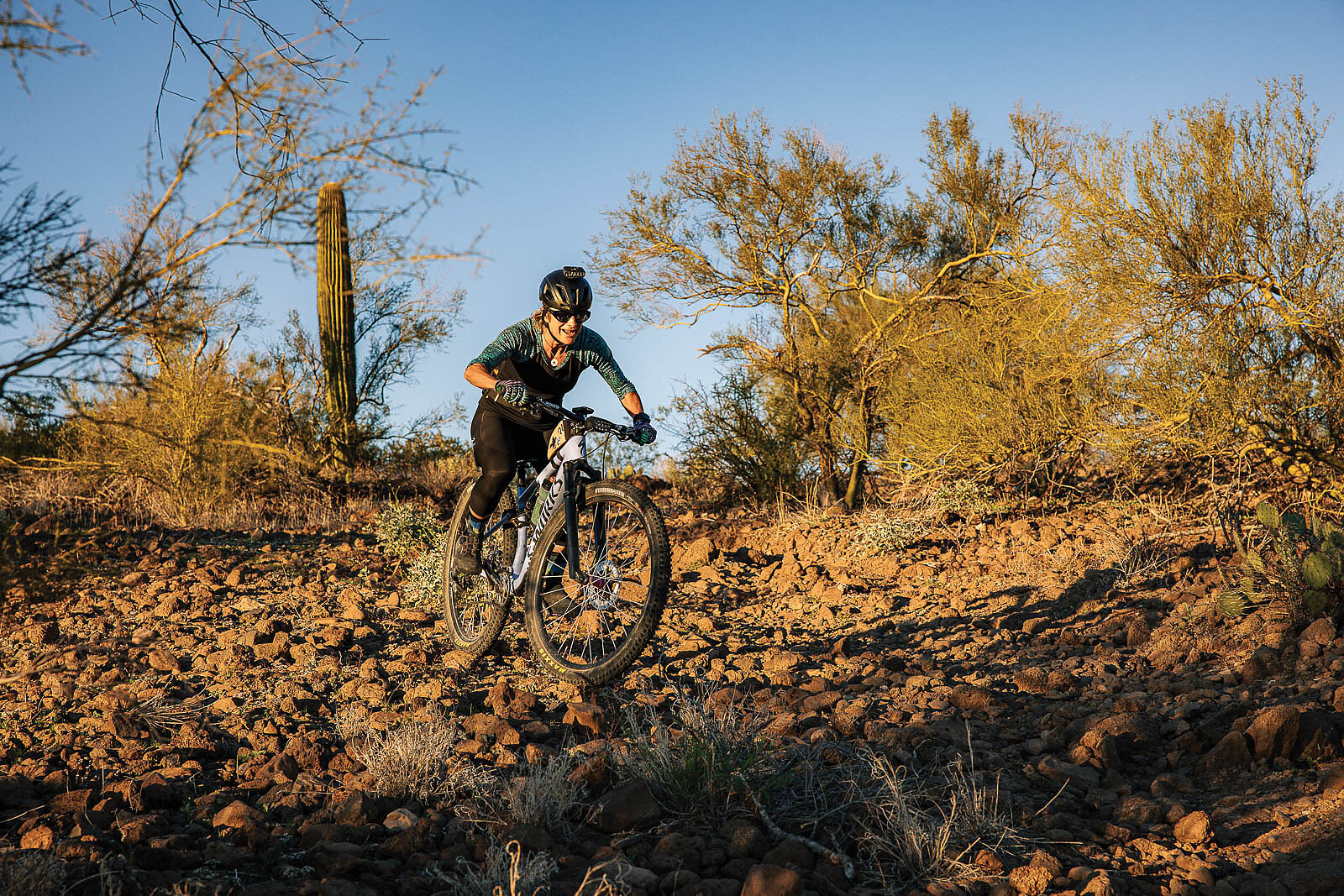
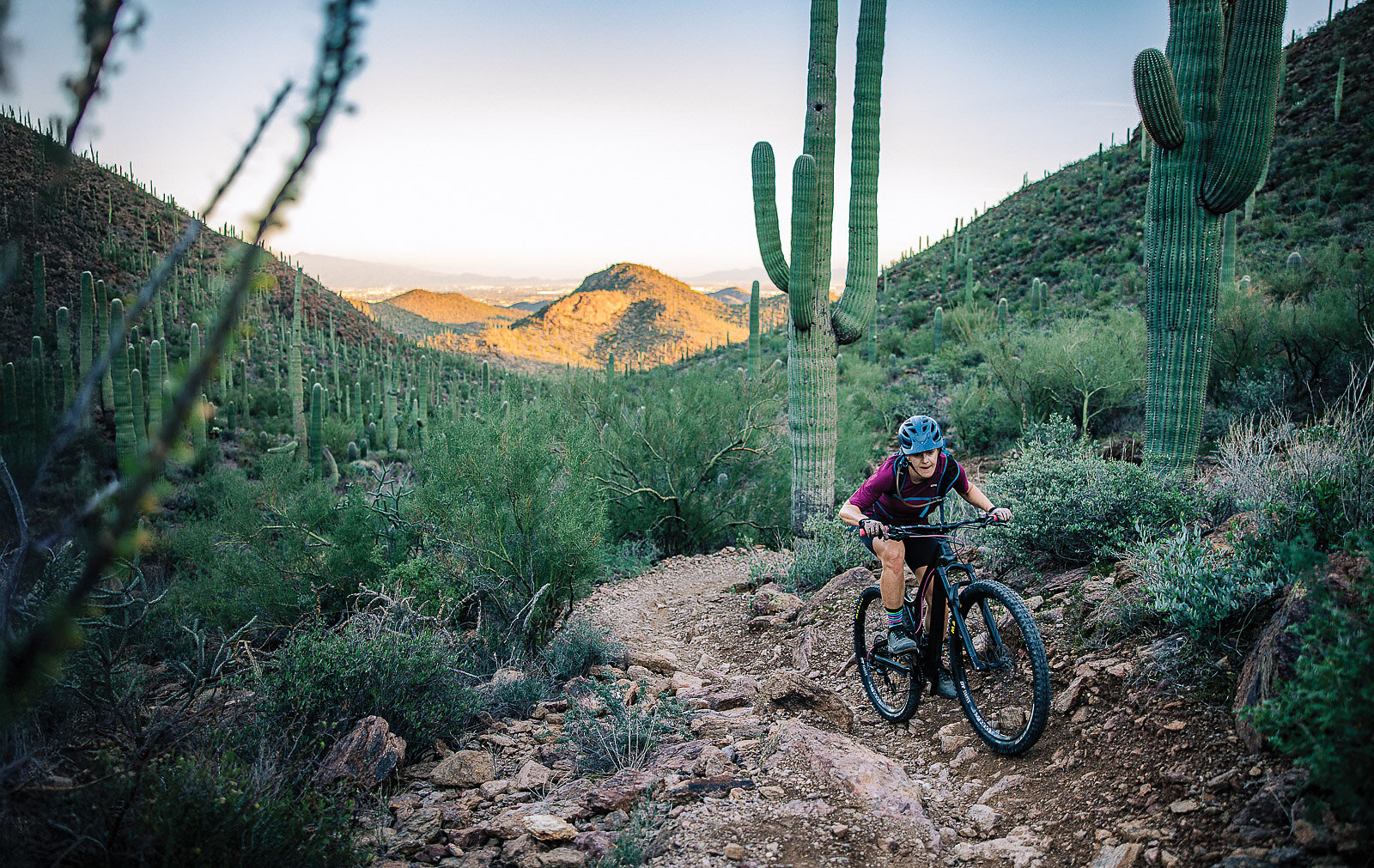
On a rare rainy week in the Sonoran Desert, Kate Van Roekel juts out her tongue in concentration as she confidently navigates an upper section of the Explorer trail within Tucson Mountain Park.
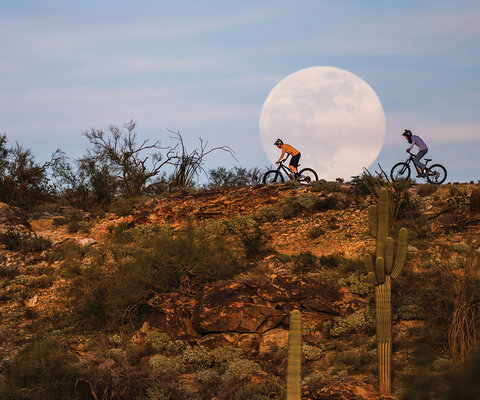
The trail charts a path through stands of huge, impossibly stoic saguaro cactus, found only at certain elevations in and around the Madrean Sky Islands, a series of isolated, desert mountain ranges. Their shallow roots extend from a central stem in every direction, akin to spokes on a wheel. They reach out radially for water, for connection, for life. The desert is thirsty and the dirt is perfect. The sky has cleared and the sun is setting low behind the Tucson Mountains.
Mountain biking in Tucson has matured through grassroots trail development efforts, transforming strenuous and sparse routes into an expansive network that now serves a broad range of skill levels and terrain preferences.
Two miles long and surrounded by cacti, creosote and mountains, Explorer is one of dozens of mountain bike trails in the Tucson Mountain Park west of town. The park was established in 1929 to protect 20,000 acres of desert ecosystem and outdoor recreation resources.
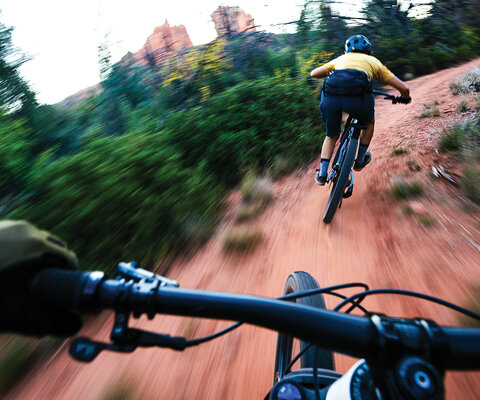
As Van Roekel rides, a popping thwack sounds from the straining lugs of tires suddenly releasing their grip from the rocks. The loose dirt crunches. Most walk this steep and loose section of the technically demanding trail. Breathing deeply, Van Roekel maneuvers her front wheel between small boulders to corner around a saguaro, handlebars daringly close to the cactus’ spines. Yet, with ease, she makes it.
“Yes!” she exhales, under her breath, as she rolls through to the top. It’s been a while since she has cleaned the whole section.
Today, hundreds of miles of mountain bike-accessible singletrack and more than a dozen trail networks are easily within riding distance from central Tucson. However, while mountain bikes and mountain bike trails did exist in Tucson in the 1980s and ‘90s, neither the bike technology nor the trail systems were anywhere near as established as they are now. Early mountain bike trails were rudimentary at best. Back then, going for a ride meant horse trails, wash trails, hiking trails, decommissioned hiking trails, jeep roads, bushwacking, and trespassing. Tucson mountain bikers were making it up as they went along before organically forming the programs and partnerships with land managers to move development forward.
Zach MacDonald, a board member of the Sonoran Desert Mountain Bicyclists (SDMB), was there for those early challenges.
“Back in the day, there were just hiking trails and none of it was really rideable,” he says. “Maybe it was a horse trail running through the wash. Or we just could not find the trail and it would take six of us wandering around to locate it.”
MacDonald has a long personal and professional history with the Sonoran Desert and its trails. He’s held such positions as SDMB board member and former trail director of the Arizona Trail Association (ATA). He currently works as the conservation lands project manager for the Arizona Land and Water Trust.
“Bug Springs trail was there, Milagrosa trail and the Arizona National Scenic Trail too but these were mainly used by hikers in the Coronado National Forest near Mount Lemmon,” MacDonald says. “There technically were some MTB trails in other parts of Tucson but these were mostly ‘social trails’ that folks would try riding on the mountain bikes of the time.”
And the bikes? Technology and design was just as nascent as Tucson’s trails—small wheels, small tires, narrow handlebars, and almost nothing effective to speak of in terms of suspension. Bicycle manufacturers were also experimenting, exploring, and making technology up as they went along in a parallel to the trail development in the region.
In the ‘90s, riders hopped the barbed wire fences of old rangelands to ride cow paths that criss-crossed vast, undeveloped parcels. One such area, a 362-acre plot close to the Davis-Monthan Air Force Boneyard in southeastern Tucson, later became the Fantasy Island Mountain Biking Trails Park. Initially, there was no plan and certainly no permission. But there was a bike shop called Lone Cactus and there was Craig Randall, also known as “the Bike Monk.”
Randall elevated Tucson’s mountain bike culture and his shop became a gathering place for the growing scene in the ‘90s. At the same time, Chuck Boyer literally dug his heels into the caliche to almost single-handedly incept the twisty, kicky, cross-country style network of cow paths that eventually became Fantasy Island.
As the open range of Tucson’s outskirts were sold off due to increasing pressures of water scarcity and urban sprawl, housing developments began encroaching on the informal system of trails cherished by mountain bikers. The volunteer-driven SDMB nonprofit formed in 1998 to promote socially and environmentally responsible mountain biking through community events and trail workdays. Legitimizing Fantasy Island required collaborative efforts among Tucson Parks and Recreation, SDMB, and passionate riders and trailbuilders. The efforts to “Save Fantasy Island” brought recognition to the community value of the trails and helped achieve the legal and protected status as a City of Tucson park in 2014.
While there is now a bridge ride over where the gap jump used to be, you will never get tired of visiting Fantasy Island. Here, 20-plus miles of funky, action-packed blue and green singletrack has something for every skill level. And, because of the Chuck Huckleberry Loop bike path, it’s easy to ride to Fantasy Island from just about anywhere in town.
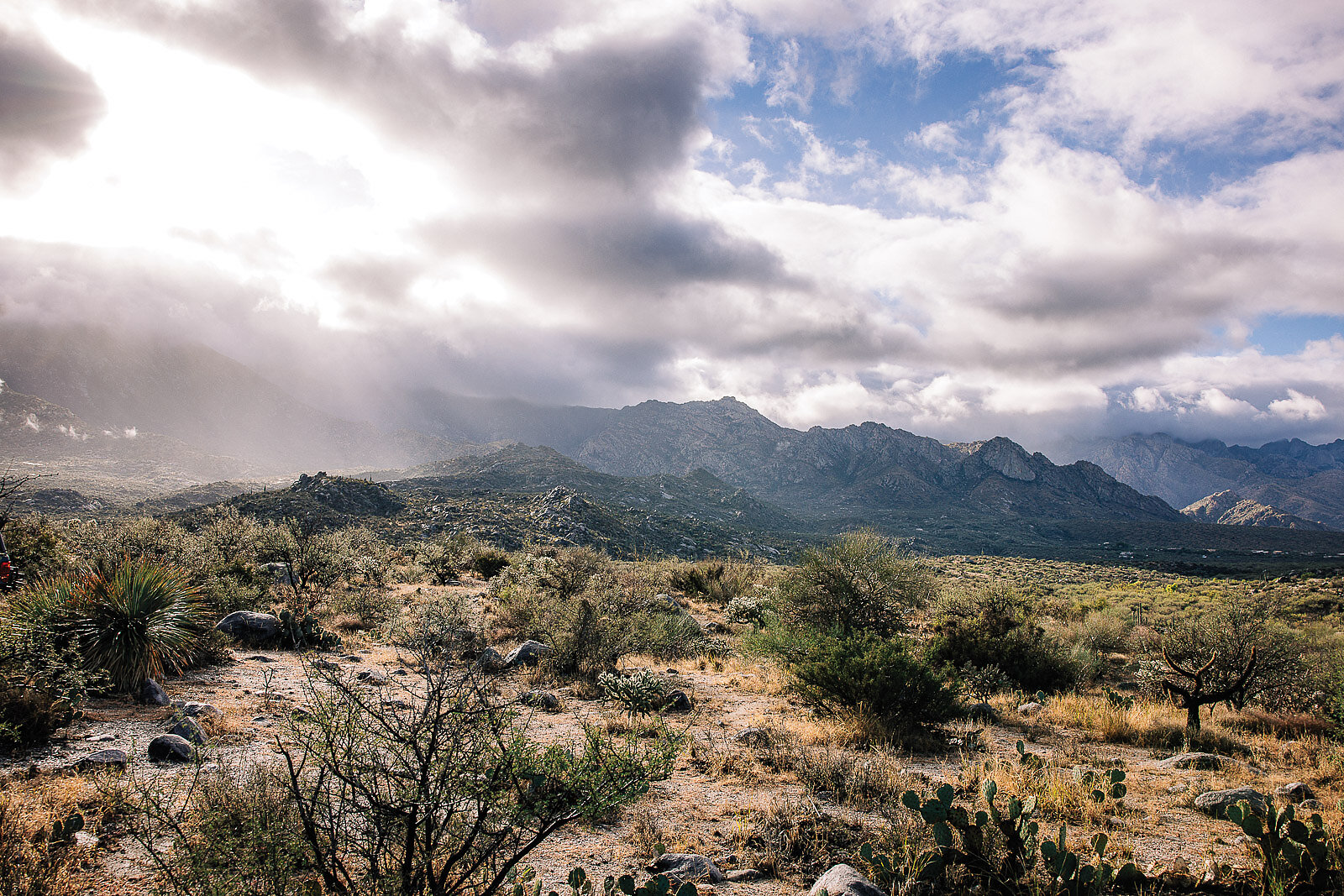
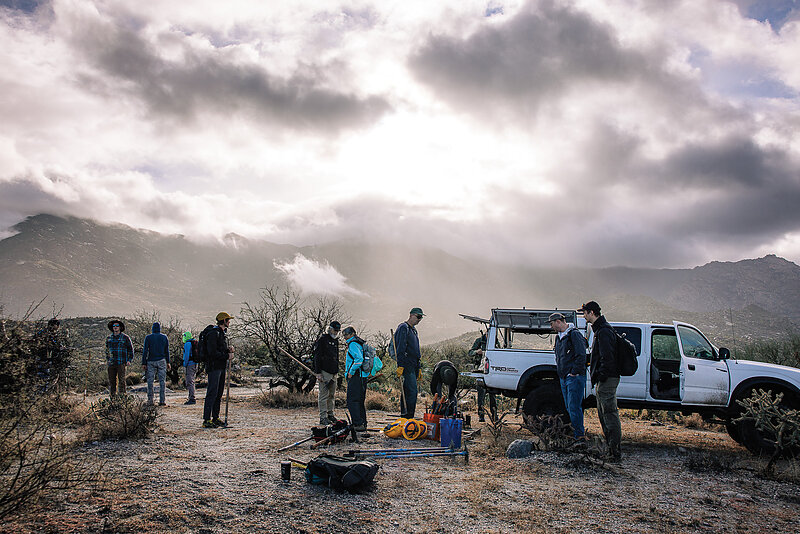
Creating a thriving mountain bike trail system is inherently collaborative. On an early Saturday morning in fall 2025, the Tucson Off-Road Cyclists and Activists (TORCA) hosted a trailwork day a few miles up a mildly rugged dirt road at an intersection with Middle Gate trail in the Coronado National Forest. Morning residual condensation from winter night rainclouds rolled down the west side of the Santa Catalina Mountains as volunteers gather at dawn with dozens of tools laid out on the ground. This is 50-Year Trail—named simply because of an agreement with the State Trust not to develop the land until 2039, and it is a highlight of Tucson mountain biking: fast pedaling and sandy singletrack, slick-rock style slabs, chutes, and jumps.
Nick Giovannucci, TORCA’s president, chats with board members Leland Boeman and Kristina Giovannucci over a map and radios, laying out the plan and discussing how to delegate the work ahead.
“Wow, this is the largest group we’ve had yet!” Nick says, addressing the group that has gathered around ready to get to work.
There are a dozen SDMB members, a dozen TORCA members, and another dozen folks from various regional conservation and environmental advocacy organizations present. For more than 25 years, TORCA has focused primarily on developing and improving mountain bike trails and access within the Coronado National Forest, which includes everything on the “upper mountain” as well as any “lower mountain” trails, such as 50-Year.
Early TORCA leaders spent well over a decade building and developing upper mountain trails like Canada Del Oro (CDO) and Red Ridge, which connect down to 50-Year. But the Bighorn Fire swept through the upper mountain in 2020, effectively destroying many of those trails. Adding to logistical challenges is wildlife habitat protection: for several months in the spring and summer doing any trail work in the National Forest is prohibited to protect creatures like the Spotted Owl during mating season. Restrictions like this mean that most local riders take the view that there are a million other reasons to be happy with what already exists.
Nevertheless, a tenacity to keep exploring and building, a commitment to respecting the environment, and leveraging established relationships and agreements to work in harmony with various managing agencies and lands stewards is what’s pushing the natural evolution of Tucson mountain biking. Above all else, Tucsonan mountain bikers do not take their trails for granted.
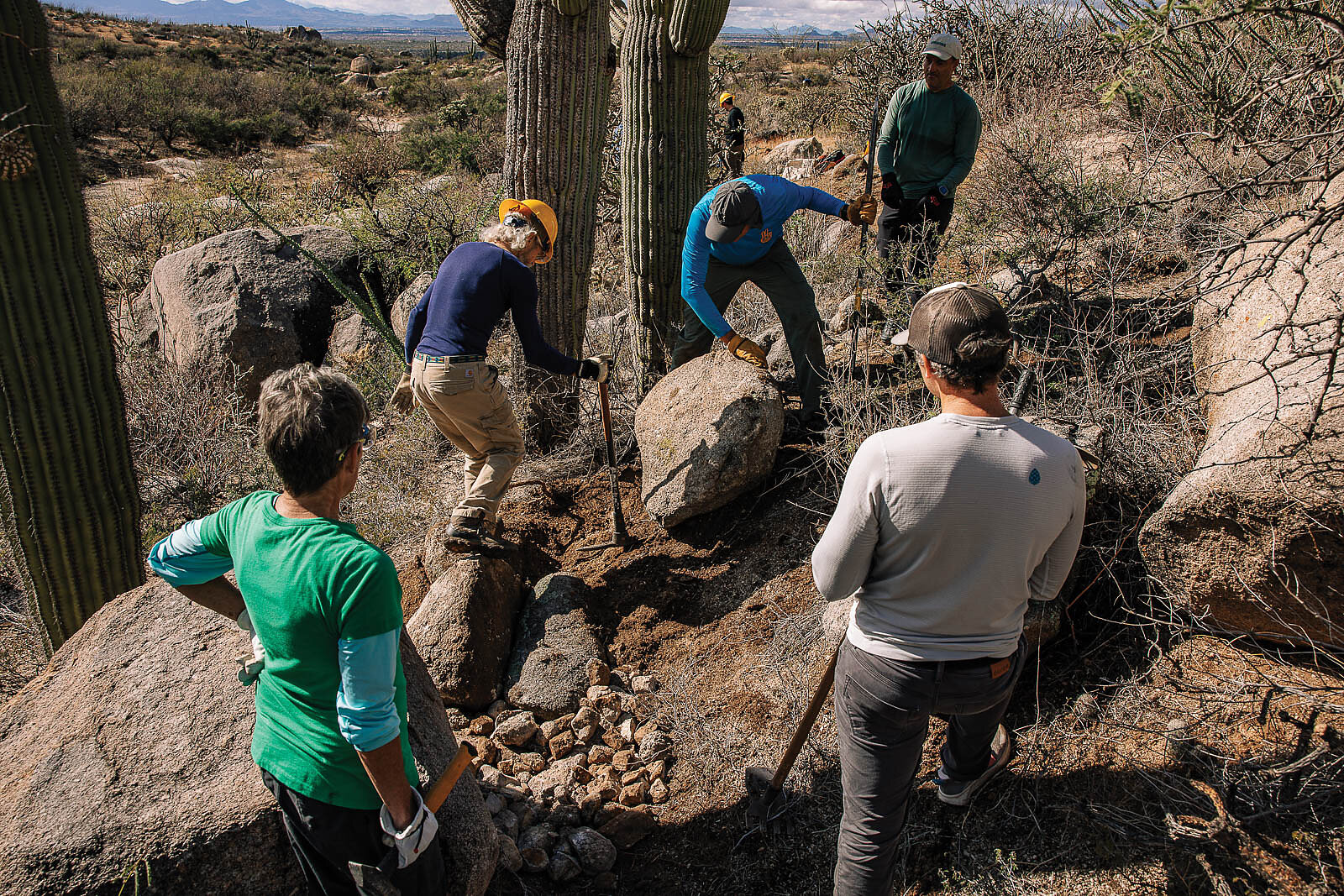
Back on trail, MacDonald surveys a section of trail that volunteers have been working to repair.
“This is fantastic work,” he says. “They were able to clean up this entire lower section of trail yet not change the challenging and rowdy nature of it.”
Just past “the tequila tree” on La Milagrosa trail, MacDonald points out other recent, major trail work TORCA completed in the spring. Milagrosa is a beast of a double-black-diamond trail. It is unrelenting, it is fast, it is rowdy with lots of exposure and many high-consequence sections. It will quickly kick you over the bars if you are not completely focused.
“It really just beats the hell out of you the entire time,” MacDonald says, laughing.
After a mix of pedaling and some lift-your-bike-up-big-rocks to get high and away from Molino basin, a descent over ledgy-rock drops and into blissfully fast downhill sections starts almost immediately. Milagrosa has long been an established trail in Tucson, but only in the last couple decades have organizations like TORCA been able to coordinate with the Forest Service to put in real work to make the trail viable.
The development of good working relationships with the Forest Service, Pima County, the City of Tucson, countless Sonoran conservation organizations, and other recreational user groups has taken decades. Tucson mountain bikers take pride in their history of showing up for each other, of stewardship of the land and the water and the desert.
Northeast of town, regrouping in a clearing after a long, steep, tall railroad-tie-filled hike-a-bike section, MacDonald gathers with SDMB members Mike DeMatties, Evan Santerior, and Luke Bertelsen to check gear and pause to drink water. There is another rider there, lounging against a rock, rolling a joint, his bike leaning against a manzanita tree. The guys make small talk with the stranger and DeMatties starts geeking out on his pink-to-purple-fade, steel full-suspension bike.
“That’s a really cool bike!” DeMatties says.
The rider says something about it being handmade in South America and offers the crew the joint: “Want a hit?”
Politely declining his offer, they share pleasantries and small talk before buckling their helmets and dropping in. Bertelsen is the first off, pedaling away from the clearing and deftly sending it off a rock drop. That is the proper start to Bug Springs trail, a 5-mile true enduro adventure, ripping through five of Mount Lemmon’s seven distinct biomes. Another rock drop comes, then another, and another.
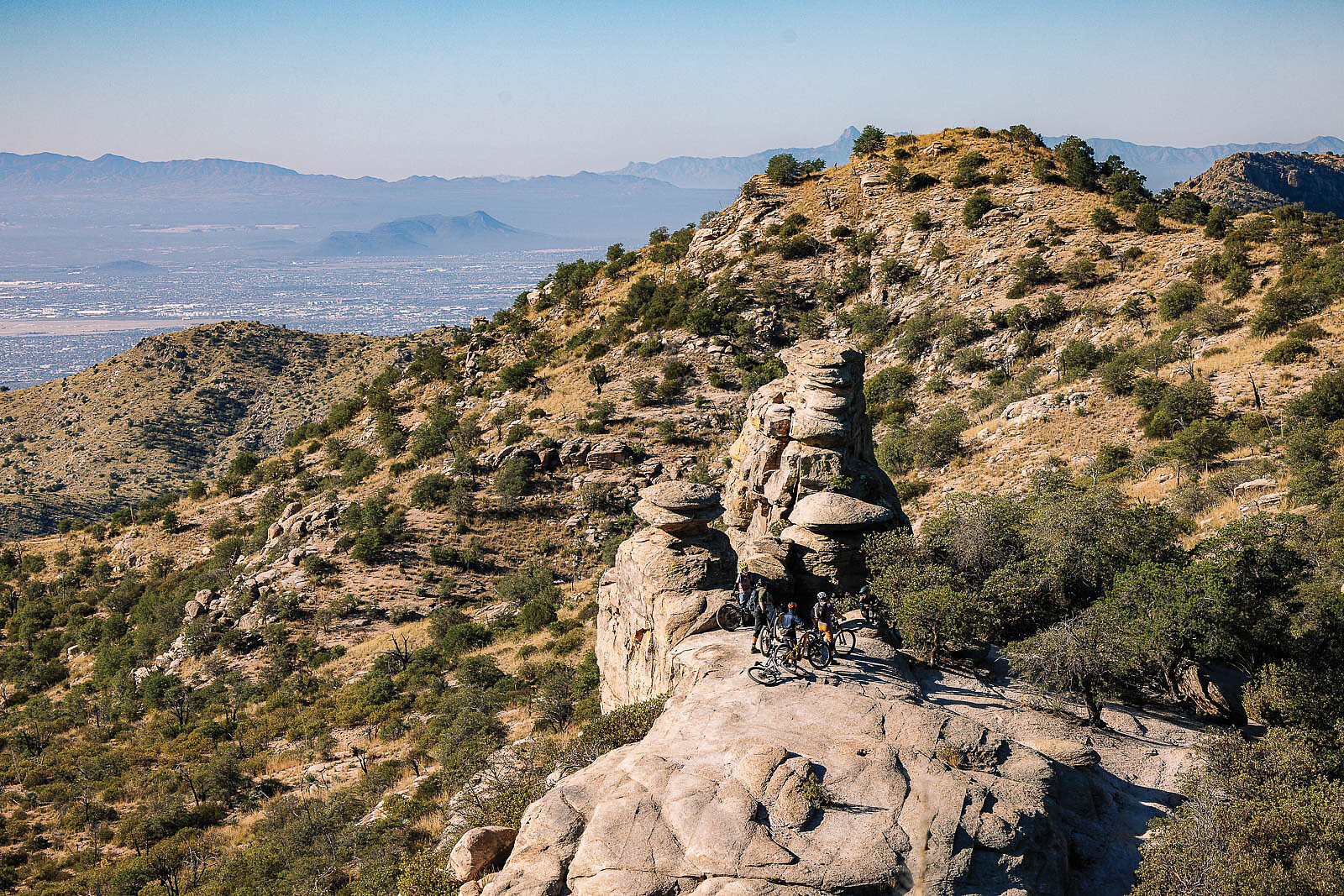
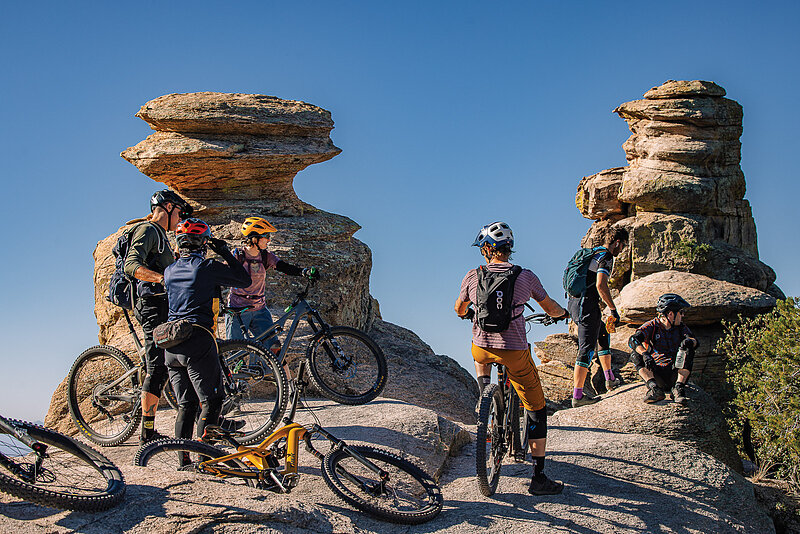
“Bugs” trends downhill, dropping through stream crossings with punchy, rooty climbs to get riders up and out. The ledges and drops and turns keep coming as the trail winds its way through the manzanita and pine trees of the Coronado National Forest. Loamy singletrack sprinkled with pine needles twists and turns through tree canopy before popping out onto a massive, exposed rock hoodoo. The group pauses again to chat with some other riders on the rock, drink water, and enjoy the view before turning to finish the run down through the Gordon Hirabayashi Campground, aka “Prison Camp,” and on to Molino Basin Campground. Most folks ride Bugs as a shuttle from town, leaving one truck down at Molino Basin to pick up later. Other riders, like the joint-toking stranger, pedal an hour or more on pavement to the Bug Springs trailhead alongside roadies and triathletes getting their workouts done on the Mount Lemmon Scenic Byway climb.
If you continue southeast from Fantasy Island there is a literal vortex—the Vail Vortex—another system of “social trails” born out of need, of desire, bordering on illegality and under constant threat of housing development and urban growth as Tucson’s roots splay farther out in the coming decades.
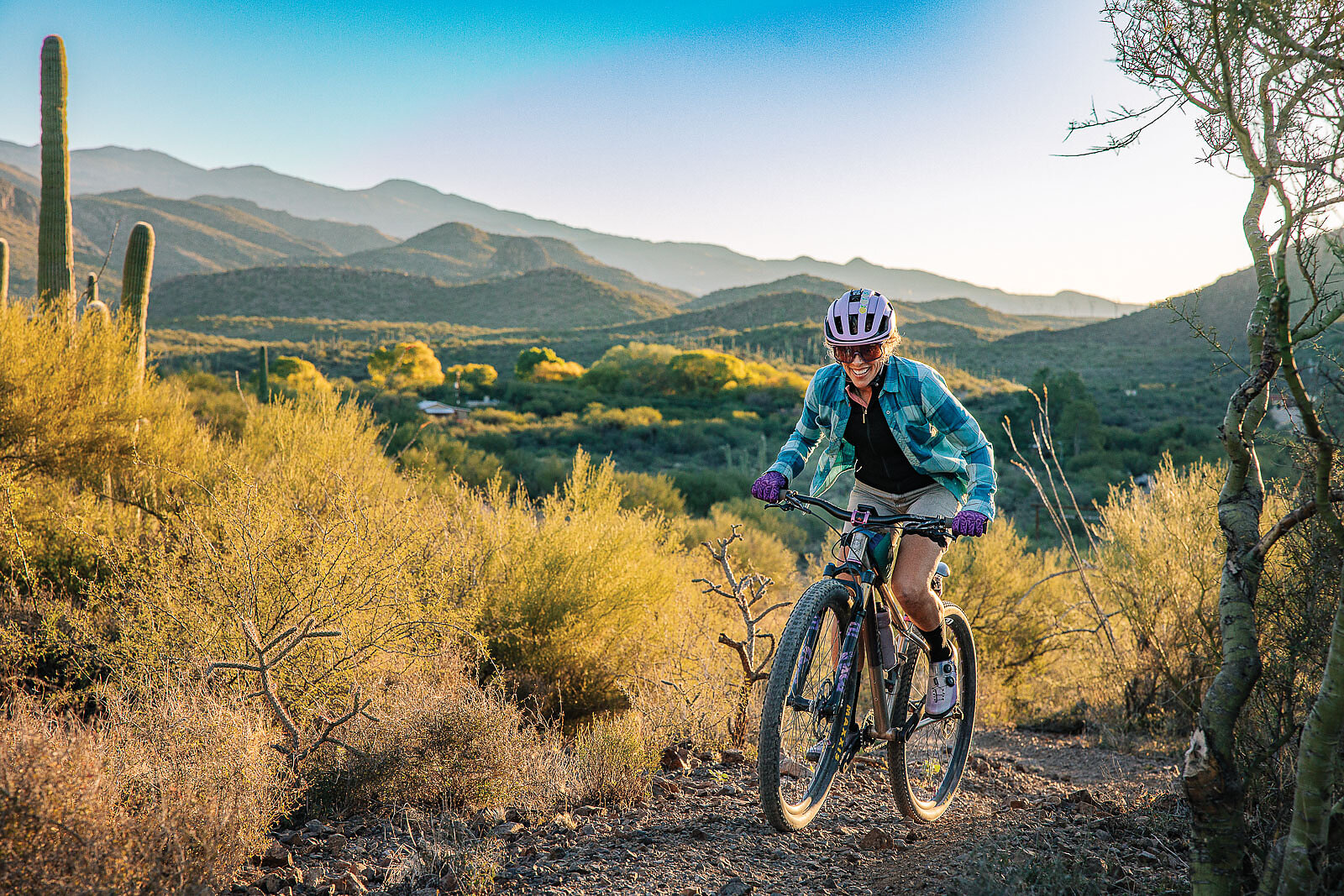

Jody Bartz swore she would not move back to Tucson, yet she made her way to the Vail area and embraced mountain biking completely. It comes easily. Her doorstep is now close to more than 20 miles of punchy and flowy singletrack in the Vail Vortex with multiple dirt connectors to incredible sections of riding on the Rincon Creek, Colossal Cave, and Cienega Creek sections of the Arizona Trail (AZT).
Bartz founded GRO girl GRO (Gathering and Recreating Outdoors) a nonprofit whose mission aims to empower girls to “learn to give back, be responsible, and take ownership” through getting out on bikes.
On a crisp morning, Bartz puts on cut-off jean shorts and a warm flannel shirt to hop on her single-speed 29er and pedal down through the Vortex to La Posta Quemada Ranch to meet a client for a one-on-one coaching session.
“That’s it! Elbows relaxed, eyes ahead!” she says, shouting as she watches intently. “You got this!”
Bartz is invested in what she’s doing to the point that it feels visceral. She truly cares about the people she works with and loves seeing them improve. When she’s not running camps or clinics and empowering young women and girls, she works one-on-one with mountain bikers of all genders to help them improve their technique and confidence on the bike. And there is no better place for it. Between dozens of miles of stunningly beautiful sections of flowy AZT, the rugged and rocky pitches in Vail Vortex and Colossal Cave will challenge and awe all who ride them.
The vast mountain bike community of Tucson is made stronger through great opportunities for skills clinics with coaches such as Bartz, frequent rides and meet-ups through groups like the Tucson Women’s Shredders, and trailwork days with SDMB and TORCA.
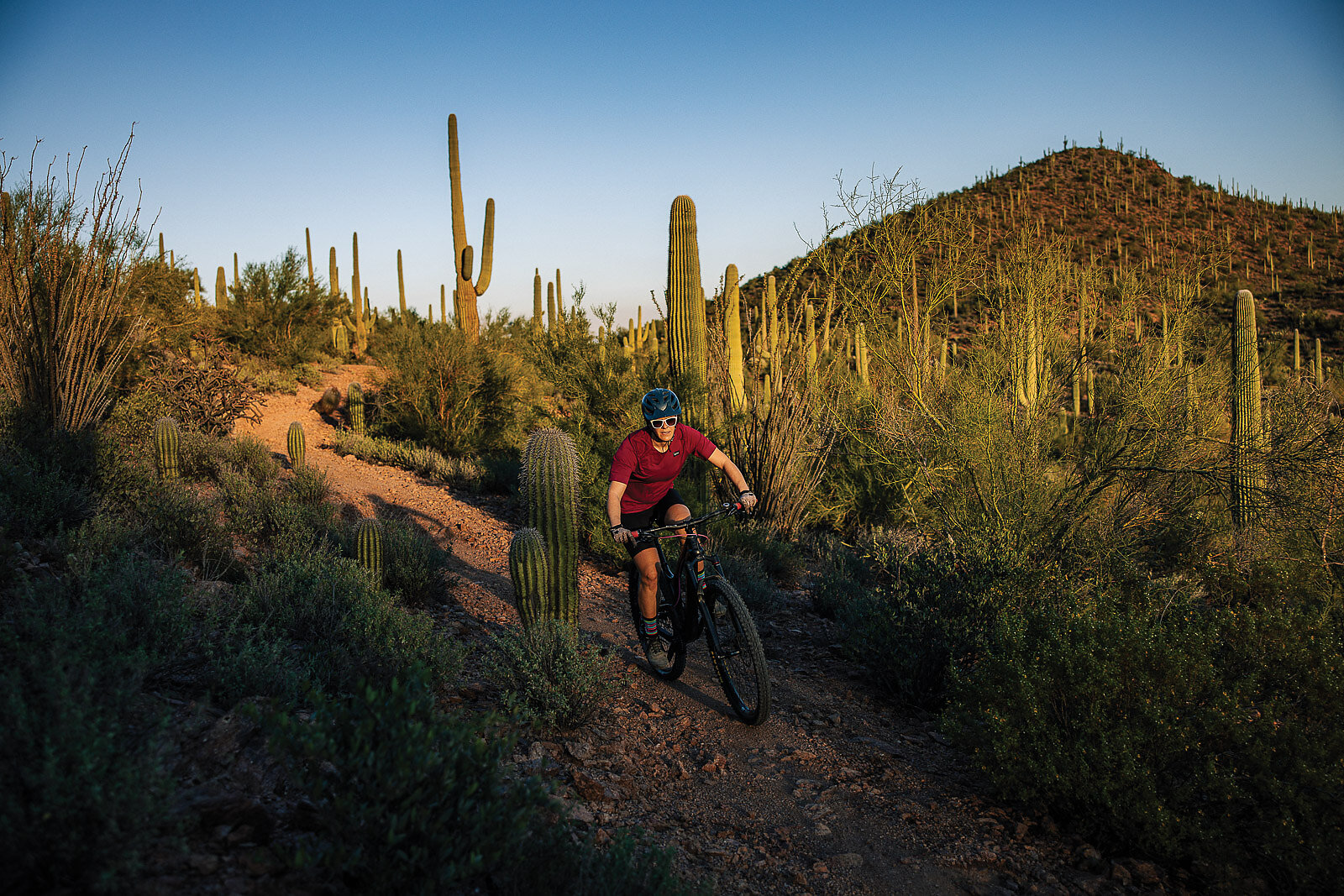
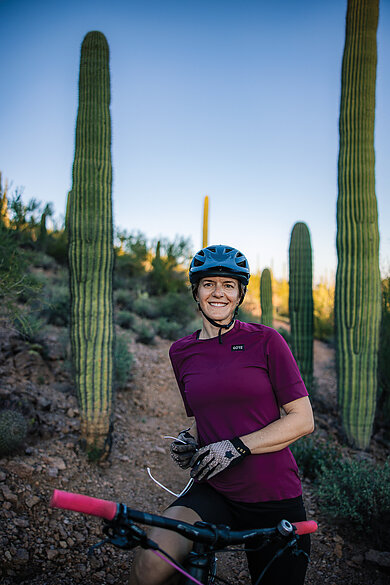
Van Roekel recalls first getting into the sport. While serving with the Peace Corps, her program director in Africa was an avid adventure cyclist or, as she puts it, “something we would call a bikepacker these days.”
Intrigued by his stories and love of this wild and rowdy type of off-road bike riding adventure, she was curious to try it. After she finished her Peace Corps term and returned to Tucson, she bought a rigid, steel mountain bike with no dropper and started riding in Tucson Mountain Park, the trails she could ride to from her house.
“I didn’t know any better, it was rough!” she says. “And I thought, ‘Whatever, I just need to ride harder.”
It wasn’t until after she took a skills clinic with Tara Alcantara from Homegrown Mountain Bike Tours that Van Roekel realized the limitations of her original equipment.
“I had rented a dual-suspension mountain bike from Homegrown and that was a game-changer for me,” she says.
Van Roekel left that clinic and bought a decent dual-suspension mountain bike and began riding more and more. In an almost-parallel timeline, Tucson’s trails were getting better and better. The Robles Pass trails became her favorite stomping ground, ducking her head while riding through the drainage tunnels under Ajo highway to the Camaro loop and back, and connecting the over 100 miles of singletrack in Tucson Mountain Park. On longer days, she’d ride the Fantasy Island trails before heading up to the Sweetwater park trails, sometimes even riding up to Honeybee and back. New trails, meant more mileage. All within riding distance of town.
As Van Roekel attended more group rides and meet-ups organized by shops like Campfire Cycling, Guru Bikes, and Transit Cycles, she realized she wasn’t improving her technical skills by riding with the guys because she was faster than them. So, she started a “Foxy Friday” ride with a girlfriend solely to cheer each other on and practice skills on the technical and rocky singletrack in Tucson Mountain Park with friends. It wasn’t until she started sessioning with the ladies that she started progressing technically. Riding to the top of Explorer trail wasn’t just a small personal victory. It was the manifestation of decades of mountain bike advocacy and trail work. Elliott Milner can relate.
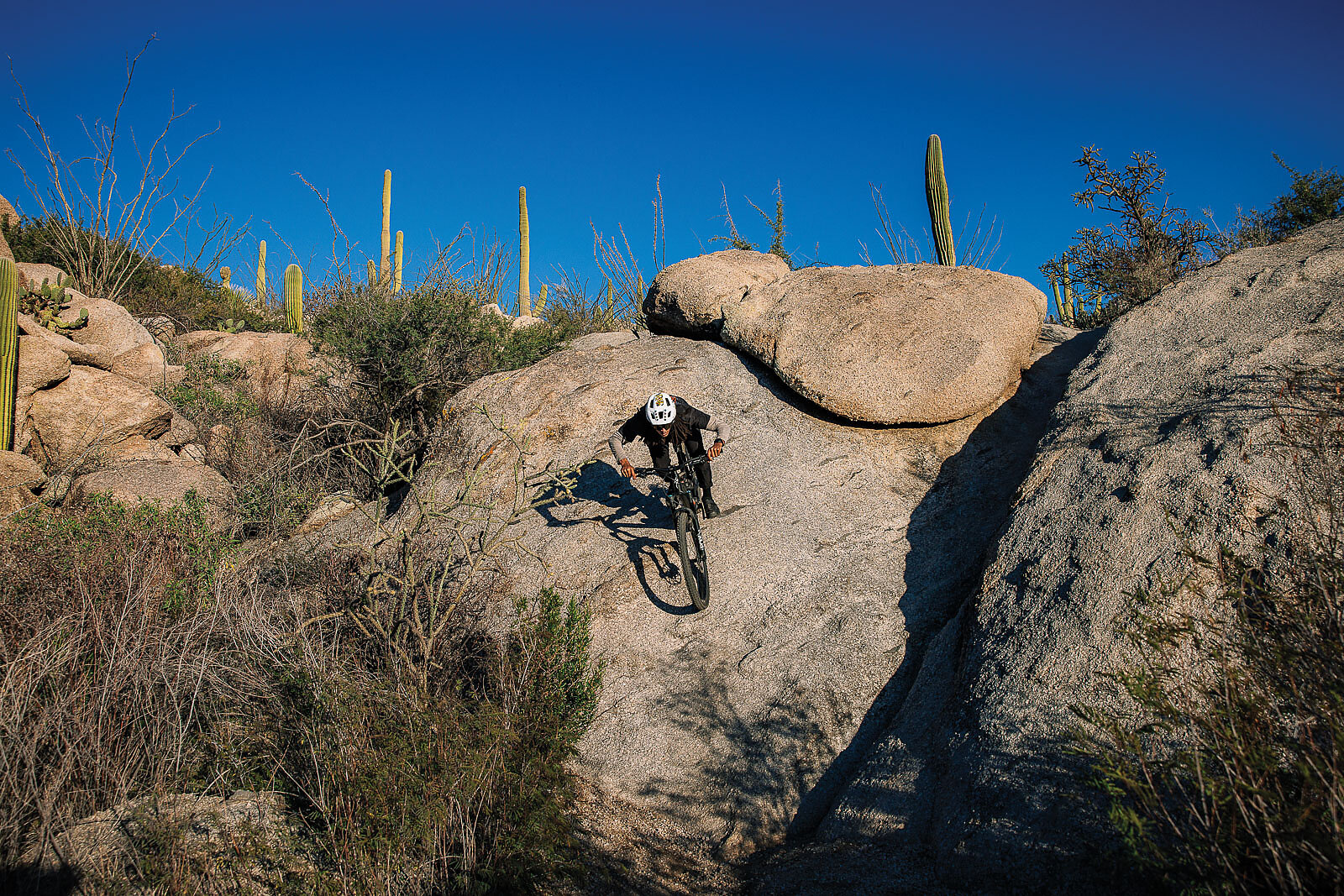
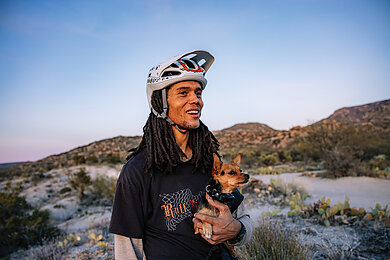
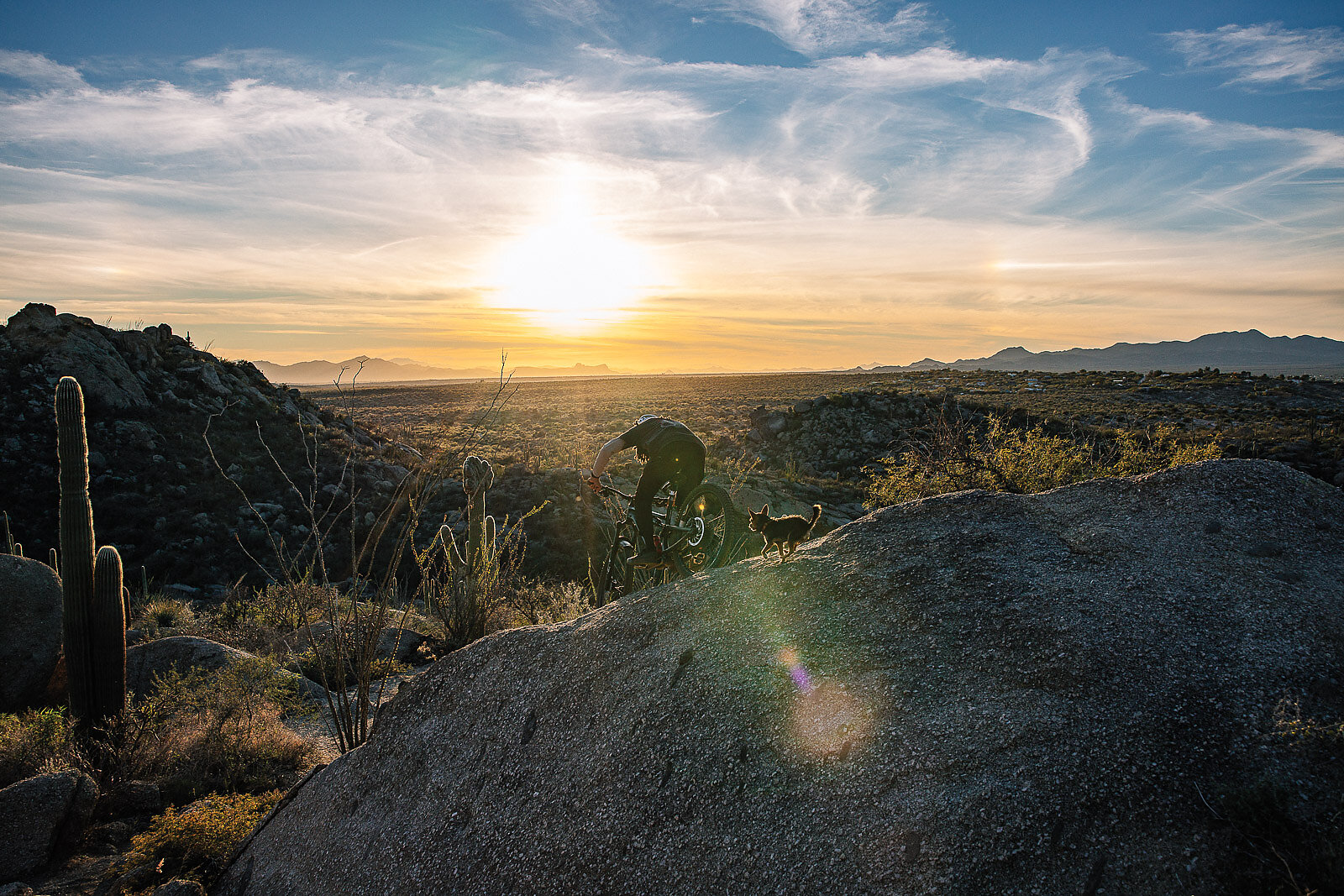
“I moved here for this—the silence, the space,” Milner says with a grin. His eyes are wide and sparkling in the blazing sunset glow. Gesturing with his open palm to the vast Sonoran Desert, a crested saguaro in the foreground, nothing but mountains and cacti and trees and desert beyond.
Reaching over his shoulder he pets his dog Frankie’s head and checks to make sure she is tucked safely into his backpack. Then he clips in and pedals effortlessly into Upper 50-Year trail. Popping his front wheel up and rolling over a granite boulder, they disappear out of sight down the other side of the massive slab.
“I drove out here from L.A. a few years ago and just rode everything I could,” Milner says. “Milagrosa, 50-Year, Starr Pass, Honey Bee, Tortolita.”
Milner had spent time in Sedona, been to Moab, and had ridden trails all around Phoenix and Flagstaff. Still, he felt nothing had the variety, challenge, and difficulty level that Tucson has to offer.
“I figure, if I ride this stuff on the regular and can get comfortable on it, like, how good I would be?” he says.
So, he packed up and moved to Tucson full-time. The mountain bike trails drew him here initially, but it was the pace of life—la cultura—the serenity, and the access to quiet wilderness areas that captivated him. He goes out to 50-Year regularly, driving down the same jeep roads that TORCA, SDMB, and every other Tucsonan mountain biker uses to spread their personal roots and grow while connecting to the Sonoran Desert on their bicycles.
It’s easy to ride year-round in Tucson and hit a different trail every weekend. SDMB and TORCA continue to build and develop trails across the Madrean Sky Islands. The relationships between the diverse outdoor recreational user groups, conservation organizations, and managing agencies has never been better. The bikes have evolved, trails became accessible, and the riding community has grown. Tucson’s mountain biking roots continue to spread—reaching outward, connecting, and thriving in the Sonoran Desert.