Groundswell Waves of Change Hit Maui's Trail Community
On a breezy Sunday afternoon at the West Maui Bike Park, the kids are champing at the bit. They huddle around Ray Watson, their tufts of sun-bleached hair poking through the vents of their helmets.
“Uncle, uncle! Can we ride yet?”
Not yet. Watson sends them back into the park with five-gallon buckets and miniature McLeods.
They scatter toward the red-dirt jumps and pumptrack, eager to earn the right to ride—and to eat birthday cake afterward. It’s the first birthday of Watson’s son Louie.
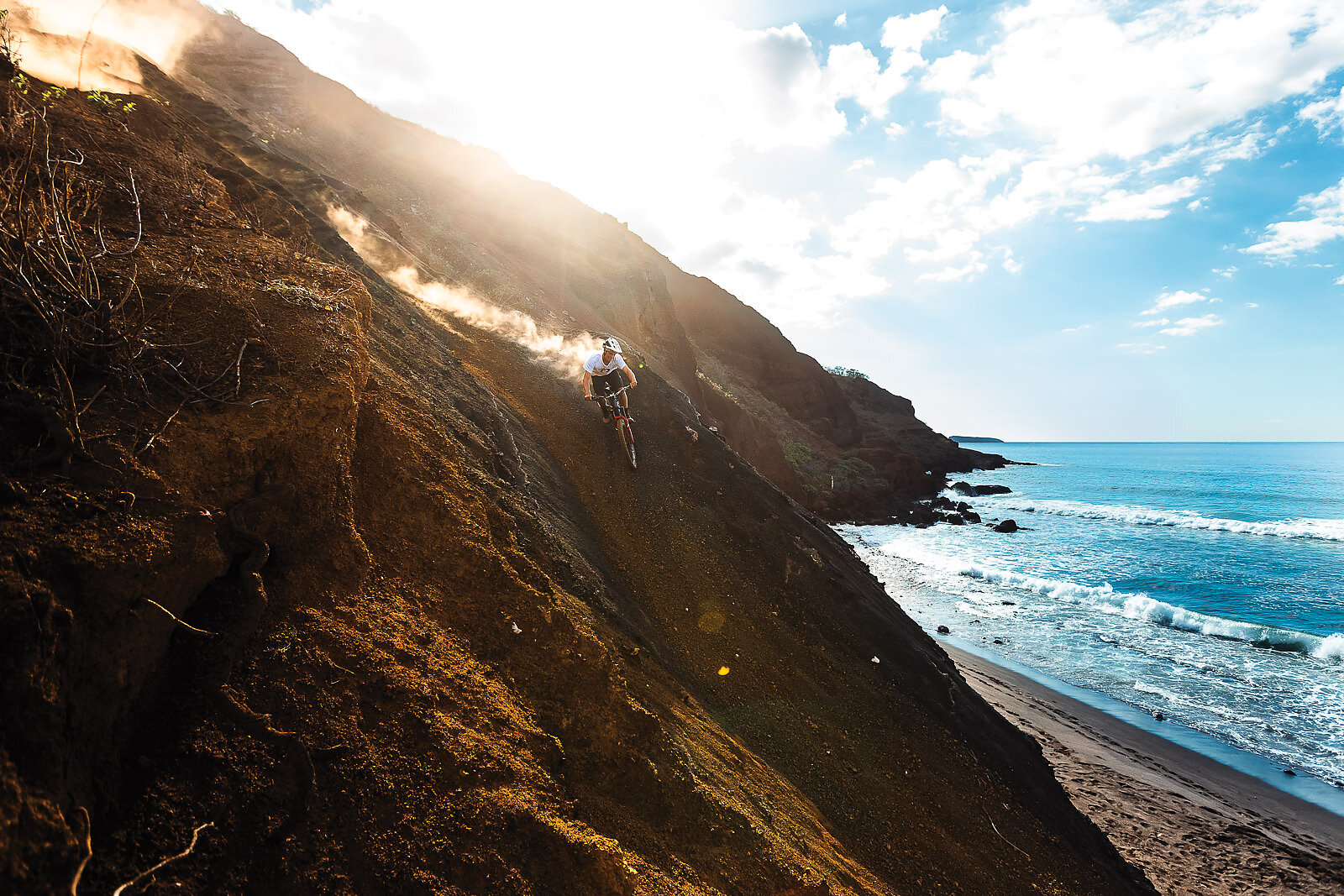
Just beyond the park, on the seaward side of the highway that loops around West Maui, lies Napili, a tidy pocket of homes and low buildings pressed between road and reef. Beyond that, the islands of Lāna‘i and Moloka‘i rise from the water like the rounded spines of humpbacks. Beyond that, there’s nothing but open ocean.
In Hawaiʻi, water defines everything. The islands sit isolated in the middle of the Pacific, ringed by ocean in every direction, and culture has long oriented itself toward what happens seaward.
Hawaiʻi’s first inhabitants arrived by canoe, navigating open water by the stars and swell. Today, surfboards still outnumber bicycles by orders of magnitude. So do canoes, sailboats, and kite rigs. The shoreline remains the most obvious place to play.
But the mountains matter just as much. On Maui, the massive Haleakalā volcano dominates the island’s eastern half, rising more than 10,000 feet above sea level. Its slopes, along with the West Maui Mountains, shape everything from weather to water supply. Trade winds push moisture up the windward sides of the island, where rain feeds streams and aquifers. The leeward slopes stay drier, browner, and more fragile.
So central is this relationship that the language itself is organized around it: mauka for toward the mountains, makai for toward the sea. Fresh water flows from upland forests through watersheds, sustaining agriculture, communities, and ecosystems below.
Recreation in Maui’s mountains has always existed, but for fewer people, and often as an afterthought to surfing. Mountain biking was the same, with a small crew of riders making do with little infrastructure. Growth has been stunted by complicated access issues. With limited land divided between public agencies and private owners, mountain biking on Maui has always lived on the fringes. It has survived though, from rogue trails in the forest to sanctioned experiments on public land. Now new partnerships on private holdings are reshaping what access might look like next.
When Donnie Arnoult moved to Maui in the late 1990s, he wasn’t looking for mountain biking. He was riding his road bike when the mountain bikers found him.
“I can’t remember where I was,” Arnoult says, “but this guy stops me and says, ‘Hey, we’re doing a mountain bike trip over to Lāna‘i. We chartered a boat. You interested?’”
Arnoult had only been on the island for a few months and had no reason to decline the invitation. There were about 25 riders on the boat. “And we’ve been friends ever since,” he says.
If that kind of invitation feels foreign now, it helps to remember how small the mountain bike scene was back then. According to United States census data, only around 92,000 people lived on Maui in 1990, and most recreation revolved around the water. By the time Arnoult arrived, however, mountain biking had already taken root.
“There was a scene,” says Aaron “Moose” Reichert, who arrived on Maui in the 1990s and took his first mountain bike ride on the island in 1998. “People were riding.”
According to Arnoult and Reichert, the riding then centered in two places. One was Polipoli Spring State Recreation Area, on the southwestern flank of Haleakalā, where riders linked together existing trails and fire roads. The riding was legal, if not exactly designed for mountain bikes.
“We improvised,” says longtime rider Marty Hearne. “We’d hit the pu’us, little cinder cones, coming off the Skyline Trail.”
The other place was less official. Riders simply called it “the forest.”
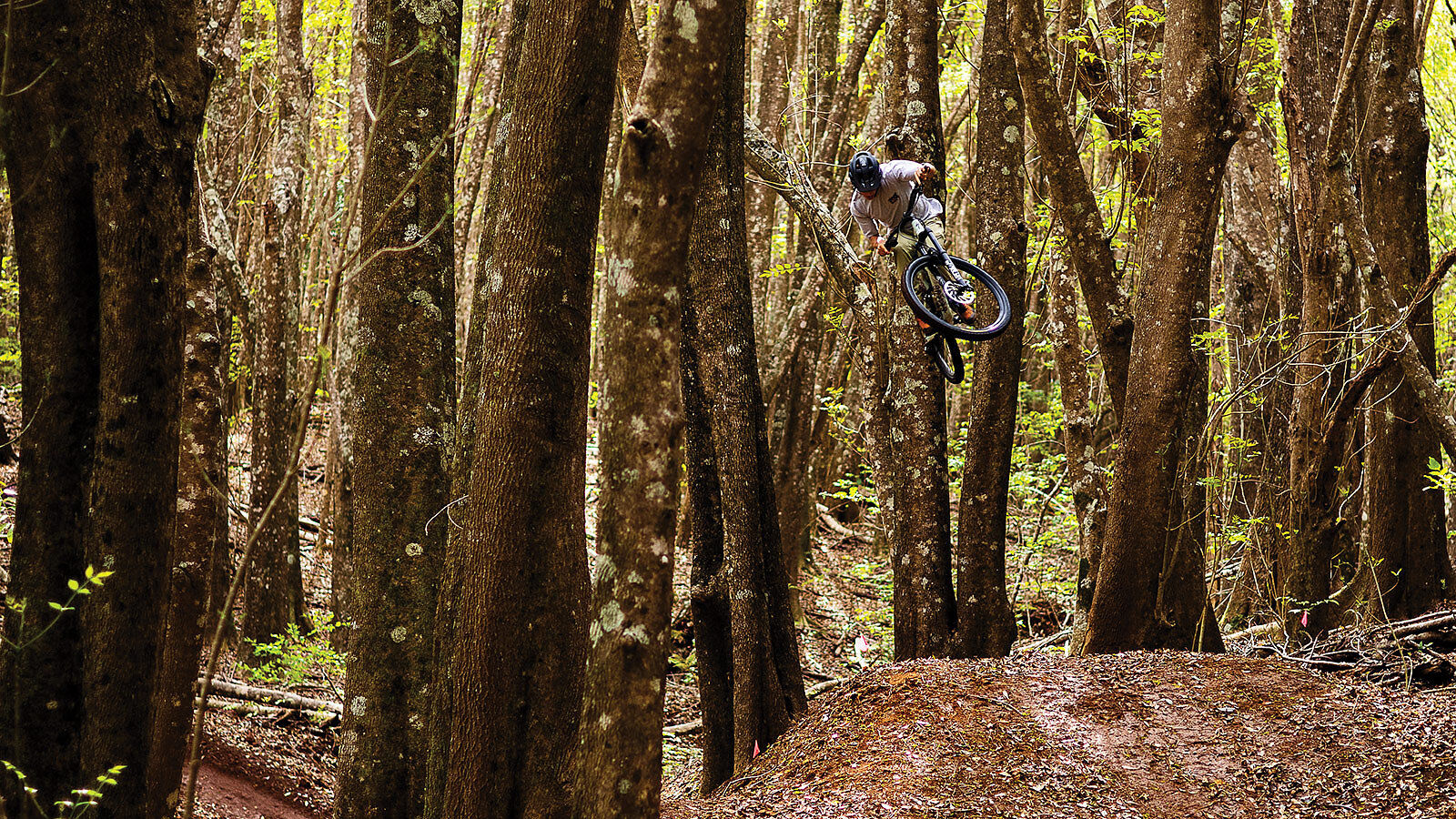
Above the rustic cattle town of Makawao, in the Makawao Forest Reserve, riders had begun to dig a network of trails under the dense canopy. The lines were steep, and the dirt was loamy. They weren’t unique because they were illegal, but because they revealed what Maui’s early riders valued. Jumps and drops were common.
“It was like seven, eight, nine, 10 percent,” Arnoult says. “Way harder than what they build now. We were younger and stronger. We didn’t care. You didn’t want a switchback. You wanted to see if your buddies could hang.”
Every so often, Maui’s mountain bike scene hit the spotlight just long enough to confirm it was real. In 2004, a segment of the cult classic film “The Collective” featured riders dropping into a natural bowl known as the Sinkhole, carpeted in green and tucked between two gulches on Maui’s remote northeastern coast. A decade earlier, an MTV film crew showed up near Haleakalā, and anyone with a bike came out hoping to be included.
“Everybody and their brother showed up with a bike of any sort and were just flying down the hill,” Hearne says.
On an overcast Sunday in December of 2025, Hearne and a buddy were loading their dirt-speckled eMTBs into the bed of a white pickup in the Kahakapao Recreation Area parking lot. They’d just wrapped up the second of their weekly rides in the forest—something they’d been doing long before anyone called it a recreation area. Kahakapao sits within the Makawao Forest Reserve, a roughly 2,000-acre parcel on the windward slopes of Haleakalā. The reserve was established in 1908 to protect watershed and forest resources.
Riders like Hearne had been threading their own lines through the forest since the early 2000s, but in 2003 the state constructed the Kahakapao Loop Trail, a multi-use path that formalized some of that activity. But as mountain biking grew, so did the network of unauthorized trails in the forest. By the early 2010s, that network had grown far beyond what land managers realized.
The state responded by abruptly bulldozing several illegal trails. For riders who had spent years quietly building and maintaining what they rode, it felt like an erasure.
“That was the moment,” says Reichert. “We realized we couldn’t just keep doing what we were doing.”
Rather than retreat, Reichert and a small group of riders decided to organize, forming the Maui Mountain Bike Coalition (MMBC) in 2012. The group had a simple premise: If mountain biking was going to survive on Maui, it would have to make sense to the people who managed the land. Working with the state, the coalition pursued an environmental review that would allow for a purpose-built mountain bike trail system within the Makawao Forest Reserve. Volunteers were mobilized and professional trailbuilders were hired.
When the Kahakapao Recreation Area officially opened in June of 2015, it represented something close to a best-case scenario: a sanctioned, state-funded mountain bike trail system with machine-built flow, wooden features, and technical progression. The trails were so good that even riders who had cut their teeth on the rogue lines weren’t bitter about what replaced them.
“For state land, this was cutting edge,” says Justin Varaljay, who maintains forest trails with his company Flow Farm Pacific. “You just didn’t see this level of progression anywhere else here.”
But the success at Kahakapao also revealed the limitations of doing everything right. Further expansion would require new environmental approvals. Although the state’s Department of Land and Natural Resources had secured nearly $700,000 to bring the project to life, future funding was never guaranteed. Momentum at the coalition level slowed.
“It was a bit like, ‘OK, we did it,’” Varaljay says. “The biggest mistake was not drawing more trails on the management plan.”
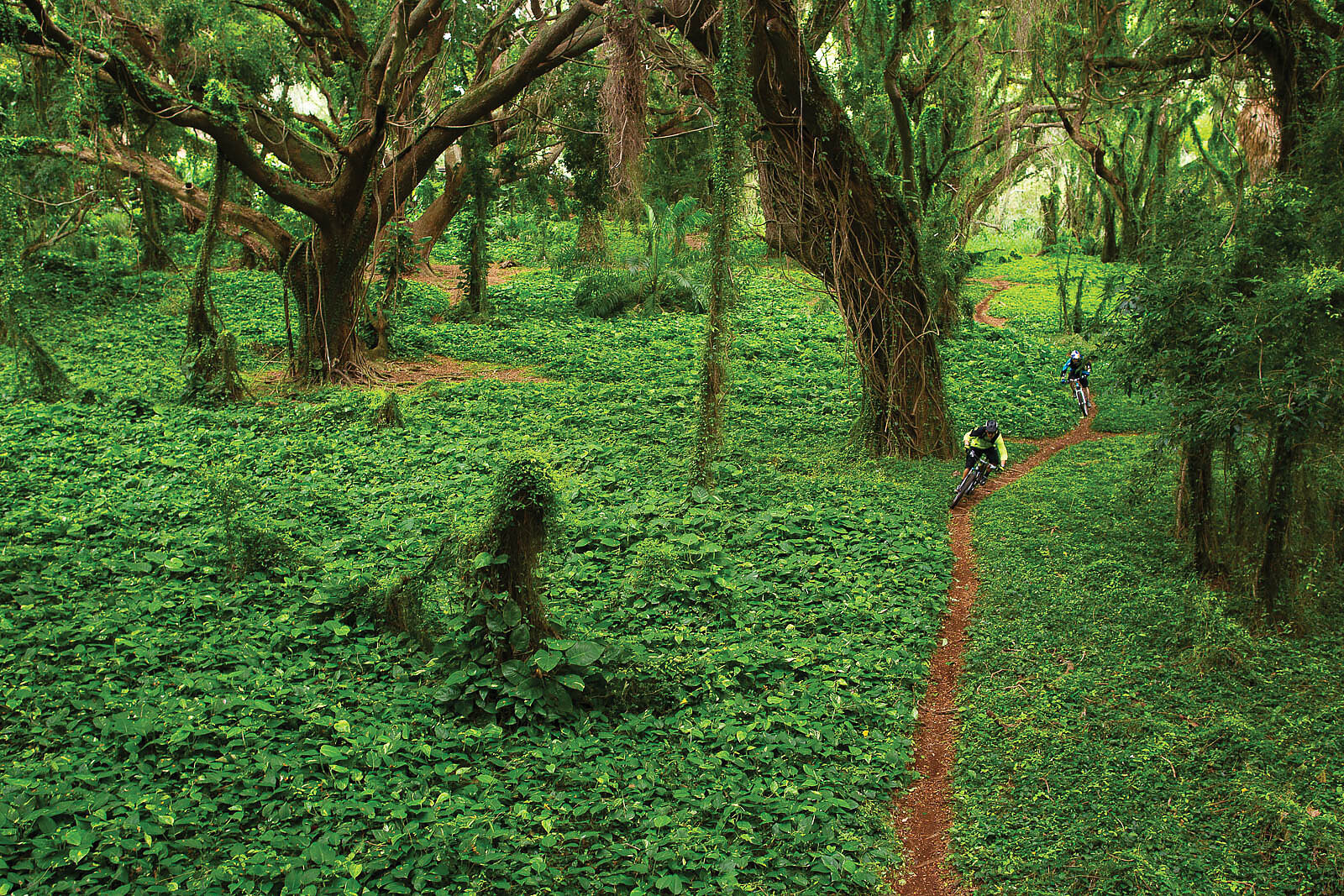
Anyone who rides in the forest will tell you how much opportunity still exists for future development. Dense stands of eucalyptus and pine give way to fern-covered slopes and deep, loamy soil. Drainages fall away steeply, offering natural lines that seem purpose-built for bikes. According to some riders, rogue trailbuilding is still alive and well.
Though the Kahakapao project proved that mountain biking could belong on Maui’s public land, it’s also a reminder of the hurdles that remain once it does. For some riders and builders, the limitations of public land were forcing them to look at the island’s large tracts of private land: farms, ranches, and vast parcels once developed for sugarcane and pineapple production.
Prior to taking on the maintenance work in the forest, Varaljay had spent considerable time building on private land, where approvals could be informal and momentum came easily. But he’d learned that permanence is never guaranteed.
“The problem with private land is that they can kick you out,” he says. “The problem with public land is that it just takes forever.”
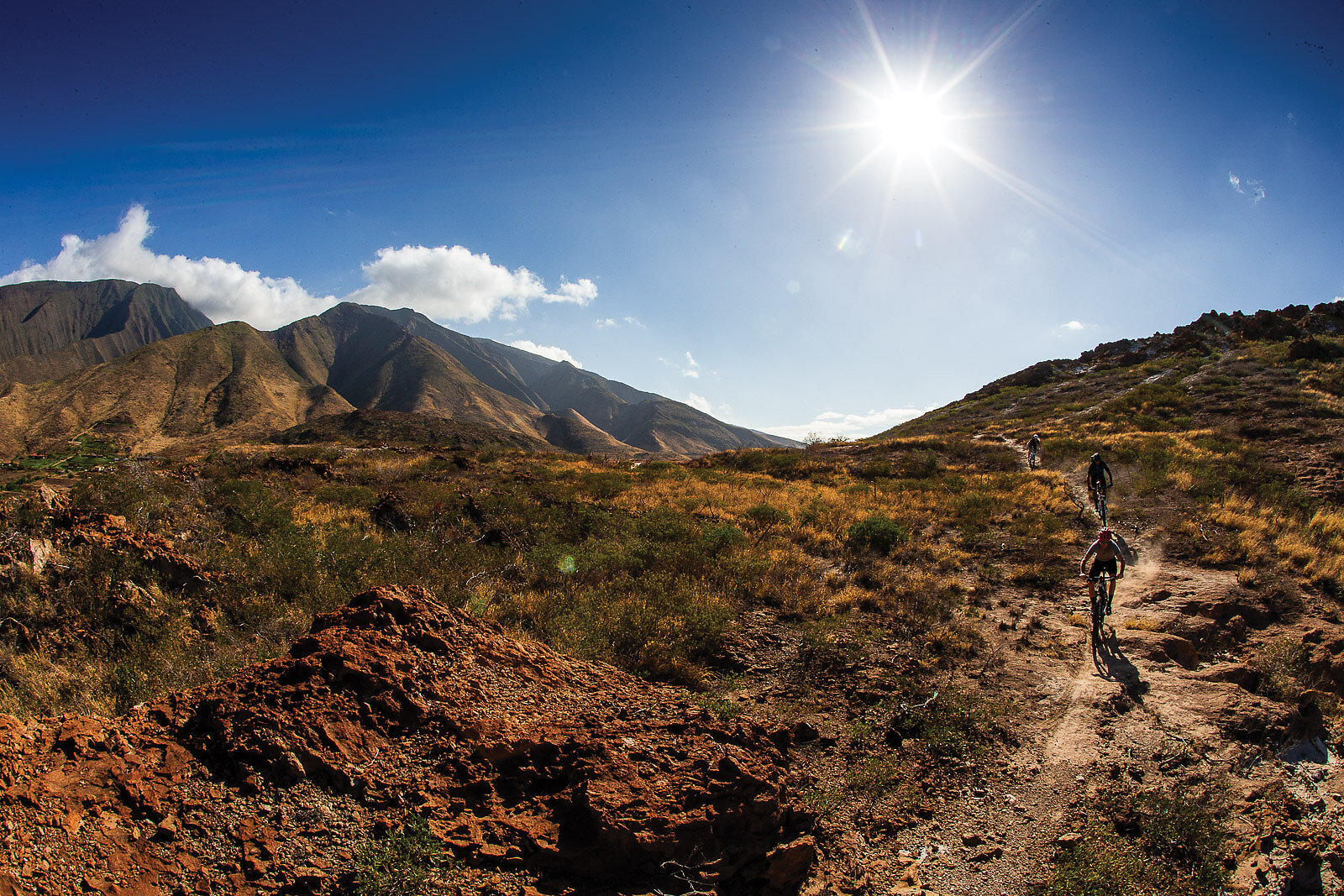
Much of Maui’s west side is privately owned, and the land looks nothing like the damp forests of Makawao. The slopes above Napili are open, dry, and exposed. Sugarcane roads snake mauku from the highway toward higher elevations, remnants of a century-and-a-half of plantation agriculture. Old irrigation ditches cut across the land, and guinea grass chokes abandoned buildings. In August of 2023, this altered landscape further fueled the devastating Lahaina wildfires, which killed more than 100 people and burned the historic downtown area as well as surrounding areas.
This was the landscape that Watson was studying when he began combing Google Earth late at night, toggling between parcels, ownership maps, and topography. He wasn’t thinking strictly like a trail-builder. He was thinking like a developer, trying to determine which private land might be suitable and available for trail development.
For years, Watson had toiled to maintain a tangle of trails near his home in Napili, where singletrack had been used for the XTERRA World Championship from 2011 to 2021. The trails, which cut through a defunct golf course and surrounding plantation land overlooking a bay with some of Maui’s best snorkeling, were prone to rapid vegetation growth and required constant upkeep. He worked tirelessly clearing brush, sometimes toting his young daughter Lyla in a backpack while he hacked away at the overgrowth. He even recruited riders he met on the trails to help. But the speed with which the vegetation grew made the effort untenable.
So, when XTERRA announced its departure from Maui in 2021, Watson reached out to Reichert, who had helped form the MMBC nearly a decade earlier, for ideas. Reichert suggested reviving the coalition, which had gone quiet in the years since the Kahakapao project had finished.
Watson seemed like the right person to inject new energy into the coalition, and in 2022, he became its new president. He understood that legitimacy would matter if they wanted to ask for more.
“I knew being rogue wouldn’t get us anywhere,” Watson says. “Everyone knows that guy who just grumbles and complains. To make a lasting impression, you have to follow the proper channels, no matter how frustrating it is.”
Within a year, the group had secured a right-of-entry agreement from the landowner to maintain the former XTERRA trails. As these were Watson’s backyard trails, part of his motivation was practical. But some of it was strategic. If the coalition wanted to propose new projects, it would need to be on good terms with the people who owned the land.
That landowner was Maui Land & Pineapple Company, which owns about 22,000 acres on the island, much of it concentrated in the West Maui Mountains. For years, Watson, Reichert, and others had tried without success to convince the company to lease land for a trail project.
In 2023, the ground shifted. Months before the Lahaina fire, Maui Land & Pineapple underwent a leadership transition. The new executives were more willing to listen to Watson, now speaking on behalf of the coalition. Two proposals followed, and while both were rejected, for the first time, there was a real seat at the table.
In the third attempt, Watson changed tactics. Instead of asking for space in the woods, he looked for land that had little development value. That’s when he found the sedimentation basin: a five-acre pit carved decades ago for a pineapple plantation’s runoff, sandwiched between a school campus and the Napili Farmers Market parking lot. He quickly realized the zone had massive potential for an actual bike park.
“This landowner owns 22,000 acres,” Watson says. “We could’ve found five acres somewhere in the woods and built something my friends and I could enjoy, but we could never have built a park out of it. It would’ve just been some janky thing in the trees. Once I set my mind to it, it was like, ‘We can do this.’”
The proposal struck the right chord with Race Randle, who’d become the CEO of Maui Land & Pineapple just months before the Lahaina wildfires. They reached an intentionally modest agreement on a multi-year lease of a small parcel with clear expectations. The MMBC would build and operate the park. Maui Land & Pineapple would allow the experiment to exist.
“It had taken a while to find something that checked all the boxes,” Randle says. “We wanted it to be low risk, and we wanted to make sure the execution could be good. You don’t want people to think it failed, and you don’t want it to be so big that it almost gets done.”
Once the green light to build trail came, a convergence of people, funding, and resources coalesced quickly.
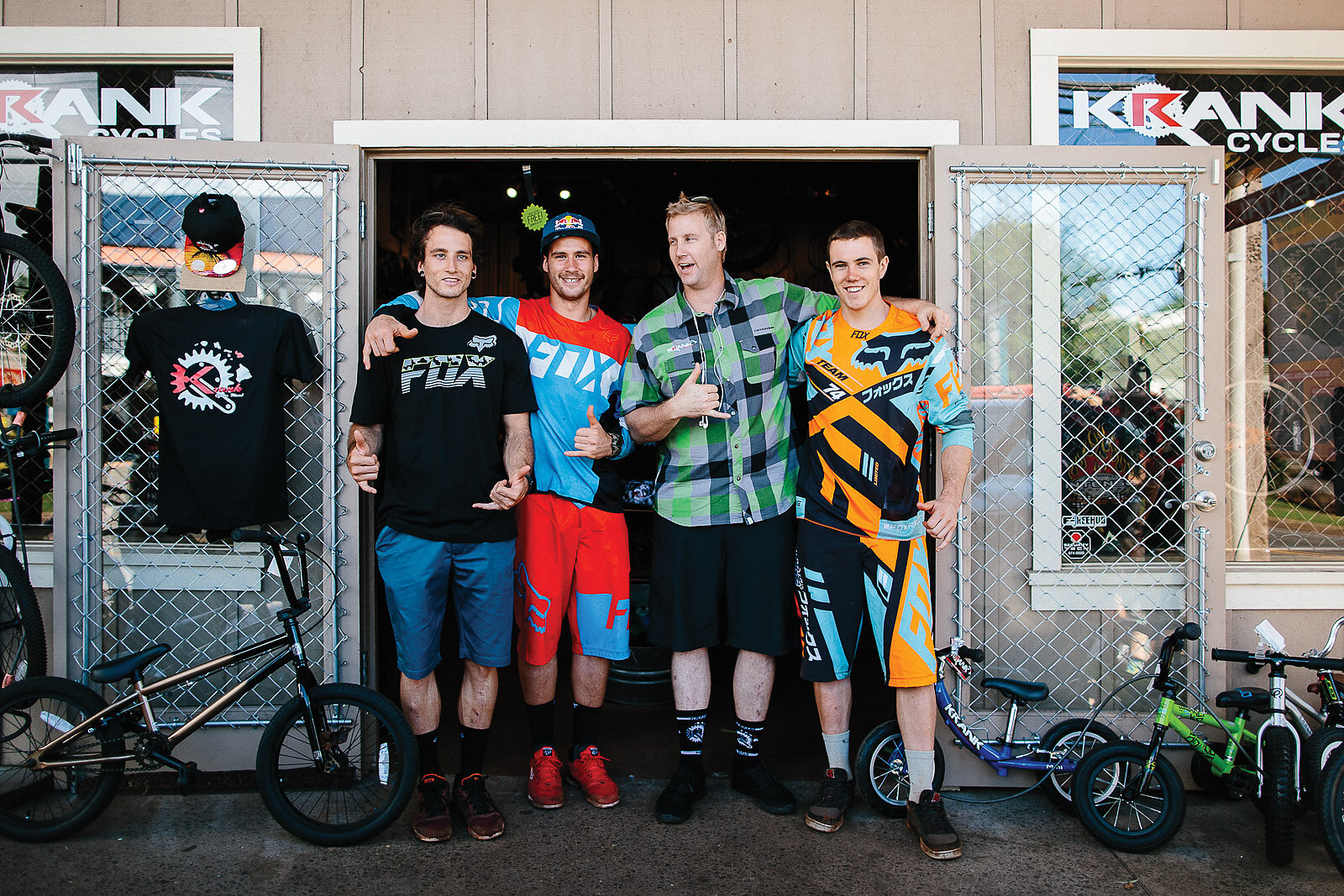
Professional freerider and Mountain Bike Hall of Famer Cam Zink had recently relocated his family to Maui, and after the wildfires he started helping the MMBC make some connections. Zink’s nonprofit trailbuilding company, Sensus R.A.D. Trails,
could bring proven gravity trailbuilding expertise, while also attracting tax-exempt donations through its 501(c)(3) status to help kickstart the project. Kona Bikes, through its Maxx G Foundation, organized a sweepstakes with a $16,000-plus prize package that raised more than $50,000 in donations from individuals, businesses, and the Maui Pono Foundation.
Sensus R.A.D. Trails’ lead trailbuilder and project coordinator, Cody Wilkins, flew in to oversee the build. Pro freeriders such as Carson Storch and Kyle Strait arrived to lend their talents with excavation and flow. And countless community volunteers turned up to help them and Watson sculpt and pack the park’s many features. Within months, the overgrown basin was transformed into a compact bike park featuring a pumptrack, jump lines, a slalom course, and a progression zone that could take young riders from balance bikes to full-sized wheels. Parents could sit at picnic tables and watch all the fun.
“We needed to prove the concept,” he says. “How viable is this as a hobby, as a resource, as an economic driver? At the end of the day, you can’t do anything without the landowner ... but if they’re developing it anyway, maybe they call and say, ‘Hey, we want 20 miles of trails in this development.’”
Watson has remained in regular communication with Randle about other potential projects on Maui Land & Pineapple property. He believes that Maui has the potential to become an international mountain bike destination, but only if private landowners can also see the potential return.
Asks Watson: “Can you imagine if you fly out here in February from Seattle, hit up 20 miles of singletrack, hit a bike park, ride the forest, pound some poke bowls, swim in the ocean, and fly home?”
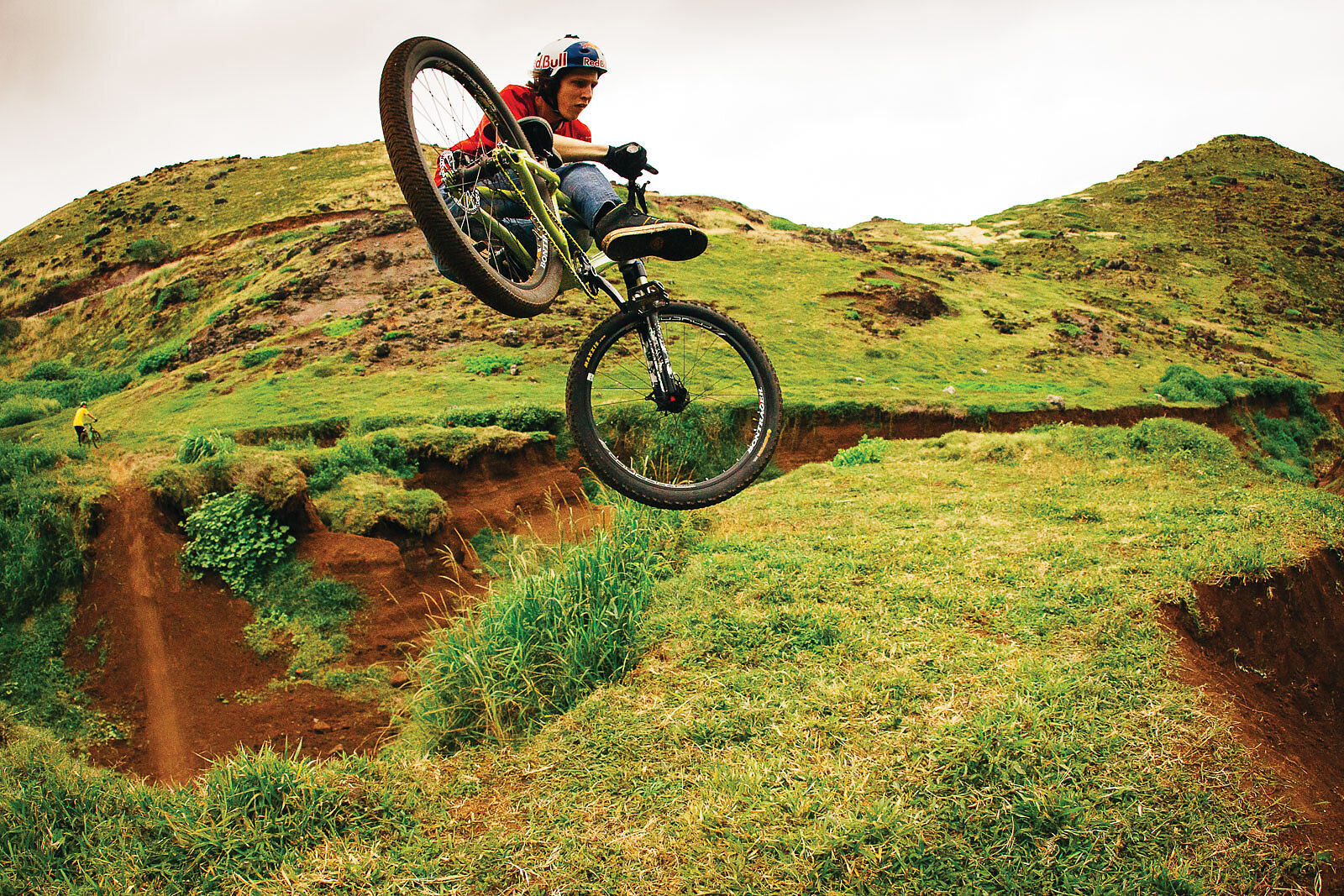
Until this happens, riders on Maui will continue to do what they’ve always done. Riders like 16-year-old Taj Berg, who was born on Maui and grew up riding in the forest. From a young age, his father insisted that he pedal up hills on a heavy big-box store bike, which turned him off mountain biking and toward skating and surfing. He came back to mountain biking during the COVID-19 pandemic on a blown-out, early-2000s full-suspension bike and has spent the past several years riding jumps in the forest. When a friend built taller ones in his backyard, Berg started riding there instead. Now, he only surfs occasionally.
Berg has traveled to ride in Whistler, Utah, Oregon, California, Switzerland, and France. Though he admits the riding on Maui doesn’t quite measure up to the world-class trails of Whistler, Berg believes it’s still better than a lot of places, especially considering that it’s on a remote island in the middle of the Pacific. What he says Maui still lacks is repetition: enough jumps in a row, enough sanctioned places to progress without worrying about getting shut down.
“If we could build more stuff that’s open,” he says, “it would be way better.”
Berg is right. If you want to ride legal trails on Maui, your options are limited. Upcountry, there’s the forest, plus the Skyline and Mamane trails below the summit of Haleakalā. On the west side, cross-country riders can disappear into the former XTERRA trails—now far less overgrown, thanks to Watson and others—and then finish with laps at the West Maui Bike Park.
Still, there are signs of cautious movement. In 2020, the state added a rare new parcel to its public lands portfolio: 3,434 acres known as Kamehamenui, on the northwestern slopes of Haleakalā above the rural area of Kula. The acquisition was framed around watershed protection and conservation, but it also earmarked areas for recreation, including hiking, hunting, and mountain biking. While future trail development in what is now officially the Kamehamenui Forest Reserve might not match the sensibilities of groms like Berg or seasoned riders like Hearne, “there’ll still be miles and miles of trails up there,” he says.
For now, Berg and his friends will keep building bigger jumps in someone’s backyard, pushing until they run out of places to land. Coalition volunteers will keep showing up for trail days in the forest, maintaining what exists while lobbying for what could. More and more bikes will start appearing alongside surfboards on roof racks.
And on the west side, in an old pineapple farm’s runoff basin, kids will keep having their birthday parties at the pumptrack.