Flashes of Light The Link Between Ride-Inhibiting Symptoms and Hormone Changes
At 35, Kelli Sherbinin thought she was having a heart attack.
Stealing a quiet moment on her back deck in North Vancouver, she felt the sun warm her face as she breathed in the smoky aroma of her coffee. Thoughts of emails and errands faded beneath birdsong and the distant hum of traffic.
“I wasn’t doing anything—I was literally just sitting there,” she says. “My mind was calm.”
Then her heart began to race. Pressure built in her chest. As suddenly as it began, the episode passed, leaving her drained. She assumed her body was run down by the demands of racing, guiding, teaching, and running a seasonal business.
“That’s when I started seeing naturopaths and going for vitamin injections,” she says.
Despite the treatments, things got worse.
Since discovering mountain biking at 18, Sherbinin has shaped her life almost exclusively around the sport. Over the years, she became an overall provincial champion, raced Red Bull Psychosis, and won the BC Bike Race Challenge while pregnant.
The bike also brought her community, including her closest friends and her husband, purpose, resilience, and a lifelong passion for learning and teaching. That enthusiasm spills into her work coaching, mentoring, and delivering university courses as part of an Outdoor Recreation Management program. Her drive to grow the sport has led her to develop international instructor certifications and co-found North Shore-based instruction and guiding company Endless Biking.
“After decades in the industry, riding is still where I feel most like myself,” she says.
Like many athletes who menstruate, there were times when Sherbinin didn’t feel her best on the bike. But when she was younger, she accepted that during different points in her cycle she had less energy, felt more emotional, and recovered more slowly from big efforts.
“I simply pushed through these more difficult times,” she says.
For years, that seemed to work. But in her mid 30s, the changes in Sherbinin’s body became more persistent and less predictable, no longer fitting the monthly rhythms she understood. As they intensified, so did the demands on her life.
At 38, Sherbinin became a mother and the rest of her life didn’t slow down. Without traditional maternity leave due to being self-employed, she juggled feedings, diapers, and sleepless nights with emails, coaching, and travel; attending tradeshows with a baby on her hip and nursing trailside during photo shoots.
“I assumed the exhaustion, anxiety, and brain fog were simply part of becoming a new mother,” she says.
But over the next several years, the fatigue became constant and the anxiety more consuming. She struggled to remember basic details, even the names of people she had known for years. The symptoms intensified and multiplied. Depression set in. Her moods became erratic, swinging from happy and calm to sad, angry, or irritable. For the first time in her life, she felt rage.
The cognitive toll followed her into work, making it harder to lead her company and manage her team. While teaching, Sherbinin sometimes lost simple words in the middle of explaining skills she had taught hundreds of times.
After only a few hours of teaching, her brain could feel so exhausted that even basic tasks became difficult to prioritize. By the end of some days, she avoided people because she felt she had nothing left to give, conserving whatever energy remained for her daughter after school. For someone whose career depended on communicating clearly, analyzing movement, and making decisions in real time, the changes made her question her competence.
“I was dysregulated and fatigued trying to balance having a kid, managing a business, and physically being out there in the field,” Sherbinin says. “There came a point when I had to pull back from coaching.”
She reduced her coaching load and stopped teaching instructor-training courses. In a male-dominated industry, she says, she did not feel able to explain what was happening, even as the changes affected the career she had spent decades building.
That Sherbinin felt unable to talk openly about what she was experiencing reflects a broader gap in women’s health. During perimenopause, hormonal fluctuations can affect far more than the reproductive system, influencing the nervous system, muscles, joints, bones, metabolic processes, cognition, and mental health. For athletes who menstruate, these changes can alter how they think, feel, train, and recover. Yet many enter the transition without the information to recognize those changes as connected. As research into perimenopausal and menopausal health expands and conversations become more commonplace, that information void is beginning to shrink. Still, the confusion Sherbinin experienced is something Marie Powell, a nurse practitioner specializing in menopause care and founder of Terra Aesthetics + Wellness, sees often.
“Women tell me, ‘I don’t feel like myself,’ but they don’t really know why,” Powell says. “They’ll say, ‘I feel foggy. I’m exhausted. I’m doing all the things I did before,’ especially if they’ve always been really active.”
Midlife is already one of life’s most demanding stretches. Careers require attention. Children still need support, parents are aging, relationships are evolving, and responsibilities pull in every direction. Against that backdrop, the line between the pressures of daily life and hormonal change can be difficult to see.
“Is it because I work three jobs, have toddlers, and am navigating life that I feel so miserable?” Powell says. “Or is it the hormonal shifts and changes?”
Not only were Sherbinin’s symptoms difficult to tease apart, but the daily pressures and obligations of her life left little time to step back and consider whether they might be connected. The cognitive changes only deepened that murkiness, making it harder to think clearly, take stock of what she was experiencing, and recognize a larger pattern.
“Honestly, I thought I was going crazy,” she says.
Meanwhile, physical symptoms piled on top of the cognitive and emotional ones. Her joints became painfully inflamed. Tinnitus set in, and her mouth felt constantly dry. Then came perhaps the most annoying change: She always had to pee.
Rachel Richards, a registered physiotherapist specializing in pelvic health and co-owner of LivWell Integrated Health, says urinary urgency and frequency commonly emerge as estrogen levels fluctuate, then decline.
Estrogen helps maintain tissue integrity, moisture, elasticity and blood flow throughout the bladder, urethra, vulva, vagina and pelvic floor. “It even plays a role in nerve signaling within the urinary tract, helping to maintain bladder and pelvic floor control,” she says.
As estrogen declines, these tissues can become thinner, drier and stiffer. A less elastic bladder may signal the need to pee at a lower volume, while an underactive pelvic floor may struggle to quiet urges. Stress and anxiety can also heighten urgency.
These symptoms are just one part of a much broader physical transition. As the changes accumulated for Sherbinin, the body she had relied on for decades became unpredictable.
“The weight gain made climbing feel like I was riding through sand,” she says. “Everything felt harder.”
After exercise, joint pain and inflammation could leave her body feeling as though it had been hit by a truck. The heaviness and lethargy made it difficult to find the “stoke” that once came naturally. Riding, which had always been an inspiration and an outlet, began to feel like a chore.
“I couldn’t make sense of it,” she says. “It’s like my energy had been stolen and I didn’t feel like myself anymore. I just felt drained. Depleted.”
That depletion created a painful distance from the sport Sherbinin had built much of her life around.
“I questioned whether I’d ever return to the level of riding that had always been part of my identity,” she says. “One of the hardest parts wasn’t simply losing strength—it was losing trust in my body.”
Dr. Michol Stanzione, a physician at Aroga Lifestyle Medicine Clinic in Victoria, British Columbia, which specializes in women’s health, says hormonal changes can alter an athlete’s response to familiar training.
“As estrogen starts to fluctuate and decline, it can affect sleep, mood, temperature regulation, and how the body responds to stress,” Stanzione says. “So, an athlete may do the same training she’s always done and suddenly find that recovery feels much less predictable. One week she feels great, and the next she may feel unusually tired or flat.”
Endurance coach and former professional triathlete Tenille Hoogland compares the added strain to training with a heavy backpack, one that can obscure but not erase an athlete’s underlying fitness.
“Then all of a sudden, they’ll take the backpack off, and they’re just like, ‘I am so good,’” she says. “The power was always there. They just happened to be wearing a really heavy backpack that was slowing them down.”
For Sherbinin, the effects eventually reached beyond fatigue and recovery. After more than two decades on the bike, she began struggling with coordination and concentration. She hesitated on features she had ridden dozens of times and started crashing more often.
Stanzione says hormonal fluctuations can affect concentration and the way the brain responds to stress. For an experienced athlete, that may show up as second-guessing or feeling less confident in skills that once felt automatic, even when the underlying ability is still there.
Although Sherbinin now recognizes all these changes as early signs of perimenopause, it took years for her to understand them that way. At 48—13 years after her heart inexplicably began racing on the back deck—she finally experienced the symptoms she had long associated with the transition: unmistakable hot flashes, night sweats, and irregular periods. Only then did that earlier episode take on a different meaning. The racing heartbeat was likely palpitations, a recognized but lesser-known symptom of fluctuating hormones. That delay isn’t unusual, Powell says.
“We tend to think of perimenopause as periods starting to change, but for most women, that happens a little later,” she says.
Those recognizable symptoms gave Sherbinin a new way to understand everything that had come before. She immersed herself in learning about perimenopause, reading books, listening to podcasts, and talking with friends who had experienced it. She began journaling, using a smartwatch and a period-tracking app; she recorded her sleep, menstrual cycle, and symptoms.
Patterns began to emerge. Some symptoms followed a rhythm; others were less predictable. All the accumulated evidence pointed increasingly toward the menopausal transition.
Powell says perimenopause is usually identified through symptoms and menstrual history—not a single hormone test. Hormone levels can fluctuate too sharply during this phase for one blood draw to provide a reliable answer. Bloodwork may still help investigate other possible causes, including thyroid dysfunction, iron deficiency, or anemia. For Sherbinin, the value of tracking was the longer view: Her records helped turn symptoms that had seemed disconnected into a pattern she could take to her doctor.
By then, she had spent years moving through appointments with health professionals. Each practitioner addressed a symptom in isolation. Relief, when it came, rarely lasted.
Armed with what she had learned and the patterns she had documented, Sherbinin returned to her doctor. Together, they began tracing symptoms that had seemed unrelated for more than a decade and confirmed her suspicions.
“Finally understanding what was happening was incredibly emotional,” Sherbinin says. “I felt relieved because I realized I wasn’t imagining my symptoms—I wasn’t going crazy. I was scared that I had figured it out too late. And hopeful that I could begin rebuilding my health.”
Because no one talked about menopause, I blamed everything else. I blamed being a new mom. I blamed running a business. I blamed stress. I blamed myself for getting older.”

That silence is beginning to lift. Sherbinin says more open conversations about women’s health have helped her feel less alone and have created a community where women share what they have learned and help one another navigate symptoms and care. Her own treatment has been a process of trial and error. There has been no single solution, but rather a combination of lifestyle changes and hormone replacement therapy, or HRT, now also known as menopausal hormone therapy (MHT).
“My cognitive symptoms are evolving,” she says. “Since becoming more aware that this is hormonal, and that I’m not going crazy or losing my mind, I’ve focused on systems to help me through it.”
Sherbinin uses timers and reminders, takes more notes, makes more lists, and tries to slow down, rest more, and be kinder to herself. She and her physician are also still working to find the right MHT dose, a process she says has been tricky.
Some improvements, however, have been striking. Inflammation in a knee reconstructed years ago once became so severe that she couldn’t exercise for six months. Since starting MHT, the flare-ups haven’t returned. Sherbinin can’t say whether the timing is a coincidence, but after years of recurring inflammation and repeated injections, the change has held for more than three years.
Stanzione says MHT can be effective for many women, particularly those closer to menopause who have been appropriately screened, but it isn’t a one-size-fits-all treatment.
“Hormone therapy isn’t right for everyone, but for many people it can make a meaningful difference,” she says. “The important part is looking at the individual patient, their symptoms, their health history, and where they are in the menopause transition.”
Some symptoms may need more targeted treatment. Low-dose vaginal estrogen acts primarily on tissues in and around the vagina, vulva, urethra, and bladder, with very little entering the bloodstream. It can be used on its own or alongside systemic MHT to address dryness, irritation, tissue fragility, urinary urgency and frequency, and recurrent urinary tract infections. Nonhormonal vaginal moisturizers can help relieve dryness and irritation, but they don’t address the full range of urinary symptoms.
Richards often sees mountain bikers dismissing recurring vulvar irritation, abrasions, or small tears as a normal consequence of being in the saddle. But those issues can also reflect tissue changes associated with perimenopause.
“For mountain bikers, I’m seeing their vulvas tear more easily, particularly in the crease between the labia minora and majora,” she says.
Thinner, less elastic, and more fragile vulvar tissue is more vulnerable to friction and small injuries in the saddle. Riders may notice the damage only afterward: a burning sensation when urine reaches an abrasion, or another small tear while showering. For riders experiencing this kind of irritation, Richards says low-dose estrogen or nonhormonal vulvar moisturizers applied between the folds of the vulva, may help.
Lifestyle changes can be among the most significant sources of support for managing cognitive and physical symptoms. Stanzione sees sleep as one of the foundations of managing symptoms and supporting recovery. She also encourages athletes to make sure they are eating enough to support their activity, getting adequate protein, and incorporating strength training.
Katrina Strand, a mountain bike coach and strength and conditioning specialist who works with athletes through pregnancy, postpartum, and menopause, says riding builds fitness and skill but doesn’t always provide the progressive load muscles and bones need to remain strong. With her perimenopausal clients, she prioritizes heavy lifting to help counter age- and menopause-related muscle and bone loss.
“The training we do can create an external stress—a stimulus—to support our bodies in the way that our hormones used to support those key parts of our systems,” she says.
Strand balances those benefits against each rider’s existing workload. Strength training should support time on the bike, she says, without leaving an athlete too depleted to ride or recover.
“Every little bit is going to help, and we do what we can, given what’s going on in our lives,” she says. “If you’re riding your bike a lot and going to the gym for two or three strength-training sessions a week is taking away from your riding, then you don’t need to do them. You can take breaks. You can come back when you have more time.”
Strand follows the same approach herself. During the height of riding season, she scales back her strength work and focuses more on mobility. When her body has the capacity, she brings back heavier lifting. That flexibility doesn’t mean lowering her ambitions. Strand still wants to ride hard, climb mountains, and take on long, multiday adventures. Adjusting her training helps her continue pursuing those goals without giving up the athlete she has always been.
“Gone are the days when, at this phase of life, we need to completely change everything we once were,” Strand says.
Hoogland offers athletes a simple question to guide those day-to-day adjustments: “Can you meet the intention of the workout today?”
If the answer is no, she recommends modifying the session or resting instead of forcing the body through a workout it isn’t ready to handle.
“If their body doesn’t want to respond, they may need some rest,” she says. “If they back off today, they can try again tomorrow. There is always tomorrow.”
Learning to listen to those signals has changed how Sherbinin looks back on her own experience. She wishes she had understood more about hormones—and paid closer attention to her patterns—before symptoms began disrupting her life.
“If I could tell my younger self one thing, it would be this: Know your baseline,” she says. For her that means understanding what is typical for her body; her cycles, sleep, mood, energy, and recovery, then tracking changes, asking questions, and advocating for care. She urges women not to automatically dismiss anxiety, brain fog, fatigue, or weight gain as simply signs of aging and, above all, to remember they are not alone.
“As mountain bikers, we’re taught that progression comes from understanding the fundamentals,” she says. “I believe our health deserves the same approach. The better we understand our bodies, the better equipped we are to continue doing what we love for decades to come.”
Sherbinin has put that approach into practice.
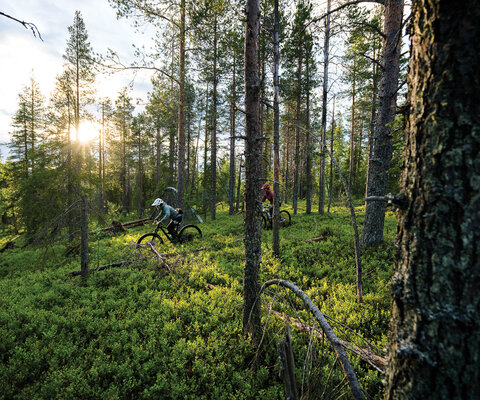
These days, she is back where she feels most like herself: on a bike, ripping through the trees, leaning into turns, and feeling the trail unfold beneath her. She no longer measures a successful ride by whether she hits every drop or technical feature. More days than not, success means feeling fully present in her body again, connected to the landscape and to the freedom mountain biking has always given her.
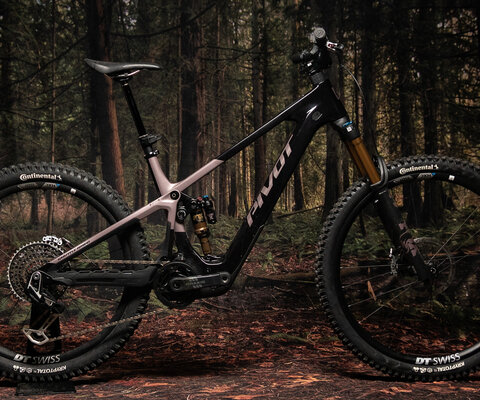
Turning down the intensity of her riding, and embracing e-bikes when they help, has allowed her to spend more time on the trails, not less. Instead of coming home depleted, she can finish a ride with energy left for the rest of her day. She has let go of the need to make every ride about performance. What matters now is feeling healthy, staying active, and staying on the bike for the rest of her life.
“Every day on a mountain bike is a good day on a mountain bike,” Sherbinin says.