Branching Out Passing Down Knowledge in Rural Appalachia
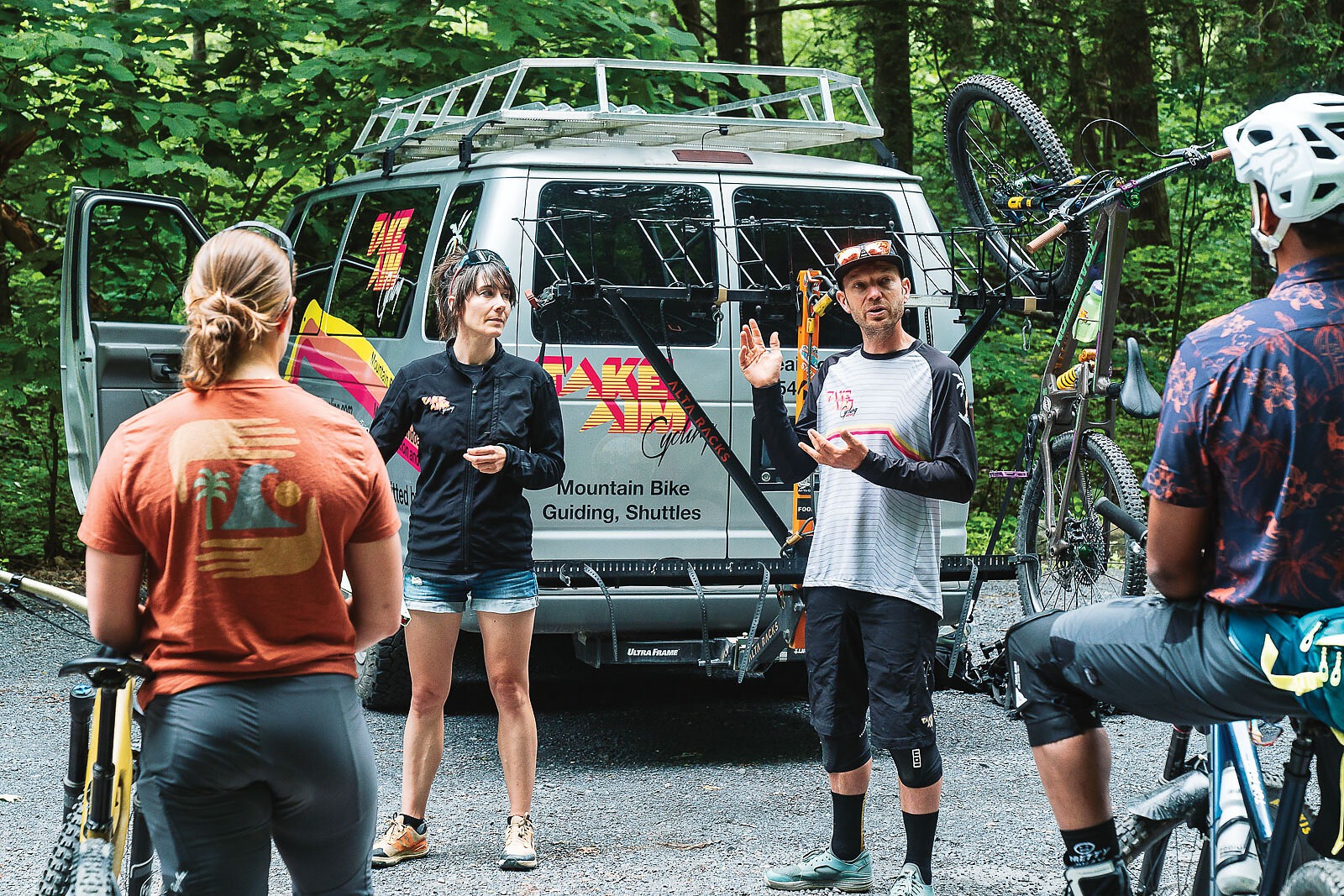
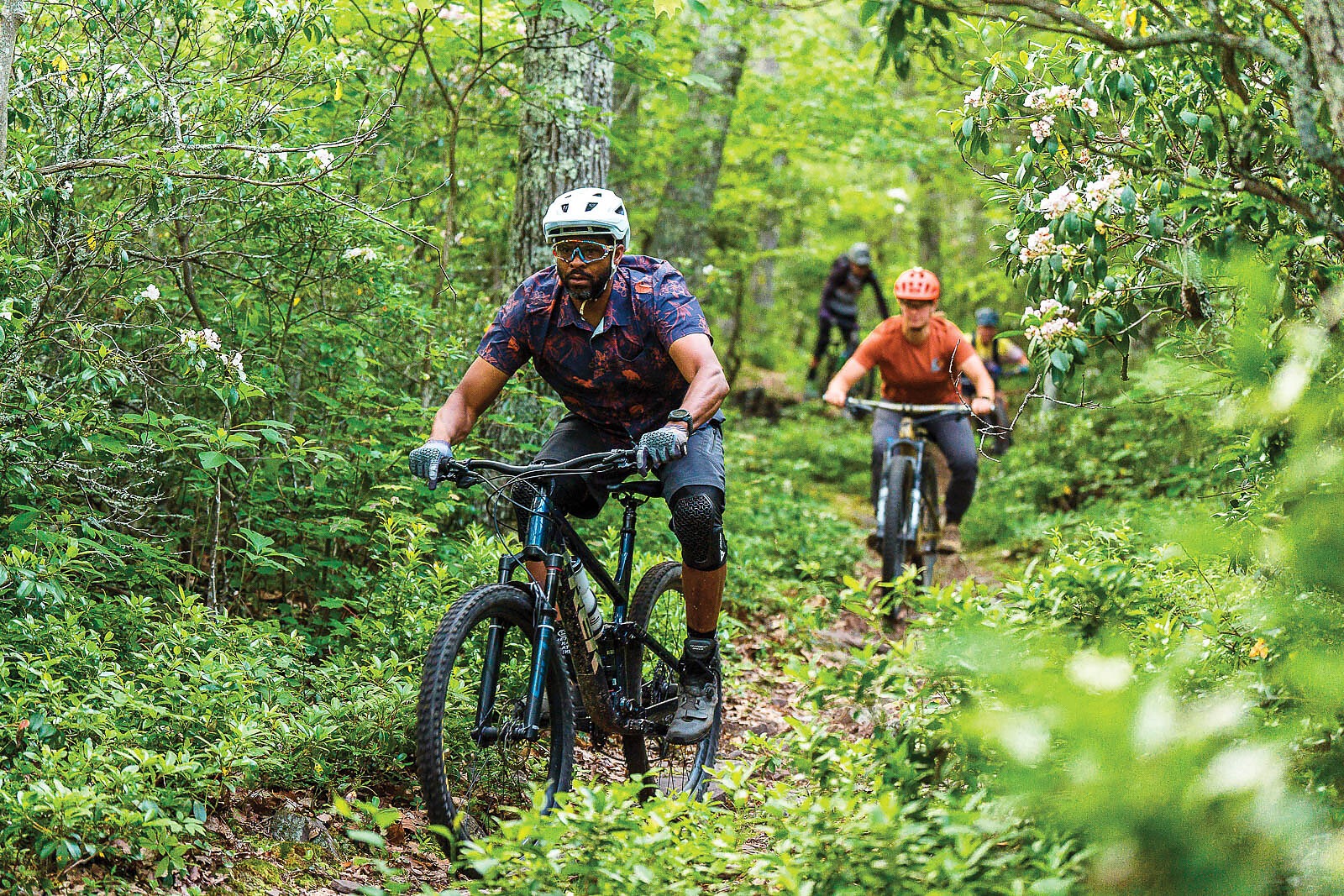
One day this past June, Harlan Price gathered a group of riders before setting out for a day of backcountry riding in the George Washington and Jefferson National Forest in western Virginia.
“From this parking lot, we are about an hour and a half away from the nearest shock trauma hospital,” Harlan said. “An evacuation from the trails we are riding today—about half a day away.”
These sober words weren’t meant to scare riders Jali Fernando, Maddie West, and Trae Shelton, but rather to set expectations and provide a reality check to these newcomers to remote, unsupported, adventure mountain biking.
Riders who are new to backcountry excursions are part of a growing demographic of clients for Harlan and Phoebe Price’s Take Aim Cycling, a company that provides guiding, coaching, and shuttling services in and around Shenandoah Valley. This trend mirrors a larger explosion of visitation to public lands for outdoor recreation that spiked during the COVID-19 pandemic and has remained steady.
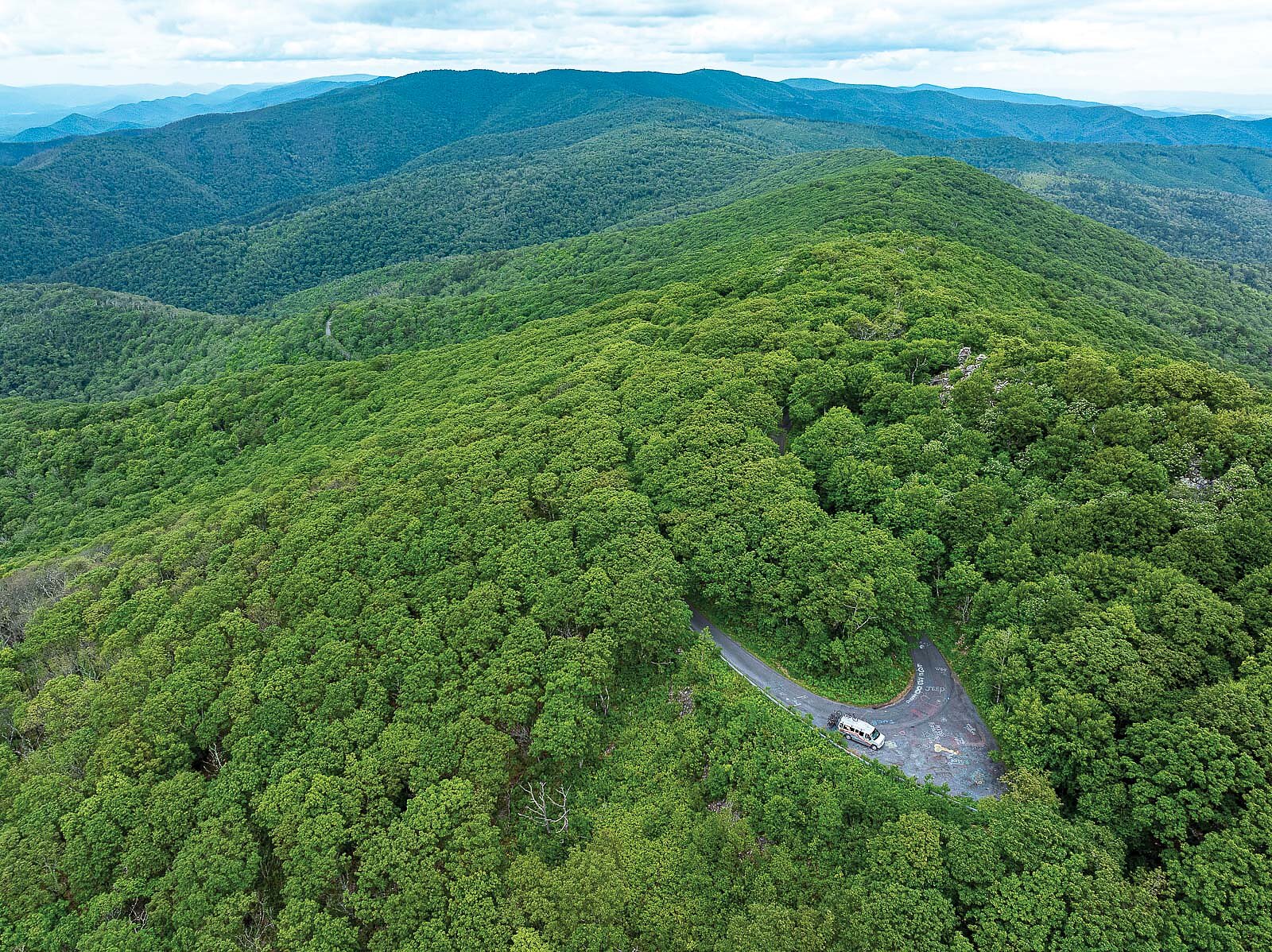
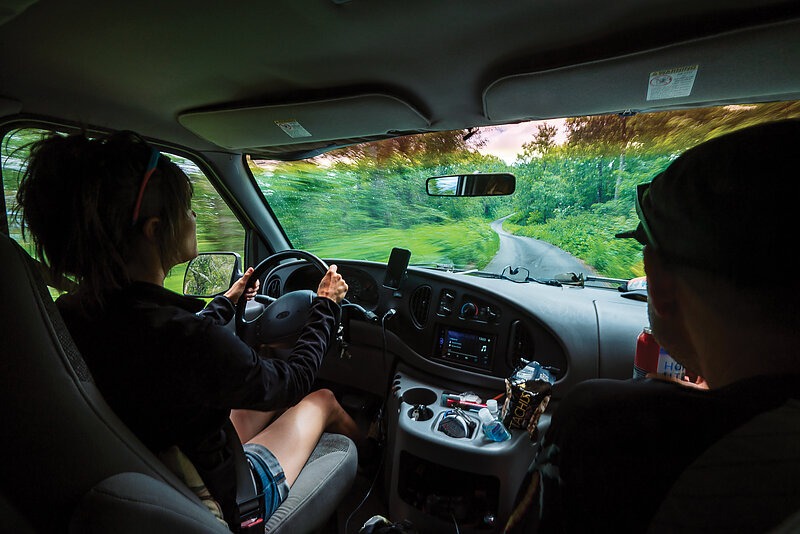
After a safety briefing in the parking lot, bikes were loaded up on the Take Aim shuttle van so Phoebe could drive the group up the 3,000-foot climb to the summit of Reddish Knob, the second tallest peak in Virginia. Phoebe and Harlan know that many casual mountain bikers don’t have the time to fully develop a baseline of fitness that allows for regular long days in the saddle, so they frequently use shuttles to give riders a leg up at the beginning of bigger backcountry days. Take Aim’s mission for its backcountry arm is to make this style of riding more accessible to those that have an interest and some basic fitness and skills. Information is provided to ensure attendees are armed with the knowledge they need to have a good day, from advice on bike prep to emergency supplies to have on hand to fitness and skill requirements.
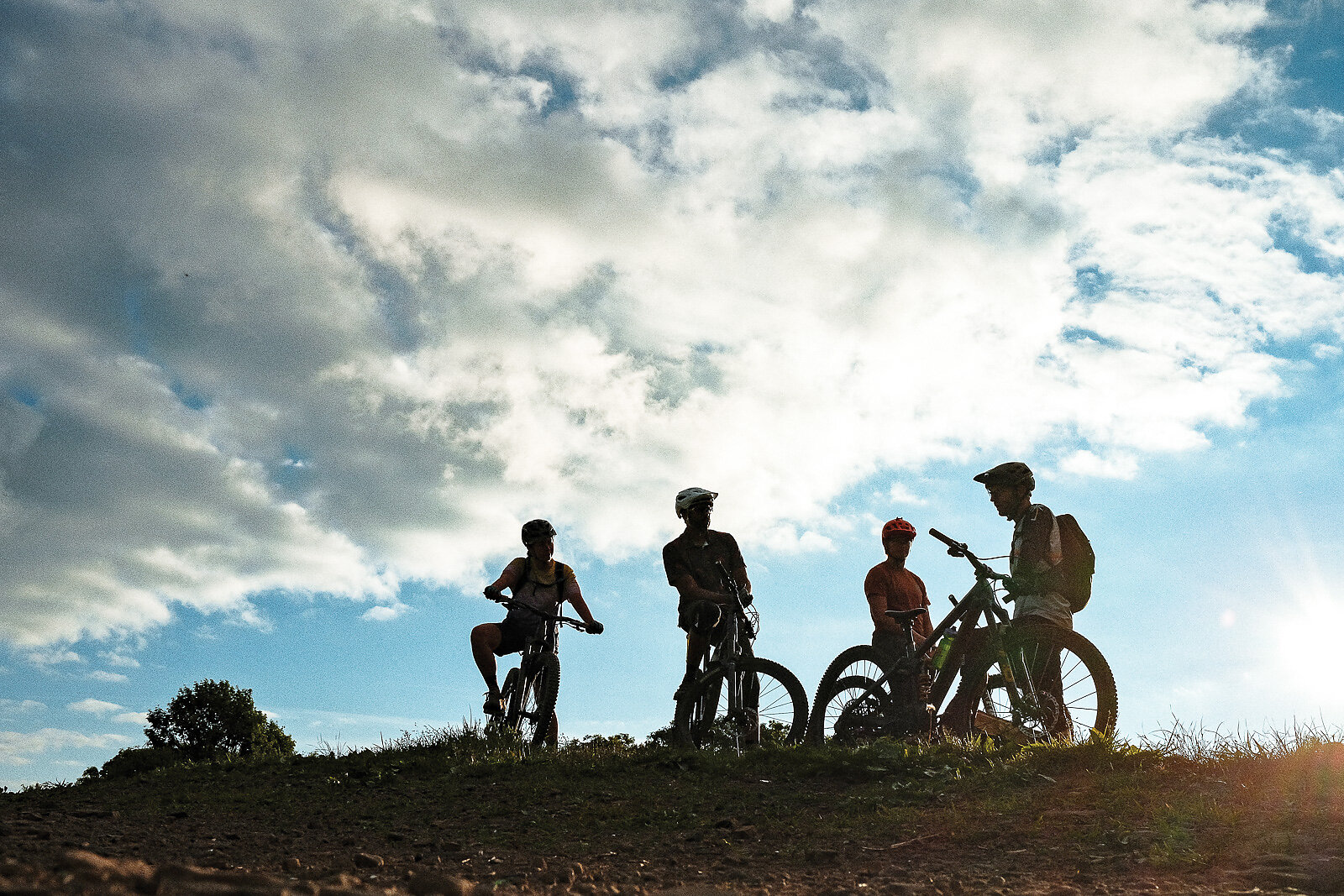
At the top of Reddish Knob, Phoebe shared bits of information about the area and pointed out some other local mountain bike hotspots such as the Massanutten Bike Park. Harlan checked in with the riders and made sure that fixes he’d recommended earlier when meeting everyone had been taken care of—West was sent to check on a couple bolts. Shelton was told to slightly up his tire pressure. Fernando now had extra fruit snacks. Despite a lifetime of lessons in the woods, Harlan doesn’t assume that everyone carries the same intrinsic bicycle knowledge that he does.
His own outdoor experience dates back to when he was a child in Florida. Back then, going deep into the woods to play was simply a way of life. From an early age, he would get lost in Florida’s boggy forests or go fishing on the Suwannee River. He carried that ethos north when he went off to college in Pennsylvania. In the late ‘90s, he discovered mountain bikes which became his primary vehicle for far-flung exploration.
His desire of wanting to go play in the woods all day when married with the mechanical advantage of a bicycle led him to racing, where he excelled. After college, he found himself on National Ultra Endurance Series starting lines and quickly won several marquee races. In 2011, while thinking about what he’d do after racing, Harlan started down the path of skills-based mountain bike coaching. The field was in its infancy and Harlan saw opportunity. Today, he’s grown his skillset and knowledge about the nuances of helping others succeed on bikes to the point of providing instruction to other coaches. And, when he isn’t shuttling first-timers in the backcountry with Phoebe, he runs instructional mountain bike clinics for Bryce Resort in Basye, Virginia, and mentors his junior gravity race team.
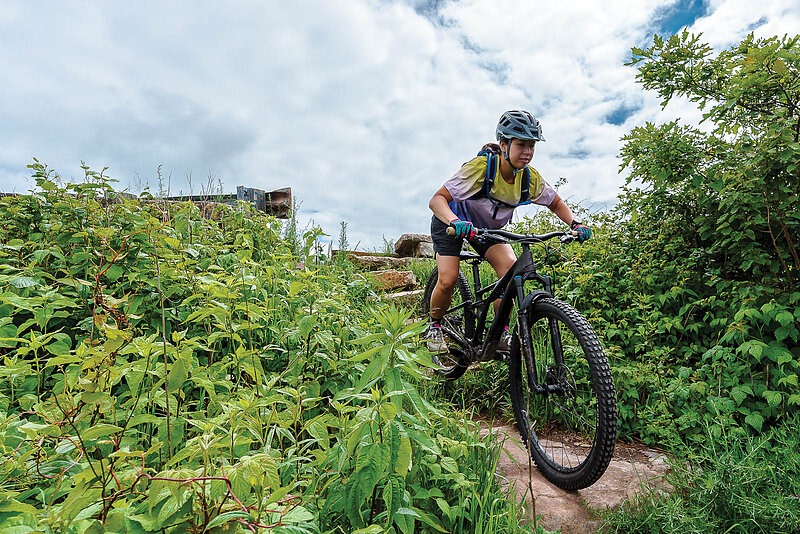
“I find it feels like a part of me,” Harlan said. “It feels very important to my soul to be able to just kind of wander in the woods and whether that’s alone or with friends, I particularly like to be quiet in the woods—I’m drawn to it.” Back at the top of Reddish Knob, Harlan got to work helping Fernando, West, and Shelton as they scoped out the trail’s iconic roll-in. Everyone in the group walked the line to get a feel for the chunky, gnarled stairs that comprise the beginning of the descent. Then, with Harlan’s safety talk still fresh in their minds, all three riders cleaned the section with no issues.
Once past this initial trail feature, Reddish Knob invited riders to let off their brakes and chase the first dopamine hit of the day on a fast section of mostly open trail with classic East Coast rocks sprinkled in. After an abrupt 90-degree right turn brought brakes back into the equation, West was the first victim of a mechanical issue with a dreaded snake-bite puncture.
West, a fire protection engineer in Washington, D.C., is a lifelong athlete but only got into mountain biking when a college roommate introduced her to the sport. Now, she rides just for the thrill of it. With bacon strips in hand, her and Shelton got to work plugging and patching her tire before taking turns on a hand pump to get it back up to pressure.
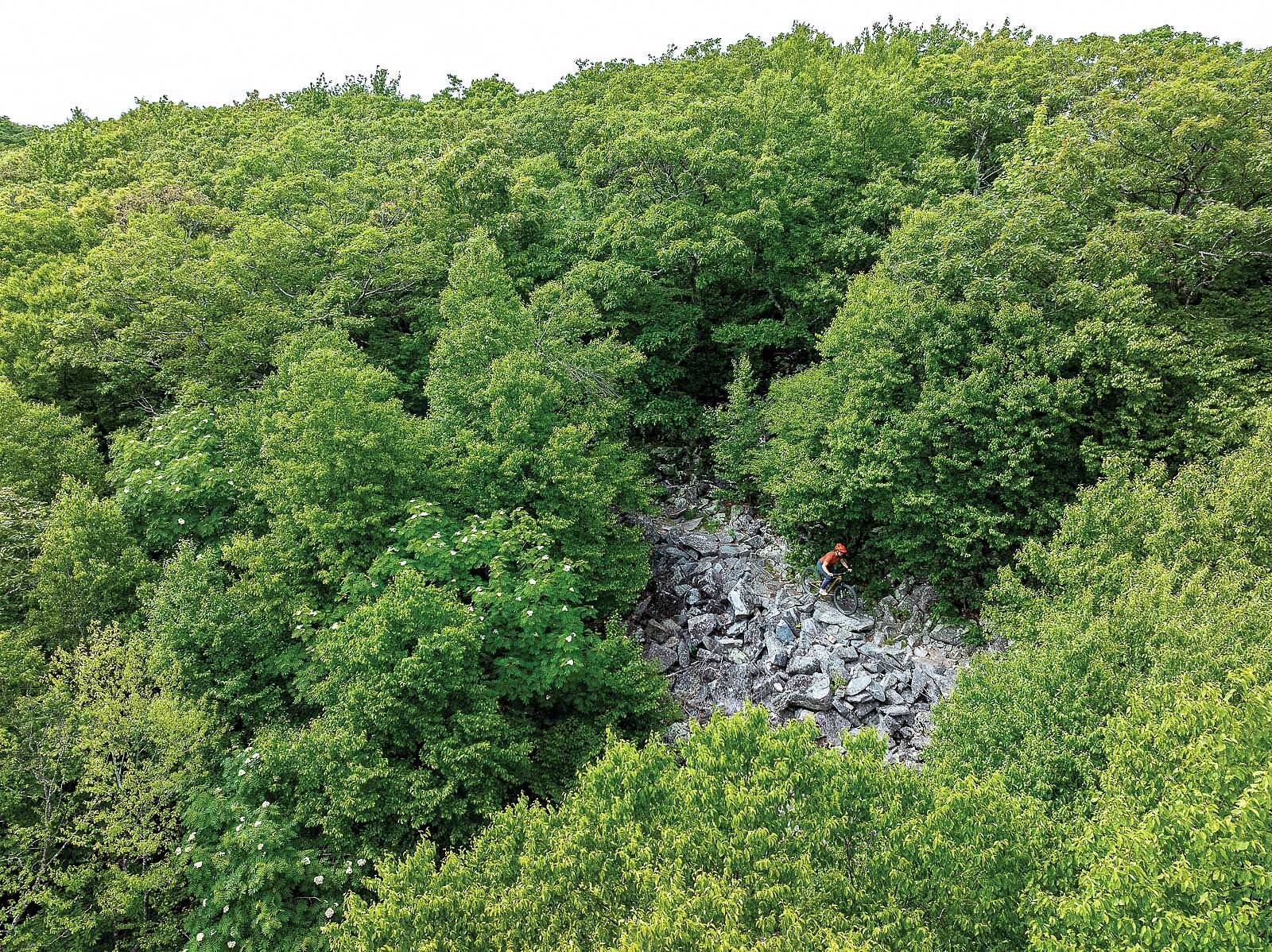
Shortly after the group got moving again, the gradient pitched up toward the sky and the crew worked hard to navigate a ridge traverse. Several punchy climbs were almost always preceded by a fast section, forcing the riders to flip from eyes up to head down as the trail rapidly shifted from down to up. Harlan coaxed the riders along, encouraging them to stay efficient and to use their energy sparingly and intelligently.
“I’ve grown a passion for downhill,” Shelton said. “I don’t necessarily like climbing, but I do realize that in order to get the fitness that you need to have fun downhill, you gotta climb. So you gotta go up to go down.”
Shelton, a self-proclaimed park rat and a U.S. veteran, works as digital forensics specialist in Maryland. As a husband and father, he views mountain biking as a way to connect with himself away from his job and family commitments. He wanted to join the day’s ride to see what the hype was about since a number of folks in his regular riding crew have ridden with Harlan and experienced the wonder of the George Washington National Forest’s (GWNF) trails. Bike mechanicals and brutal climbs aren’t the only challenge to riding in the backcountry. With trails not being trafficked nearly as much as those near metropolitan areas, they do not get the same attention in terms of trailwork. To ensure an enjoyable experience for those who join his guided rides, Harlan puts in considerable hours of trailwork to chop back overgrowth and remove deadfall in the GWNF. In 2023 alone, he tallied about 140 hours of work on the trails. For Harlan, it’s personal.
“I want to preserve this backcountry environment because so many people are riding more machine-built trails, and we’re actually losing a lot of that backcountry feel,” Harlan said. “As long as it’s sustainable, it’s great to get people out onto those trails and give them a different riding experience.”
In March 2020 when the world shut down due to the COVID-19 pandemic, people flocked to the outdoors. Bicycle sales skyrocketed and, seeking solitude and exercise, many residents of the greater D.C. area flocked to nearby national forests. Local land managers such as Greg Slezak, a GWNF deputy district ranger, says he noticed a major influx in visitors. D.C. area flocked to nearby national forests. Local land managers such as Greg Slezak, a GWNF deputy district ranger, say he noticed a major influx in visitors.
“Folks who hadn’t considered their access to the George Washington and Jefferson National Forest for recreational opportunities provided by the Forest Service were introduced to us and the public lands we manage,” Slezak said. “With increased usage came some hard truths—the agency recognized that there were opportunities to improve how outdoor recreation was managed.”
Much of those improvements came, Slezak said, in the form of the Forest Service recognizing that it had work to do in rethinking strategies to meet the changing demands of the public.
“We know that recreation choices differ today than from previous generations in the mix of activities, duration of stays, technology, and relative popularity,” Slezak said. “Much of our infrastructure was built before long-term, proper landscape planning. Our multiple-use mission also exposed new visitors to the plurality of ways public lands support their safety and well-being. Timber sales, wildlife projects, and other natural resource management activities intertwine with the many recreational opportunities we provide.”
For Harlan and Phoebe, it’s important for Take Aim’s guided rides to also include an educational component. This means practical riding tips—dial it back a touch in the backcountry, bring a proper first aid kit—but also more nuanced local knowledge about routes, trails, and navigation in the GWNF.
On the ride, forks in the trail served as spots to regroup but also places where little bits of knowledge could be passed along: The SM100 comes up that; That trail hasn’t been running well in a while. It needs some work; Technically you could ride up that, I guess…
Various trail navigation apps are great in certain circumstances, but Harlan is quick to point out that they should not be viewed as a replacement for a guide. Relying on crowd-sourced data works for casual jaunts but gets infinitely sketchier as the destination gets more remote and, therefore, more consequential. Additionally, it takes a human to share real-time info about which trails suck to climb or which one has a pesky new ground wasp nest right in the middle of it.
The day continued with a rip down Red Diamond— a high-speed descent that feels more like a Formula One racetrack than an old backcountry trail. While Phoebe and Harlan had stressed at the start of the ride that dialing back the pace is wise for a safe experience, this particular piece of singletrack invites riders to chase an adrenaline rush. Many trails in this region are legacy hiking trails that were later adapted for mountain biking use.
The top section reminded the group of Reddish Knob as bench-cut trail sprinkled with the usual mid-Atlantic seasoning of chunky rocks kept riders on their toes. Toward the bottom, the trail gradient turned properly steep and allowed riders to practice dialing it back to stay well within their personal comfort levels. The blooming rhododendron quickly made the green tunnel go into hyperdrive as riders felt the rush of letting off of their brakes to quickly gain speed.
After flowing down Red Diamond, everyone in the group popped out onto the lower access trail. A round of high-fives ensued over the smoke rising from cooked brake pads and scorching hot rotors.
“This is everything that I love about mountain biking,” West said. “Riding stuff blind, meeting new people, and getting to shuttle without having to do a horrible climb to go down. Also, it’s not like a bike park where you get a lift up in the sun and ride the same six trails 40 times.”
While pedaling back to the trailhead, Harlan imparted some last words of wisdom. He spoke about other trails in the area worth checking out and about continuing education to make for well-prepared backcountry riding, with special emphasis put on taking a Wilderness First Aid course. He also gave acknowledgment to the additional crews and organizations that help keep this type of riding alive in the region, specifically the Shenandoah Valley Bicycle Coalition.
Riders West, Fernando, and Shelton listened intently, absorbing all the information they could. With any luck they’ll visit these trails again, perhaps without the assistance of a professional guide like Harlan. It’s that type of confidence that can only be gained through the careful passing down of knowledge from one mountain biker to another.