Just a Number Reg Mullet and the Inevitable Passage of Time
Something wasn’t right. At first, he thought he’d pulled a muscle in his back. But how? Then his breaths got shorter and harder. Eventually, he was coughing blood. By the time Reg Mullett got back from closing day at the Whistler Mountain Bike Park in 2019, 10 hours from his home in Calgary, Alberta, he was in the throes of a pulmonary embolism.
A stout, shaved-bald viking of a man, going down like this was unthinkable. At 46, he seemed invincible—usually outpacing men half his age. He and Mark Haimes had set the Guinness World Record for the most cumulative amount of vertical descended on a mountain bike in 24 hours on his 41st birthday and he’d built a life and lore around never stopping.
With inexhaustible energy, he had founded Calgary’s Moose Mountain Bike Trail Society (MMBTS), through which he championed 19 beloved trails. He regularly stood on top of downhill race podiums. He was omnipresent in every riding scene between the Alberta foothills and British Columbia’s Columbia Valley. He opened up some of the burliest alpine rides in the Canadian West, with at least 30 first descents to his name. Reg Mullett was everywhere. So, when a blood clot moved into his lungs and almost killed him, it posed the biggest question of his life: Could he slow down?
Five years later, scurrying around his van in the parking lot of Golden, B.C.’s Mount 7, he appears mostly unchanged from when I first met him a decade ago. But time has subtle tells. He still has the same iconic Sprinter van (he was one of the first to the trend), but it’s rusty now. He’s still built like a linebacker, but with wrinkles. And he still has the same permanent glee plastered on his face, but with a set of reading glasses stationed above his Oakley shades.
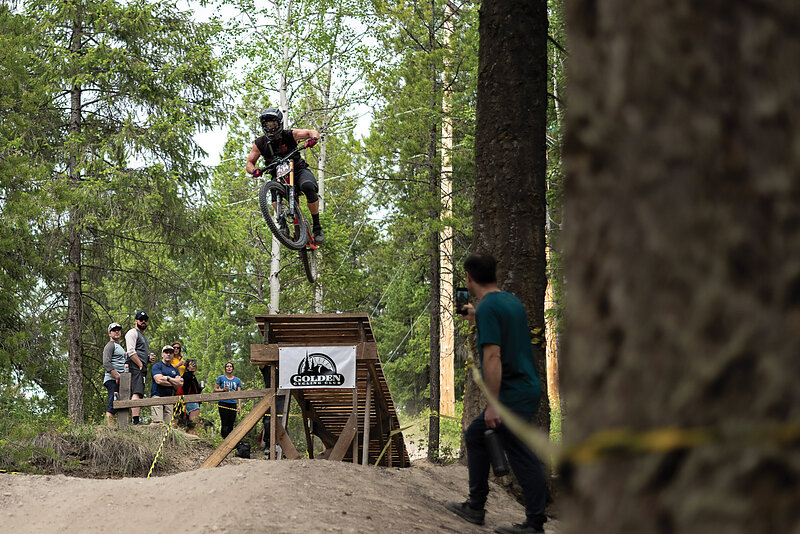
He’s here, on a crisp June morning in 2024, to train for the 25th anniversary of Psychosis, an event Red Bull once dubbed the world’s most demented downhill race. Mullett won the Masters category in 2007 and 2008 with a time only narrowly behind seasoned pros like Sam Hill and Chris Kovarik.
There hasn’t been an open Psychosis race in 16 years (though it was briefly revived for Crankworx as an invite-only event during the pandemic). It’s a terrifying track, with a 40-degree scree chute right off the start, from which point—amazingly—it gets even steeper. That’s exactly why it’s always been Mullett’s favorite. He and Haimes ran the punishing 4,000-foot trail 27 times in a row on a wet August day back in 2014 to claim the record.
“I’m just competing with Reg from 2008,” Mullett says, coyly, while local riders from Golden, others visiting from Calgary, and a rag-tag group of old dogs orbit his van. One asks if he has physio tape. He does. The other asks if he can get in on a shuttle lap. He can. Another just wants to hear if SRAM’s new brakes are any good. They are. Mullett knows everything and everybody—at 51, still sponsored by Santa Cruz, he is the sage elder of the Rockies downhill scene. Blessed with the tender affect of a bubbly teenage girl, a disarming lisp, and the kind of soul-warming friendliness that only comes from Newfoundland, his magnetism is inescapable.
Mullett was raised with five siblings in the town of Gander, on the blustery Atlantic island of far eastern Canada. It’s a quiet place, so it was big news when it hosted about 7,000 impromptu visitors on 9/11 after 38 commercial flights were grounded there. Townsfolk literally opened their homes and filled their couches with strangers. Those were the kinds of values he grew up with. When he moved to Calgary, Canada’s fourth-largest city, to study environmental science in his early 20s, it felt different. The arid fetch of the Canadian Prairies was an abrupt change, alongside the enterprising but individualistic spirit of Alberta.
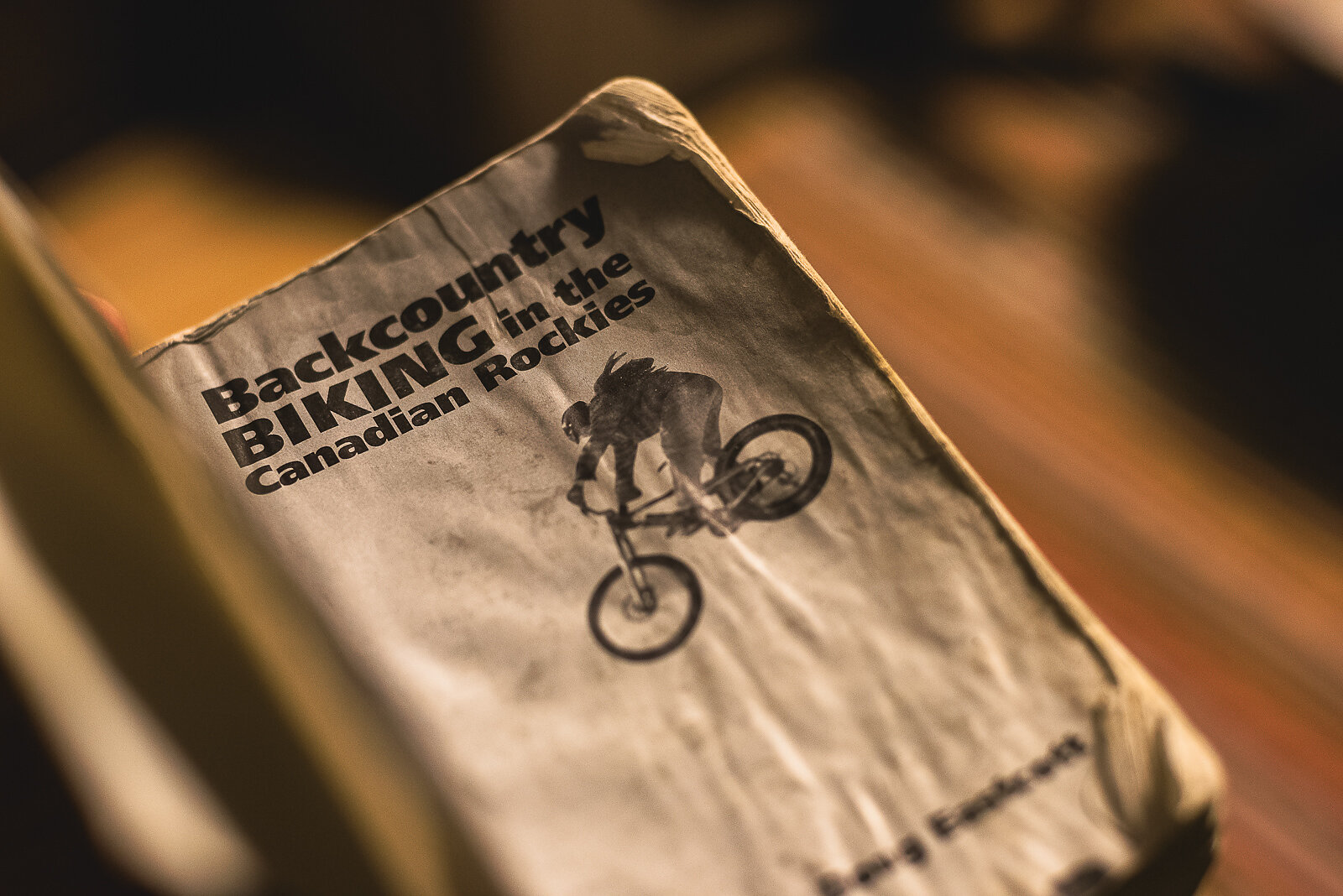
But when he discovered the Doug Eastcott book, Backcountry Biking in the Canadian Rockies, he realized the alpine just within sight of the city could be an apt stand-in for the tussock grasses and massive rock formations he grew up with. Riding the high country became his unyielding focus.
“Within two years I did every ride in the book,” Mullett says. “I was breaking bikes left, right, and center. So, I got into downhilling.”
When he did, he found his tribe.
“Newfoundland is a very community-based environment,” he says. “So the moment I saw somebody working on a trail [in Alberta] I offered to help.”
From there, he wove his way into every riding community within striking distance of Calgary, including Fernie, Invermere, and Golden.
Twenty years later, he circles the precipitous alpine drop-in for Psychosis like a raptor closing in on its prey. He’s training with his friend Jody Kidmose, who just turned 50. A few other riders follow to bite off some of Mullett’s wisdom, and he’s generous with them the whole way down, stopping frequently to point out lines while explaining the best ways to deal with rowdy features.
“Air the fuck out of that root ball,” he says matter-of-factly to a young racer from Calgary, whose eyes widen at the proposal.
If the 200-pound man is a gentle giant with people, he’s a battering ram on the trail; it’s like he moves the mountain itself when he pushes his bike. On this day on Mount 7, though, he has nerve pain in his shoulder. His dad recently passed away, and he figures he’s holding grief in that spot. He’s also juggling a lot at work. As an environmental specialist in air quality for one of the largest oil and gas companies in North America, he oversees billion-dollar projects. Mullett’s spent the last 10 years trying to make the oil-and-gas industry more sustainable—no small push in its own right.
Though he has no kids, he is married and devotes much of his time to his wife of 10 years. Annette Kempston is a quick-witted pharmacist who manages a drug information team for Alberta Health Services. She never misses an opportunity to chide him or force him to clear out the spent gear he hoards in their garage. This stockpile includes a trove of old espresso machines he swears he’s going to refurbish. Mullett adores coffee, and coffee makers.
Kempston loves to ride too and accompanies him on the road as much as she can.
“I feel like I’m on a float in a parade,” she says while cooking breakfast in the van as even more riders swarm to chat with Mullett.
“He’s certainly a draw,” Chris Carrier says. “It would be very weird if he was at Moose [Mountain] and there weren’t a dozen people gathering around him.”
Carrier took over as president of MMBTS in 2019, a role Mullett occupied for its first seven years. He says Mullett had an incredible administrative talent because he focused on relationships. He legitimized all of Moose Mountain’s rogue trails within a few seasons, and then began expanding the network from there.
“He’s certainly a draw. It would be very weird if he was at Moose [Mountain] and there weren’t a dozen people gathering around him.” —Chris Carrier
“His perseverance in the early years … like, a lot of folks would have given up after being shut down so many times—whether it was illegal or legal trails,” Carrier says. “And then trying to get mountain biking recognized as something that’s worth taking seriously as far as land planning goes—he deserves a lot of credit there.”
Even after Mullett gave up the presidency, he stayed on the board as “Director of Shred,” and then an advisory role, all while working full-time, personally hand-digging a half-dozen trails, pioneering new alpine lines, and generally riding insane amounts. Somehow, Carrier quips, the only thing Mullett ever managed to miss was his turn to drive shuttle.
“I think he probably just cut the hours out of sleep, more than anything else, to make it all happen,” Carrier says.
Back in the day, Mullett was so prolific the Canadian beer brand, Pilsner, even logo-ed his first beater van and supplied him with free suds as a herald of mountain biking good cheer. It made him very popular.
“Pilsner just wanted pictures of us spreading the love, which we leveraged with MMBTS to lure people into trailbuilding,” Mullett explains. “At Psychosis we had a beer for everybody!”
And while he doesn’t have free beer anymore,he does still have his old Pilsner jersey. He wears it fondly while wrenching on his bike a couple of weeks later, on the morning of the race, as friends wander by to reminisce. One asks why he didn’t get a new one made for the anniversary.
“Do you know how much shit I have going on in life?” Mullett volleys back with a chuckle. It’s a joke, but also true, and the first time I’ve ever heard him acknowledge his limits.
“A couple years ago all you’d hear from Reg is, ‘I’m so tired, but don’t go without me!’” the guy tells me, before laughing it off and loading up for his inspection run.
It’s been five years since the embolism, and today isn’t just a chance to relive the intoxicating glory of yesteryear, but to prove he’s still the master of his own body. For once, he’s taking his time. There are consequences when you don’t, and he learned this the hard way.
“That was the biggest mission of my life,” Kyle Dionello tells me over the phone, remembering the trip that ultimately brought Mullett down. The 35-year-old fellow Calgarian is one of Mullett’s most consistent adventure partners. They share a rare passion for suffer missions, so when they set out to traverse 80-plus miles on a ride from the top of Alberta’s 10,171-foot Mount Harlan in 2019, they just kept smashing even as thick wildfire smoke moved in.
“I was pretty wiped at the end because I ran out of food,” Dionello says. “We weren’t planning to spend four days.”
While Dionello went home to recover, Mullett just kept stacking more riding—from the Rockies all the way to Whistler. Somewhere along the line, between the smoky atmosphere, the overexertion, the dehydration, and the long sedentary hours in his van between trailheads, the blood thickened in one of his legs and moved up toward his heart.
“It was really scary,” he says as he spreads out in a camping chair while breakfast simmers. “I was rushed to Foothills [Medical Centre]. I spent a week in the hospital, and fortunately my embolism was relatively small. It did some damage to my lungs, but not permanent damage. You lose a lot of faith in your body when it goes sideways like that.”
But after the acute danger had passed, a full recovery was still not guaranteed.
“My cholesterol was even high, which I was shocked to find out,” Mullett says. “My new doctor, who I don’t see that often, she walked in and she’s like, ‘Well, you’re going to have to start exercising more.’ And I was like, ‘Are you kidding me? Isn’t that how I got into this mess?’”
She put him on blood thinners, along with orders not to risk any activity where he could cut himself for three months—because he could bleed to death—which included mountain biking. There was a possibility he might have to be on them indefinitely.
“That does not work with my lifestyle,” Mullett remembers saying—and it wasn’t the first time. When he and Haimes set their world record, it was not long after a terrible elbow reconstruction that was also supposed to be the end of his riding career.
Among friends, Mullett is the uncontested king of FOMO. For better or worse, it’s the fire in his engine, and few people know this better than Haimes. Based in Squamish, he recalls the time Mullett came to visit for a couple of weeks, only to ride the Whistler Mountain Bike Park so much his hands stopped working. When he conceded to taking a break, it was only for one morning, to do a trail ride instead.
“I was like, ‘Dude, that is not a fucking day off! To go pedal 4,000 feet in the morning, ride some double-black trails, tear down your fork and rebuild it again, and then go and hit the bike park for like four hours in the afternoon,’” Haimes says, remembering his futile attempts at convincing Mullett to slow down.
Mullett, for his part, is aware he’s always been obsessive. He was the same way with basketball when he was young, and mountaineering when he first moved to the Rockies.
“I think the underlying sentiment is that I just feel like I was really late in life finding the thing that I was meant to do,” he explains. “And I feel like I need to make up for the lost time.”

In that respect, his whole life is a race. But when it comes to Psychosis, more specifically, he wants to do it a full minute faster than he did 16 years ago.
When he finally drops in, it’s the culmination of every moment of his riding life until now.
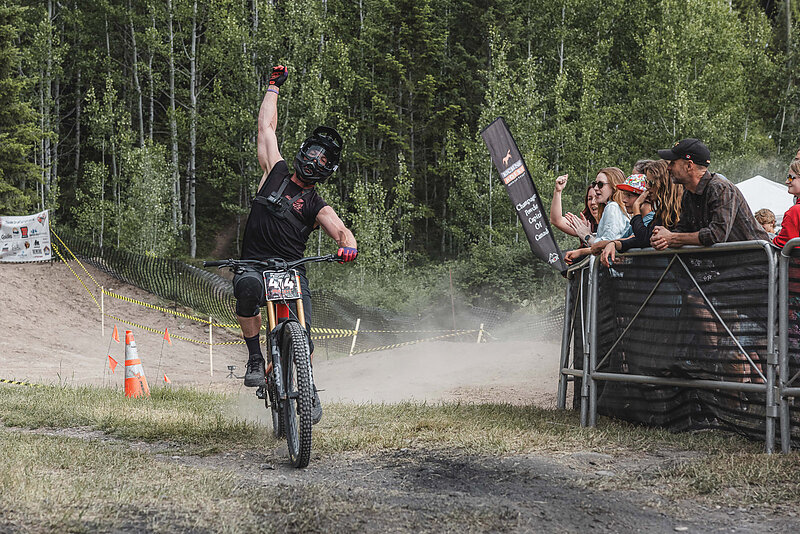
He nails the chute, airs the root ball, greases the 30-foot road gap, and crosses the finish line to the biggest cheers of the day. He peels his goggles off and sees a time of 13:01—56 seconds faster than in 2008, but four seconds slower than his goal. A crowd of hundreds of friends swallows him nonetheless; even in 19th place out of 142 racers, he’s the undisputed king of Mount 7.
Mullett and Haimes’ record has since been beaten twice, both times by riders using lift access in bike parks. And that’s fine. It was never meant to last. It was just meant to make a big-ass show of doing it the rowdiest way possible: the Mullett way. To this day, he’s still putting on that show, and more people than ever are tuned in.
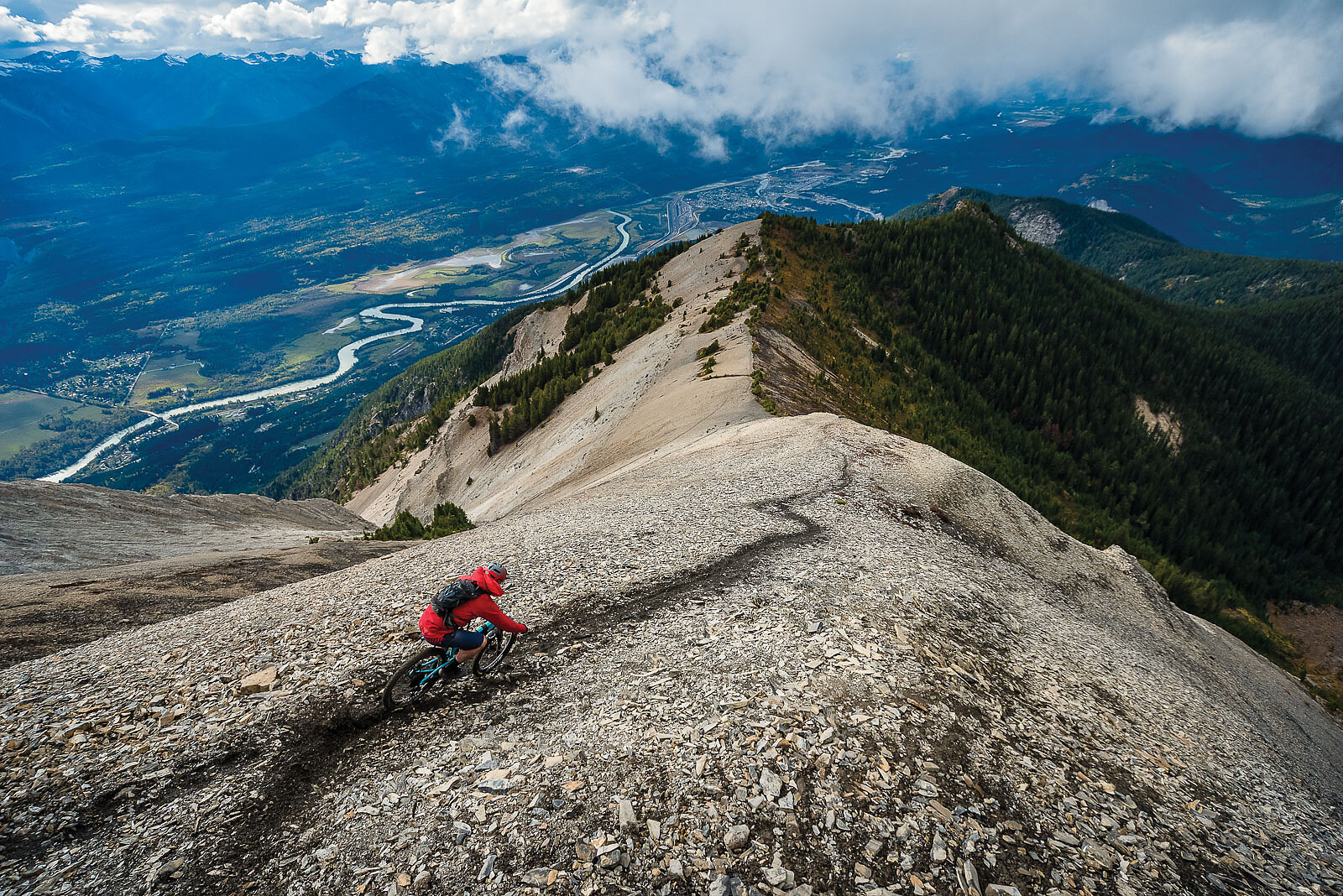
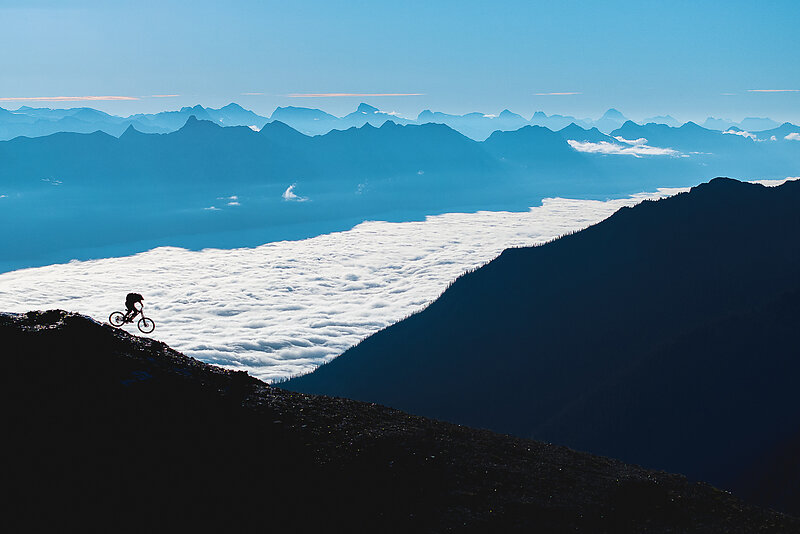
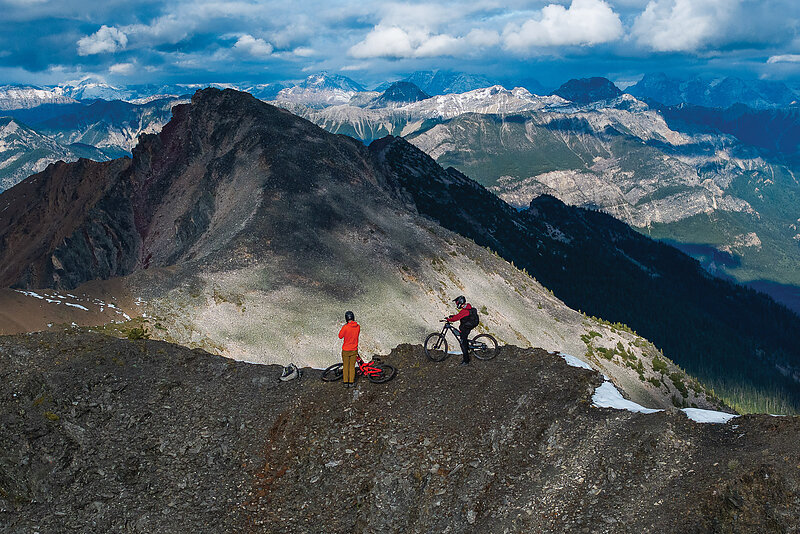
A few months after his PR on Psychosis, in August 2024, Red Bull Rampage legend Kurt Sorge recruits him to help suss out new alpine lines in a remote stretch of BC for a film project. I’m invited to tag along, camping for two nights in an alpine meadow below some of the most divine scree slopes in the world. The two have been riding together for a couple of weeks by now, tagging big lines in places they prefer to not name. Mullett hasn’t felt this strong since before Mount Harlan, but Kempston’s still made sure he has aspirin with him to substitute for blood thinners in a pinch.
“I finally reached out to Reg last summer after seeing his incredible adventures and lines he’d been riding for years on the internet,” Sorge says. “He sees ways to ride lines that most people wouldn’t, and has the vision to make them a reality.”
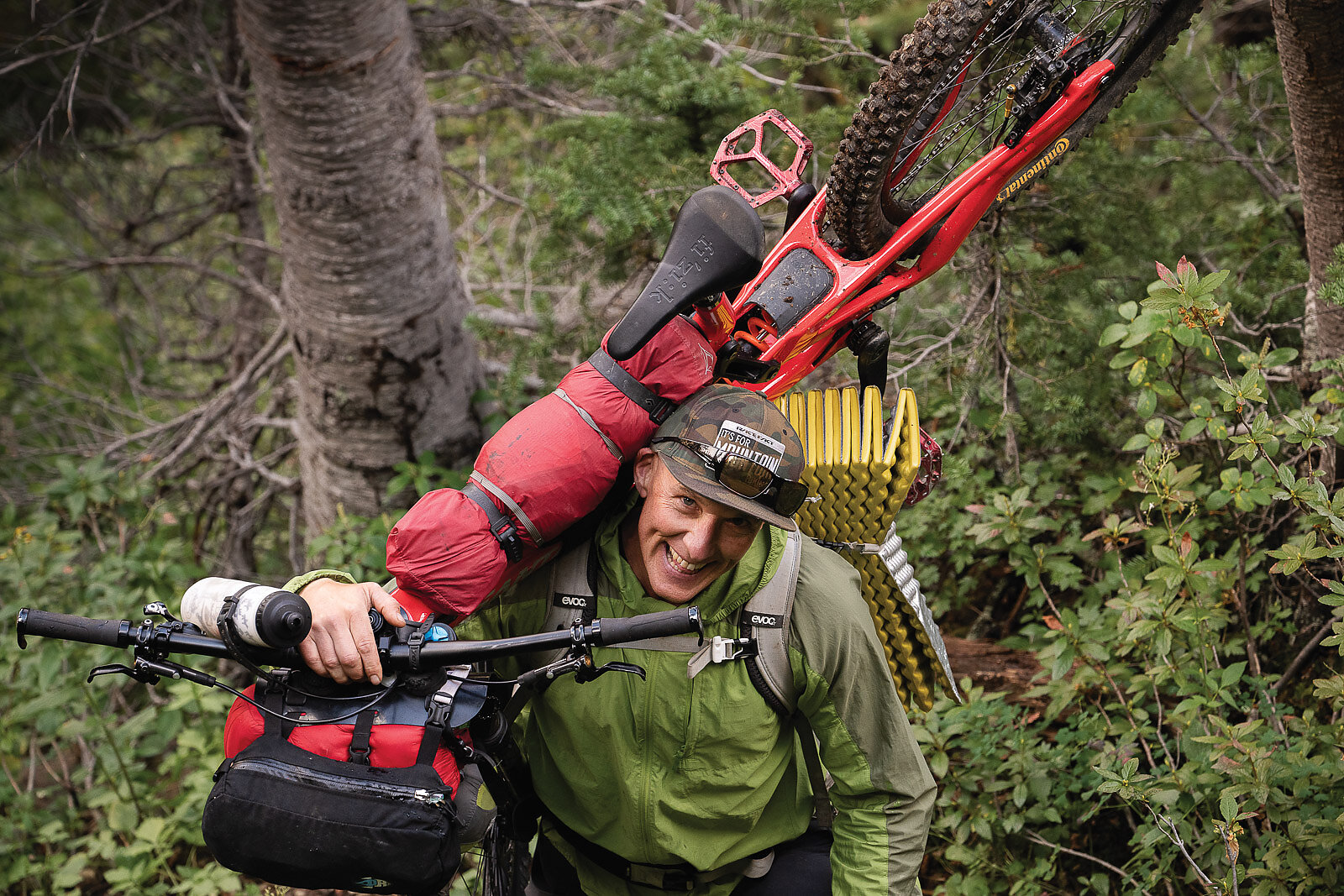
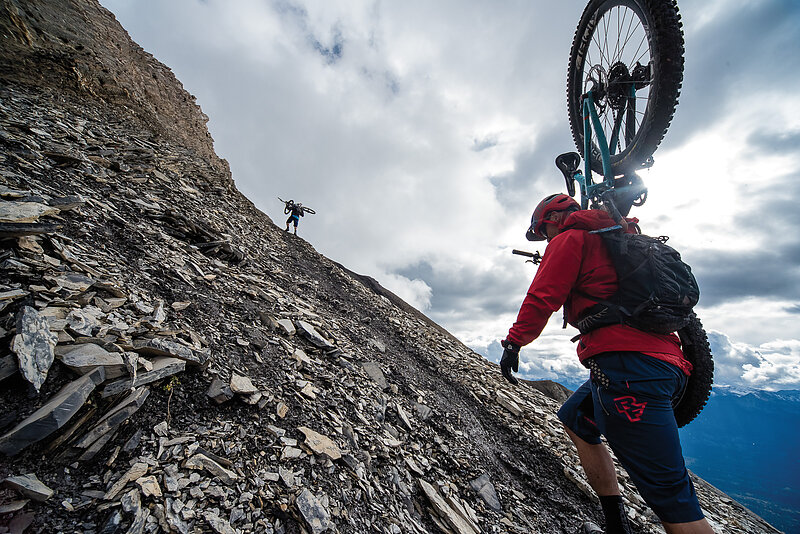
The spot they bring me to starts with a four-hour hike-a-bike to camp. Mullett and Sorge push their heavy downhill rigs while I plod along on my trail bike. Two cinematographers follow, while photographer Reuben Krabbe—an old friend of Mullett who has documented many of his alpine missions—plumbs along in seasoned fashion, clearly knowing ahead of time what he was in for.
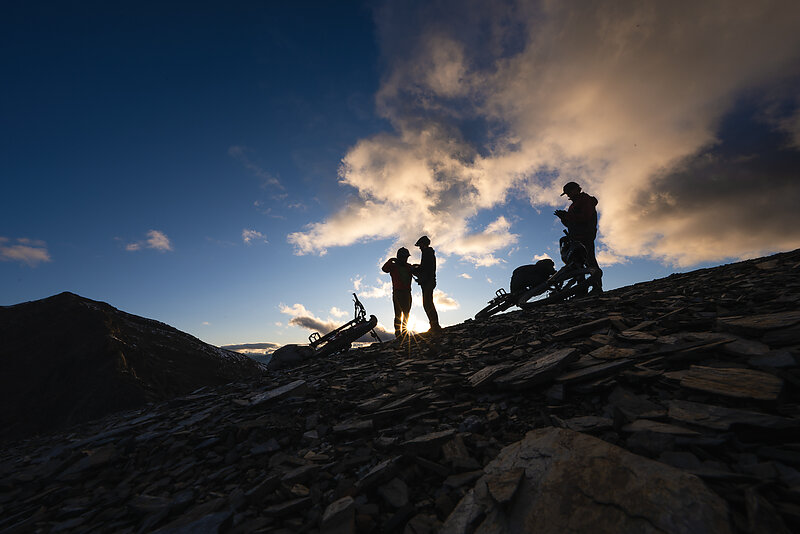
By the time we reach the meadow, the filmers are tired from carrying their heavy packs, but Mullett wants to get at least a couple of sunset laps in. He and Sorge hike up a 2,000-foot gentle slope covered in perfect kitty litter, and make it look like heli-skiing all the way down. The zone is incredible. It’s one that Mullett sniffed out years ago and has been exploring ever since. But when morning comes around, he doesn’t get out of his tent. He’s been dealing with food poisoning, and it’s finally catching up.
A mouse got into his food on the last mission and he hadn’t noticed until he’d already eaten. His stomach has been upside down since. He makes the call to stay put and try to re-hydrate, while Sorge heads out to make the best of the early light. Passing up a morning session like this, for any reason, would have been inconceivable five years earlier. I wonder if it’s a sign of maturity, or just how sick he is. Haimes, who’s about the same age as Mullett and recently recovered from a badly broken back, will later tell me it’s probably both.
“He sees ways to ride lines that most people wouldn’t, and has the vision to make them a reality.” —Kurt Sorge
“I think Reggie’s always had really good judgment,” Haimes says. “He’s not crazy. He’s not loose. He’s very skilled and calculated and strong and all of those things. I have ridden with him over the last year when he did seem to be OK with stopping. Like, ‘Alright, we’re going to go and hang out and have a beer and have a meal, and not make that at 10:30 at night when it’s dark and everything’s fucking closed.’”
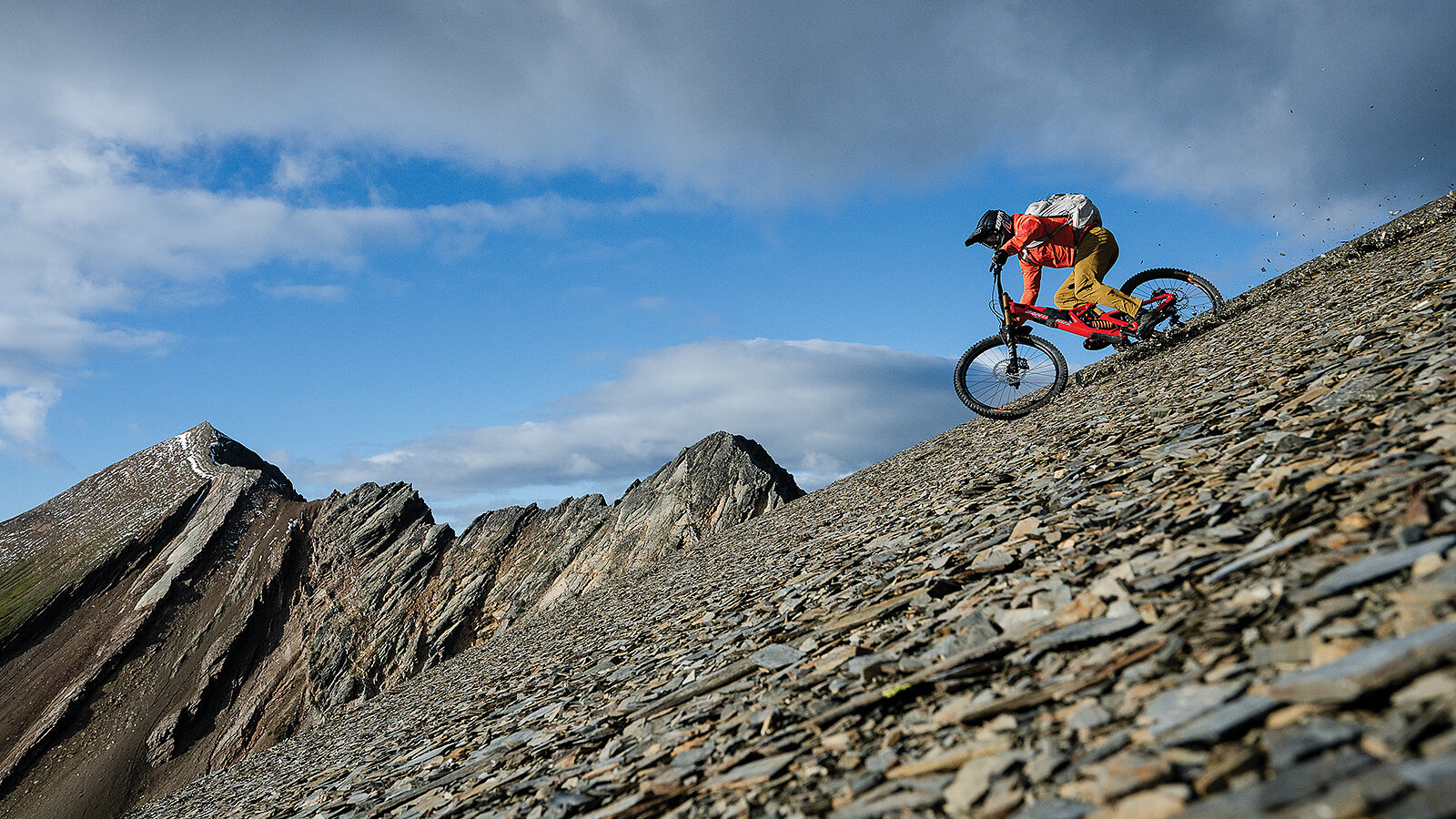
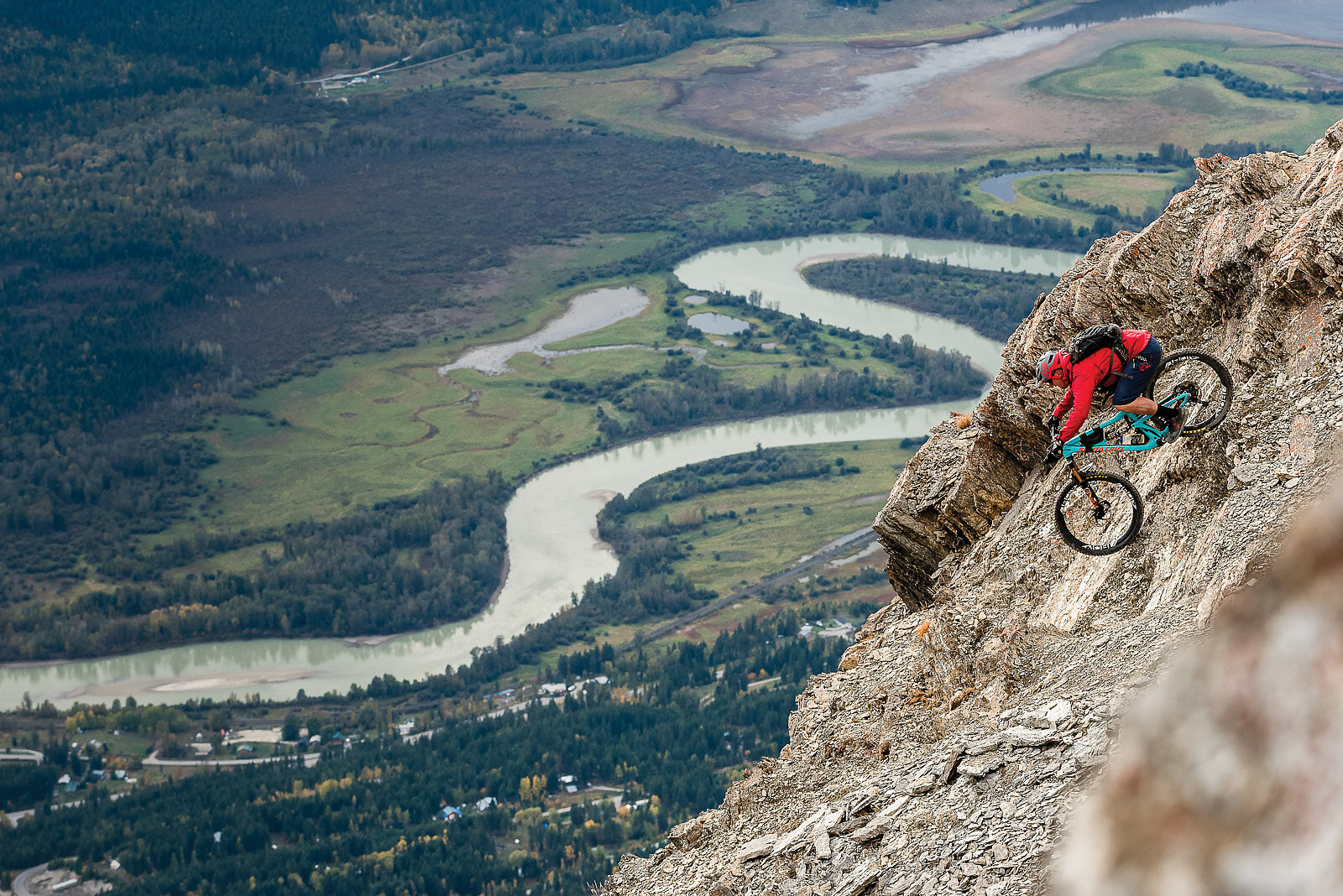
Out here, though, there’s nothing to close, and the usual push is sunrise to sunset. So when morning comes anew and Mullett’s finally holding down food again, he’s the first one out and moving. He and Sorge settle on attacking a winding chute with a tight choke about 2,000 feet above us. Getting there takes them a couple of hours as they traverse under imposing cliff walls to reach ridgetop, using their bikes like mountaineering axes to grip the slope.
Sorge drops first, lacing together features that, from my vantage, don’t even look rideable, and stomping it in flawless form. He stops part way down the bowl and radios up to Mullett, telling him the scree is perfect and that he can send it.
Krabbe, camera in hand, interjects: “Kurt, maybe you want to stay in position in case anything goes wrong?”
“I have complete confidence in Reg,” Sorge answers bluntly before surfing out of sight.
Mullett dips into the 45-degree pitch, weaving a precise, fluid, and fast run down terrain that looks like it’s been plucked straight from a ski movie. Now in his 50s, he remains among the best in the world at this. It’s stunning, but also confounding. That night, around the fire, I ask him how he plans to keep it up.
“I’m going to do the work,” he says, “I’m just going to train harder.”
It’s as honest of an answer as I’m going to get. I ponder it as I slip into my sleeping bag, 11 years his junior, and totally spent. After one more day of mind-melting freeriding, it’s time to exit the valley. But when we get back to our vehicles, we find a huge rockslide has blocked the road and boulders the size of refrigerators have made it impassable. I ride down into town to look for an excavator driver willing to spend his Friday night on a precariously overhanging old mining road, but have no luck. Defeated, I send a message back up to Mullett to tell him they’ll be stuck up there until Tuesday since it’s a long weekend. Around 9:30 p.m., I finally get a message back.
“We’re out!” Mullett writes. “Some of the best trundles of my life!”
With Sorge and Krabbe, he cleared all the boulders by hand. Some people, it seems, will just keep smashing forward.